Showing posts with label tablet use. Show all posts

Friday, March 7, 2014

It Turns Out People Don't Really Surf The Web On Their Smartphones

BusinessInsider reporting: 
It Turns Out People Don't Really Surf The Web On Their Smartphones

Since Apple kicked off the modern smartphone app era in 2008 with the App Store, there's been a debate over what will win in mobile: apps or mobile sites?

Well, smartphone and tablet users have spoken. And it's not even close. Mobile users spend far more time using apps than they do browsing mobile sites on their devices.

This chart from Statista breaks down the monthly usage of apps versus mobile sites.

Read more: http://www.businessinsider.com/apps-versus-mobile-web-2014-3#ixzz2vHoKy1IP

Saturday, January 4, 2014

Mobile offers local media a digital do-over

Ken Doctor reporting:
The good news is that you only have to worry about one tech trend in 2014.  But it’s a doozy. 

The trend is the dramatic shift to mobile computing, a communications revolution rivaling the arrival of the Internet itself. The fast-moving swing to mobile from desktop computing is changing everything from interpersonal communications to news consumption to commerce.  

For newspapers and local broadcasters seeking to recapture some of the audience, revenues and relevance that they lost in the rather inelegant way they stumbled into Internet publishing in the 1990s, the shift to mobile computing represents a rare do-over. 

Because the mobile universe is largely a work in progress, there is time for legacy media companies to create transformational products to delight consumers and attract a host of advertising, subscription and transactional revenues. 
Local media companies have two advantages as they mobilize for mobile:

1.  They are unrivaled in the local power of their brands, their content-creation capabilities, their ad sales staffs and their ability to market new products through their existing media.
  
2.  Owing to their largely inept responses to the initial emergence of the Internet, publishers and broadcasters know the pain of blundering into a new business paradigm without a deep understanding of the dynamics of the marketplace or a thoughtful strategic plan for capitalizing on opportunities and defending against threats.  


In the interests of preventing history from repeating itself, here’s what everyone needs to know about this disruptive, compulsive new technology platform:
http://newsosaur.blogspot.fi/2014/01/mobile-offers-local-media-digital-do.html 

Web Browsing, Email Top UK Tablet Activities

eMarketer reporting:
UK tablet users’ frequent activities on the devices are a picture of everyday internet use, according to research.
The November 2013 survey from Newsworks, carried out by YouGov, paints an unsurprising portrait. Nearly two-thirds of tablet users in the country said they used email on the devices, and general internet browsing was even more popular.
Playing games was the second-most-popular specific activity on tablets, followed by several other leisure pursuits. Just 6% of respondents said they did “other” things on a weekly basis or more often, suggesting that using tablets as work devices is generally unpopular.

An earlier survey, fielded by Kinetic Woldwide in February 2013, found that UK tablet users most commonly reported using their devices to search for information (89%) and email (80%), followed by playing games (69%) and reading the news (68%)—a similar selection of top activities, though more common overall. This is likely because Kinetic did not ask only about weekly behaviors.
eMarketer estimates that 20.0 million UK residents used a tablet at least monthly in 2013—including people who owned their own as well as those who regularly used a tablet belonging to someone else. By the end of this year, we expect 24.6 million UK tablet users.

Latest Articles

eMarketer Daily Newsletter Sign-up

Read more at http://www.emarketer.com/Article/Web-Browsing-Email-Top-UK-Tablet-Activities/1010501#oIRGRFh2wgqtaLqI.99
 
UK tablet users’ frequent activities on the devices are a picture of everyday internet use, according to research.
The November 2013 survey from Newsworks, carried out by YouGov, paints an unsurprising portrait. Nearly two-thirds of tablet users in the country said they used email on the devices, and general internet browsing was even more popular.
Playing games was the second-most-popular specific activity on tablets, followed by several other leisure pursuits. Just 6% of respondents said they did “other” things on a weekly basis or more often, suggesting that using tablets as work devices is generally unpopular. 
Playing games 54 %
Keeping up with news/events 49%
Social media 49%
Watching video 37%
Reading books 37%
Figures apply to use at least once a week
Photos 28%
Music 26%
Other internet browsing 68%
http://www.emarketer.com/Article/Web-Browsing-Email-Top-UK-Tablet-Activities/1010501/2 


UK tablet users’ frequent activities on the devices are a picture of everyday internet use, according to research.
The November 2013 survey from Newsworks, carried out by YouGov, paints an unsurprising portrait. Nearly two-thirds of tablet users in the country said they used email on the devices, and general internet browsing was even more popular.
Playing games was the second-most-popular specific activity on tablets, followed by several other leisure pursuits. Just 6% of respondents said they did “other” things on a weekly basis or more often, suggesting that using tablets as work devices is generally unpopular.


Read more at http://www.emarketer.com/Article/Web-Browsing-Email-Top-UK-Tablet-Activities/1010501#oIRGRFh2wgqtaLqI.99

Friday, October 11, 2013

Don’t write off tablet magazines

Poynter reporting:
Jon Lund in GigaOM recently declared tablet magazines a failure.
That’s true in the sense that they haven’t substantially impacted overall magazine circulation. Using Alliance of Audited Media numbers, Lund lists the percentages that “digital replica” paid subscriptions, such as for tablets, contributes to the total circulation for 25 magazines. They ranged from a high of 38 percent of total circulation (Game Informer Magazine, a noted outlier) to 2 percent (People magazine).
Like Lund, I’d discourage any new publication from focusing solely on tablet apps, stored deep inside iPad folders or in the dreaded Newsstand, far from the dynamic reach of social media and the Web....
...
But consider two of my favorite digital magazine apps: The New Yorker and The Atlantic Weekly.
The former, despite its irritating recent switch from paginated content to breathtakingly long scrolls, offers the cleanest, most convenient way for me to read New Yorker pieces. And it takes advantage of the tablet form without resorting to flashy interactive design. Short videos and poems read aloud by authors enrich the content without requiring lots of extra production resources.
The Atlantic’s foray into weekly publishing, meanwhile, also presents a model for tablet content that doesn’t profess to be a game-changer but fits nicely alongside the company’s other digital products. The Atlantic Weekly bundles pre-existing content from the Web that readers might have missed during the week. It collects only a few stories, presenting them all in the same simple design template.
Although these relatively simply apps certainly cost something in terms of staff and publishing-platform fees, Atlantic editor-in-chief James Bennet told Poynter in an email: “We do put a good deal of work into The Weekly – we wouldn’t be asking readers to pay for it if we didn’t – but we’ve been pretty rigorous about scoping that work to keep the costs in line with sales,” Bennet said.
The Atlantic Weekly requires work from four primary staffers: an editor, copy editor, designer and producer, none of whom work on this product full-time. He didn’t disclose sales figures but said they’ve exceeded expectations. Three-quarters of readers are monthly ($2.99) or yearly ($19.99) subscribers; single editions cost $1.99...
http://www.poynter.org/latest-news/media-lab/mobile-media/225440/dont-write-off-tablet-magazines/

Tuesday, October 8, 2013

Why tablet magazines are a failure

gigaom reporting:
Last year, Nielsen estimated the average mobile user has 41 apps on his or her smartphone. In April, a Flurry study showed the average smartphone user opens only eight apps a day, with the most popular being Facebook, YouTube and game apps. And according to a 2012 report from Localytics, 22 percent of all apps are only opened once.
Though these numbers are for mobile in general, not just tablets, the picture is clear: There’s not much room for magazine apps. Magazines need extremely dedicated readers to avoid being buried.

Invisible in the stream of information

To make things worse, magazine apps themselves are invisible in the large streams of information governing the web.
When a magazine is organized as an app rather than as a website, its articles can neither be indexed or searched on the web. And even if they could, clicking the link in Google at best takes readers to an app store, not to the article itself — cutting the magazine out of the greatest traffic driver in today’s world.
The pattern is the same on social media. When you can’t link directly to an article, the urge to tweet or tell your friends about it drastically shrinks. And curators like Flipboard and Zite can’t look into, link or grab content from within magazine apps.

Antiquated monoliths

When I nevertheless manage to find the time to open up an iPad magazine, I feel as if I’m holding an outdated media product in my hands. That’s ironic because these apps tend to be visually appealing, with interactive graphics, embedded videos and well-crafted navigation tools. But the gorgeous layout that works so well in print gets monolithic, almost scary, in its perfectionism on the iPad, and I find myself longing for the web. It’s messy but far more open, more accessible and more adaptable to me, my devices and needs.
Most magazine apps also fail in social.
http://gigaom.com/2013/10/06/tablet-magazines-failure/


Wednesday, September 18, 2013

Tablet Users Set the Bar High for Keeping Connected Across Devices

eMarketer reporting:
The vast majority of consumers who use tablets also own a host of other web-enabled devices. From laptops to game consoles to smart TVs, tablet owners overindex in tech device usage—particularly smartphones—compared to the average consumer, according to a new eMarketer report, “Tablet Users' Multidevice Habits: Connected Morning, Noon and Night (But On Different Devices).”
Given their penchant for web-enabled devices, this cohort is rarely “off the grid.” While that makes them highly accessible to marketers, tablet users are a slippery bunch that frequently shifts attention from one device to another. The good news for marketers is users’ transitions between devices largely mirrors the home-work-home transitions made in a typical day. Brands implementing a measurable “all-screen” marketing strategy will have the best chance to win this group’s “catch me if you can” game.

The increasing popularity of tablets has many questioning the future of other digital devices, including desktop computers, laptops and even televisions. However, research suggests that tablet users are a device-dependent group that is not abandoning legacy devices as they add new technology to the mix.
Based on an analysis from multiple sources, eMarketer estimates more than 73 million tablet users—57% of the US tablet-using population and 30% of US internet users—will also use a smartphone at least once per month this year. And in 2017, the number of dual tablet/smartphone users will top 126 million and represent nearly 80% of all tablet users—almost half of US internet users.

Understanding the number of duals is important when assessing the impact mobile device usage has on overall digital engagement. For instance, December 2012 data from comScore showed tablet and smartphone usage extended the reach of the top 25 US digital media companies by an average of 29%, and some mobile-centric properties such as Pandora experienced triple-digit audience gains.
The vast majority (90%) of tablet owners polled in May 2012 by research firm GfK MRI said they simultaneously used their tablet while doing other activities, like eating a meal, getting dressed, exercising and perhaps most interestingly, while using other digital devices. Thirty-six percent of those polled said they talked on a mobile phone or smartphone while using their tablet, and 28% used a tablet and traditional computer at the same time. By far, the most common pairing was the tablet with the TV: Some 63% said they used the two devices together.


http://www.emarketer.com/Article/Tablet-Users-Set-Bar-High-Keeping-Connected-Across-Devices/1010222


http://www.emarketer.com/Article/Tablet-Users-Set-Bar-High-Keeping-Connected-Across-Devices/1010222

Monday, August 26, 2013

iPad and iPhone Uses Differ Sharply

Folio reporting:
Publishers looking to develop their presence on smartphones and tablets need to remember that the two are separate entities. Design and utility needs to be customized for each.
Flurry, a mobile ad firm, analyzed the usage data from more than 44,000 devices in May, grouping iPhone and iPad users based on the patterns. The biggest takeaway? iPhones go out, iPads stay in.
iPhones tend to be used by shoppers, singles and new moms-people constantly on the move-while iPads spend more time with pet owners, small business owners, moms (different from new moms) and gamers-people who tend to be home more, either working or playing.
Categories of usage mirror the user personas. Navigation, health and fitness and photo and video app usage skewed heavily toward iPhones, while education, newsstand, games and reference apps were iPad favorites....http://www.foliomag.com/2013/ipad-and-iphone-uses-differ-sharply#!

Friday, June 28, 2013

National survey finds Americans say tablets make them smarter

SOURCE Next Issue Media
Majority of Americans want to be seen as "someone-in-the-know" among their peers, with many even pretending to know about a news story to impress others.
According to the survey, Americans want to be in-the-know about current events, and most (54 percent) prefer to be known as a "newsie" among their friends, more than a sports buff, fashionista or celebrity gossip.  And a majority of Americans (56 percent) believed they were more knowledgeable about current events compared to their friends – 65 percent of men and 48 percent of women felt this way. Owning a tablet may be one way to boost your news-confidence. Sixty-nine percent of tablet owners felt they knew more about current events than their friends, compared to 47 percent of non-tablet owners.
Looking to impress
But are these "newsies" really telling the truth? To look well-informed, some people will go as far as lying. More than one in three (37 percent) have pretended to know about a news story to impress someone else. Tablet owners may feel more pressure to be well-informed because of the media resources at their disposal, as 52 percent of tablet owners admitted to lying about a story to impress someone else, versus 27 percent of non-tablet owners.
Americans like a good argument
Seventy percent of Americans will find any opportunity to argue with their friends about what's in the news cycle regardless of topic. Politics was the primary subject for debate with 49 percent of survey respondents. Sports came in second with 32 percent, followed by award show results (13 percent) and fashion trends (12 percent). Arguing aside, an overwhelming majority of Americans (94 percent) have discussed current events with their family, and 82 percent said they discuss current events topics frequently...
http://wsav.membercenter.worldnow.com/story/22688003/national-survey-finds-americans-say-tablets-make-them-smarter

Monday, June 24, 2013

Magazines' iPad Editions See 24% Ad Boost in Q1

Kantar/PIB Report Shows Uptick, But Buyers Seek More Performance Data From Publishers

Magazine publishers are seeing more advertisers warm up to their iPad editions.
In the first quarter, the number of ad units in magazines' iPad editions jumped 23.6% from the same period in 2012, according to a report from Kantar Media and the Publishers Information Bureau. The report, which looked at 58 magazines with monitored print and iPad editions, found that the number of ad pages in the titles' print editions was roughly flat in the first quarter, with 10,707. But the number of iPad ad units climbed to 5,961 in 2013 from 4,824 the year prior. Total print ad pages and iPad ad units combined increased 7.5% year-over-year, the report said.

Bloomberg Businessweek's tablet edition
Magazines reported paid and verified digital circulation of 7.9 million in the second half of last year -- just 2.4% of their total print and digital circulation, according to the Alliance for Audited Media. That number does not include every non-replica edition because some publishers don't report them to the AAM.
One impediment for iPad ads is cost. There are more production costs required for interactivity, and some publishers, including Condé Nast and Meredith, have charged advertisers for interactive elements.
But more print advertisers are opting in, said Chris Kevorkian, chief marketing officer at the MPA-Association of Magazine Media. "There's real growth in marketers saying "Let's move on, let's go into this platform.'"
Tablet ownership in the U.S. has nearly doubled in the past year, with 34% of American adults owning a tablet, up from 18% a year ago, according to the Pew Research Center. With 56% of these tablet owners living in households that earn at least $75,000 annually, publishers are pitching brands on reaching affluent audiences...


How Mobile Is Shaping Global Digital Behavior

eMarkter reporting:

Tablets are producing high levels of engagement

Around the world, web users are surfing the internet on ever-more devices. A GlobalWebIndex survey of 180,000 web users in 31 countries found that as of Q1 2013, three out of five respondents accessed the internet on a mobile phone, and 22% used a tablet. That’s in addition to the steady percentage of internet users—about 93%—who’ve been using a personal desktop or laptop for the past couple of years.
Google continues to dominate as the leading web brand or app among both smartphone and tablet users, with 72% of smartphone users accessing Google sites or apps vs. 66% of tablet users doing the same. Facebook came in second, accessed by about half of smartphone and tablet users—while YouTube and Yahoo! ranked third and fourth, respectively. Where behavior began to diverge was in the higher incidence of tablet users accessing Amazon, Skype, MSN/Windows Live and Bing compared with smartphone users.
Amazon’s greater penetration rate among tablet users points to the device’s growing role in digital purchasing. While tablet users were actually 1 percentage point less likely to shop on the device when compared with mobile users, they were more likely than either mobile or PC users to review a product or brand in more depth, purchase an online service, use a group-buying website for a transaction, and even sell a product...
When it came to entertainment, the rank of activities was the same across devices. Watching a video clip was the most popular activity, followed by checking for information on music, leisure or entertainment, and then playing an online game.


Tuesday, May 7, 2013

Why the outlook for tablet magazines is getting better

TabTimes reporting:

Tablet readers will pay for content

Adobe’s study further details that readers are increasingly prepared to spend money on these tablet magazines.
When looking at the consumer’s willingness to pay for digital content, Adobe found that this stood at 65% of consumers in February last year before rising to an “all-time high” of 80% figure a year later.
“It is also interesting to compare subscriptions against single issues,” said Schambers-Lenox. “A year ago, that ratio was at 2:1 but now it closer to 3:1. People are definitely seeing value in digital magazines and want to have a long-term relationship with publishers.”
Adobe’s research found that total digital readership has grown an average of 30% across all publishers in the last year, with some publishers seeing that figure rise as high as 150%.
“We think that tablets are driving this growth. The iPad mini came in the fall and that’s definitely driving a huge number of readers, but there’s also a bit of movement around Kindle Fire and the Nexus 7.”

PDF rendering is a thing of the past

Some publishers are having more success with tablet publishing than others; case in point, the BBC's car magazine Top Gear.
Just three months ago, the magazine was reliant on using PDF replicas for its tablet magazine, something Hearst and others have previously admitted to using, but it has since moved to using Adobe’s DPS.
The results have been staggering. Adobe says that total tablet magazine downloads have since risen 48% with paid-downloads and single-issue sales up by 62% and 79%, respectively. Ad revenue has also increased by an impressive 200%, while the reader time-per issue has quadrupled from 10-12 minutes to 40 minutes.
http://tabtimes.com/feature/media/2013/05/06/why-outlook-tablet-magazines-getting-better

Saturday, May 4, 2013

Hearst Gets Its Million Digital Subscribers

All Things D reporting:
Last year, Hearst Magazines head David Carey said his company would have a million people subscribing to its tablet editions by the end of 2012.
That didn’t happen, and they ended December with something like 900,000 subscribers. But now it has: Carey said Hearst hit the one million mark at the end of March.
“I’m glad we got there,” Carey said. “We were just 90 days late.”
In February, at our D: Dive Into Media conference, Carey said he thinks that in 2016, Hearst will have three million digital subscribers, or about 10 percent of his entire base.
http://allthingsd.com/20130503/hearst-gets-its-million-digital-subscribers/


Saturday, March 30, 2013

BBC Study Confirms Tablets’ Growing Role In TV Consumption

TechCrunch reporting:
Companies like Google, Twitter and Nielsen — who respectively make money from digital advertising, want to make a lot more from digital ads, and get paid to provide data to justify ads online and offline — are putting some significant effort into showing the connection between how consumers watch TV and use their tablets and smartphones to shape that experience in the U.S.. Now the BBC — via its commercial operations of BBC World News TV and BBC.com — is also weighing in, with an international study out from BBC World News and BBC.com looking at how news is consumed today. It shows that the role that tablets are playing in TV usage — which we already knew was strong in the U.S. — is actually an international phenomenon.
The survey, BBC says, polled some 3,600 consumers across Australia, Singapore, India, United Arab Emirates, South Africa, Poland, Germany, France and the U.S., the BBC, working with InSites Consulting, says this is the biggest study of its kind. The geographical reach complements the ongoing work from Pew Research Center on digital media usage, which focuses on the U.S. only.
Specifically, the BBC notes that it found the following:
– Some 43% of tablet owners say that they watch more TV now than they did five years ago. 83% say they use tablets alongside TV.
– 25-34 year-old professionals are the biggest “news enthusiasts.” But that enthusiasm is still TV-first, other screens second, with tablets remaining distinctly in a secondary, not primary, role. Across all age groups, 42% of news consumption is still happening on TV, with laptops (29%), smartphones (18%) and tablets (10%) scoring in significance.
– Advertising may be appearing in different formats, but users are not surprised by that.
http://techcrunch.com/2013/03/26/bbc-study-confirms-tablets-growing-role-in-tv-consumption-but-also-that-tv-remains-supreme/

Wednesday, March 27, 2013

Here’s What People Are Doing On Their Smartphones And Tablets

BusinessIntelligence reporting:
It's interesting to note how smartphone behavior differs from tablet behavior:

Untitled
BI Intelligence

So, what are some key behaviors - aside from gaming and content consumption?
Well, mobile commerce is exploding. It now makes up 20% of overall ecommerce activities, as seen below:

Thursday, January 3, 2013

Finland Doubled Tablet Usage in 2012

eMarketer reporting:
Though penetration is still low in the Scandinavian country, the population of Finland was more than twice as likely to use a tablet in 2012 as it was the year before.
In 2011, according to market research firm Taloustutkimus Oy—Finland, just 5% of people in Finland ages 15 to 79 used a tablet. By 2012, the proportion was up to 12%.

Friday, October 19, 2012

New Poynter Eyetrack research reveals how people read news on tablets

Poynter reporting: 
It’s all about touch.
People were either intimately involved with the iPad screen while reading during our recent eyetracking study — keeping nearly constant contact while touching, tapping, pinching and swiping to adjust their view — or they carefully arranged a full screen of text before physically detaching as they sat back to read.
This intimate or detached touching behavior was one of the most intriguing findings in Poynter’s new research on tablet storytelling. It’s one of many that can help us define how people want their news.
“Intimate” readers were highly focused. They tended to read one or two lines of text, then make subtle, frequent swipes to move a few lines of text into their field of vision like a teleprompter. This was like a pacing tool that helped them to keep their place in the text. Intimate readers made up a majority of the study, at 61 percent.
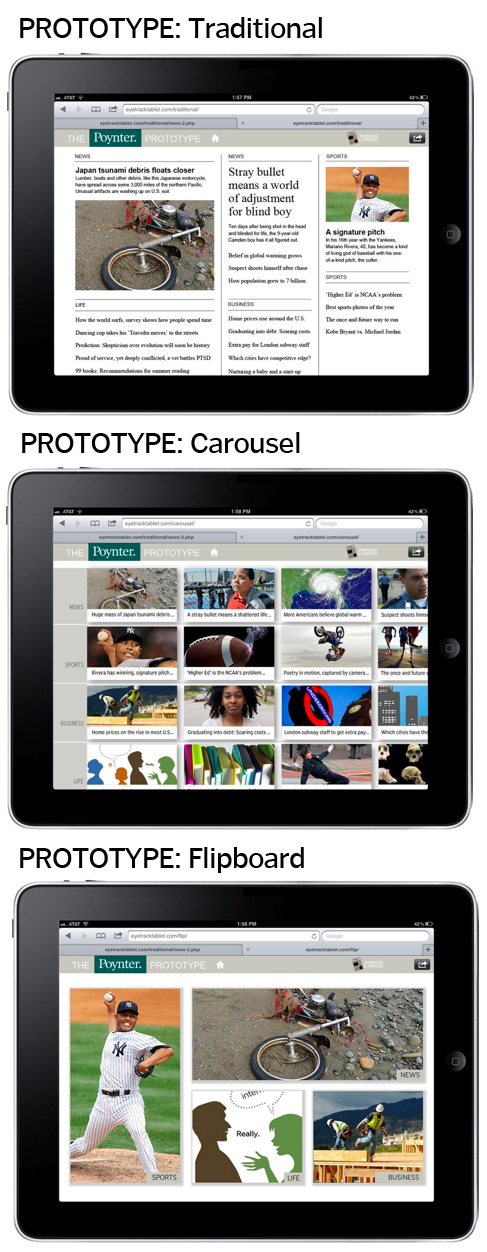
Using eyetracking gear, observation and exit interviews, Poynter looked closely as 36 people interacted with real news stories on an iPad. We closely analyzed their reading patterns after they looked at one of three prototypes created for the project.
So that we might look for clear differences, we recruited people in two, distinct age sets: 18-28 year-olds — a group we have been calling “digital natives” because they are among the first adults who don’t have strong recollection of life before digital –  and 45-55 year-olds, or “printnets” referring to one foot in the print world, one foot in the “’Net” world.
Each of the three prototypes created for the study featured the same 20 stories but had different designs for the front page or entryway. One had a “traditional” look and feel, similar to an online newspaper. It had a dominant photograph, a lead headline and headlines for each of the 20 stories in the publication.
http://www.poynter.org/how-tos/newsgathering-storytelling/visual-voice/191875/new-poynter-eyetrack-research-reveals-how-people-read-news-on-tablets/

Thursday, October 18, 2012

Mobile Rising: Newspapers, Magazine Readership, Ad Engagement Up

MediaDailyNews reporting:
More tablet owners are reading newspapers and magazines on their devices, according to the latest data from comScore’s TabLens research service, which is based on a three-month rolling sample of 6,000 tablet owners; these findings, along with new data from GfK MRI, hold out the promise of growing advertising and circulation revenues from this burgeoning new channel.

Overall, 11.5% of tablet owners -- a definition that includes iPad, Android tablets, Kindle Fire, and Nook -- said they read newspapers on their tablets “almost every day” or “at least once a week.” Some 14.6% said they read newspapers on their tablets one to three times a month, and 37.1% said they read newspapers on their tablets once a month.
Mark Donovan, comScore senior vice president for mobile, noted that 7% of all newspaper page views now come from tablets. Turning to magazines, 9.7% of all tablet owners said they read magazines on their tablets almost every day, 13.3% at least once a week, 16.7% one to three times a month, and 39.6% once a month.

Tablet owners who read newspaper and magazine content tend to skew male, with newspaper audiences 17% more likely to be male than the average tablet owner, while magazine audiences were 11% more likely to be male.
More than half of tablet readers had a household income of $75,000 or more. Tablet readers also skewed younger, with adults ages 25-34 accounting for the largest share of newspaper and magazine readers: 27.4% and 28.2%, respectively.

GfK MRI Starch Digital found high engagement rates for digital advertising delivered to tablets or e-readers along with magazine content. The survey of 30,000 digital ads across 1,000 magazine issues from April-July of this year found 55% of digital magazine readers noted or read a digital ad on their tablet or e-reader.
Within this group, 52% (28.6% of the total) interacted with the ad as result, with 38% (20.9% of the total) touching or clicking the ad to expand it...

Thursday, August 23, 2012

BII REPORT: How Annual Tablet Sales Will Explode To 450 Million By 2016

BII reporting: In the two years since Apple launched the iPad,  the tablet market has exploded. When one includes Android and other tablets as well as e-readers, nearly 100 million tablets were sold in 2011.
Tablets and smartphones will not completely displace PCs. But they will quickly overwhelm them in terms of unit sales. When, where, how and to what degree this occurs will have tremendous implications across many businesses and industries.
In a report just out from BI Intelligence, we estimate that tablet sales will reach 400 million units by 2016, and lay out the key analysis behind these forecasts.

Here are the four main considerations that will drive tablet growth in the next few years:  
Read more: http://www.businessinsider.com/bii-report-how-annual-tablet-sales-will-explode-to-400-million-by-2016-2012-8#ixzz24MiE4oDl

Tuesday, August 21, 2012

Tablets & Smartphones Generate Strong Ad Engagement, According to IAB Mobile Research

iab:reporting:
Illuminating the different ways that smartphones and tablets are changing consumer behavior, the Interactive Advertising Bureau (IAB) and its Mobile Marketing Center of Excellence released “Mobile’s Role in the Consumer’s Media Day,” an in-depth research report that reveals how receptiveness to advertising and media consumption varies by device, time of day, and location.
According to the report:
  • There is a strong degree of ad interaction among tablet users, with nearly half (47%) saying that they engage with ads on that device more than once a week
  • One in four (25%) smartphone users also said that they interact with ads at that same frequency
  • Once these mobile device users engage with an ad, they are extremely likely to take action (80% smartphone users, 89% tablet users)
“Both tablet and smartphone users show an impressive interest in mobile advertising,” said Anna Bager, Vice President and General Manager, Mobile Marketing Center of Excellence, IAB. “The key for marketers is looking at how consumers use these devices in different ways, and tailoring brand messages and strategies accordingly.”
In regard to behaviors, smartphone users consider that device to be mission-critical for their day-to-day lives, with 70 percent saying that they “never leave home without it.” In comparison, 70 percent of those surveyed said that their tablets served as entertainment and media hubs.
Those that have both devices echo this sentiment, with 60 percent preferring a smartphone to “look up info on-the-go,” in contrast to 22 percent who would choose a tablet for that activity. However, when asked how they preferred to consume traditional media like print and video on mobile devices, consumers overwhelming choose tablets (69% print, 68% video) over a smartphone (9% print, 8% video).
Time of day also has a direct impact on how consumers use their mobile devices. For smartphone users, the three most impactful media moments of the day are:

Tuesday, August 14, 2012

BBC’s ‘multi-platform Games’ reveals new appetite for live video, mobile browsing

paidcontent reporting: The BBC’s celebrated ‘four-screen’ London 2012 output has revealed a late-night iPad fetish and new high water marks for live video and mobile content consumption. ‘This has really been the multi-platform Games,’ the corporation says.
...An average 9.5 million global daily uniques to the BBC Sport website is almost a quarter higher than the previous record level.
  • Video requests were doubled from those seen during any previous event (106 million) – higher than the 2008 games (32 milion) and 2010 World Cup (38 million).
  • A third of web visits came from mobile. But only a tenth of video requests were mobile.
  • Most interestingly, the majority of video requests (62 million) were for live streams. Only eight million were for on-demand live streams, 35 million were for short-form clips.
  • The BBC, which adapts streaming quality to viewers’ bandwidth, says the average bitrate was “the highest the BBC has ever delivered online” at 1Mbps.
  • ...Hourly viewership by platform shows how most usage came from office computers at lunchtime. The newest phenomenon, albeit in line with previously-issued BBC data, is that, despite being a relatively new form factor, tablets accounted for more viewing than any other online medium late at night, as people swiped their iPads whilst watching TV from their sofas and whilst heading to bed.  
  • http://paidcontent.org/2012/08/13/bbcs-multi-platform-games-reveals-new-appetite-for-live-video-mobile-browsing/