gigaom /Mathew Ingram reporting:
In the arms race that is the social web, every publisher large or
small is trying whatever weapons they can find to rise above the noise
and increase their readership: some, like The Independent or the Daily Mail, have chosen to go
the clickbait route and try to duplicate the success of ViralNova or
BuzzFeed. But Jason Seiken, editor-in-chief of Telegraph Media Group,
says the newspaper publisher has seen a significant increase in readership by doing two somewhat surprising things: paying less attention to Twitter, and posting fewer stories.
Seiken told The Guardian that the site saw a 20-percent increase in traffic in June, with daily unique browsers hitting almost 4 million, and he attributed this jump
to some of the strategies the newspaper has been focusing on over the
past few months — including developing the paper’s Facebook audience,
which has almost tripled in size to 1.6 million, rather than focusing on
Twitter.
The Telegraph executive said that in the past, the paper had
not spent as much time on a Facebook strategy because of what he called
an obsession among journalists with using Twitter. “Journalists are all
on Twitter, and obsessed with it, so that is where the energy had
gone,” he said. “An assumption had been made without looking at data” on where readers were actually coming from.
...
Interestingly enough, Seiken said the Telegraph had also been
deliberately reducing the number of stories it posted, and focusing
instead on putting more resources into fewer pieces. “We actually
created that huge traffic jump in June producing fewer stories, not
more,” he told The Guardian,
adding that the paper had changed the way the newsroom worked in order
to become more efficient. “Seemingly mundane things make a huge
difference – things such as better planning, more creative story
conferences, and using audience data to decide what to stop doing.”
http://gigaom.com/2014/08/01/want-to-increase-your-readership-forget-about-twitter-and-stop-posting-so-many-stories-says-the-telegraph/?utm_source=GeneralUsers&utm_campaign=465ad55d21-c:mdad:08-02&utm_medium=email&utm_term=0_1dd83065c6-465ad55d21-99152541
Showing posts with label twitter. Show all posts
Showing posts with label twitter. Show all posts
Monday, August 4, 2014


Saturday, March 29, 2014
Twitter Takes to TV Tie-Ins
eMarketer reporting:
Twitter showed in 2013 that its ad business is growing fast. Even as user
growth slowed dramatically, ad revenues and ad engagement metrics ticked
up.
Advertisers cite three reasons why they’re increasing spending on Twitter: The social network’s tie-ins with TV, its real-time nature and its willingness to partner closely on creative executions. Other developments that will drive growth this year include improved analytics, more ad offerings for international markets and additional ad products in the direct-response and ecommerce areas, according to a new eMarketer report, “Advertising on Twitter: Unique Opportunities Outweigh Slowing User Growth.”
http://www.emarketer.com/Article/Twitter-Takes-TV-Tie-Ins/1010717/2
Advertisers cite three reasons why they’re increasing spending on Twitter: The social network’s tie-ins with TV, its real-time nature and its willingness to partner closely on creative executions. Other developments that will drive growth this year include improved analytics, more ad offerings for international markets and additional ad products in the direct-response and ecommerce areas, according to a new eMarketer report, “Advertising on Twitter: Unique Opportunities Outweigh Slowing User Growth.”
Twitter spent much of 2013 solidifying its connections with TV. It launched a
new ratings business with Nielsen to measure TV-related conversations on
Twitter; created new video ad opportunities with Amplify; and bolstered its
association with high-profile TV events such as the Super Bowl, Grammys and
Oscars.
Twitter’s linkups with television are beneficial to both the TV industry and the social network. TV executives know that many people multitask on mobile devices while watching TV. On-air mentions of Twitter drive conversation about what’s on TV and help keep viewers focused on the television.
Twitter’s linkups with television are beneficial to both the TV industry and the social network. TV executives know that many people multitask on mobile devices while watching TV. On-air mentions of Twitter drive conversation about what’s on TV and help keep viewers focused on the television.
Twitter
showed in 2013 that its ad business is growing fast. Even as user
growth slowed dramatically, ad revenues and ad engagement metrics ticked
up.
Advertisers cite three reasons why they’re increasing spending on Twitter: The social network’s tie-ins with TV, its real-time nature and its willingness to partner closely on creative executions. Other developments that will drive growth this year include improved analytics, more ad offerings for international markets and additional ad products in the direct-response and ecommerce areas, according to a new eMarketer report, “Advertising on Twitter: Unique Opportunities Outweigh Slowing User Growth.”

Twitter spent much of 2013 solidifying its connections with TV. It launched a new ratings business with Nielsen to measure TV-related conversations on Twitter; created new video ad opportunities with Amplify; and bolstered its association with high-profile TV events such as the Super Bowl, Grammys and Oscars.
Twitter’s linkups with television are beneficial to both the TV industry and the social network. TV executives know that many people multitask on mobile devices while watching TV. On-air mentions of Twitter drive conversation about what’s on TV and help keep viewers focused on the television.
Read more at http://www.emarketer.com/Article/Twitter-Takes-TV-Tie-Ins/1010717#ZE4HrvWz3bP20iX9.99
Advertisers cite three reasons why they’re increasing spending on Twitter: The social network’s tie-ins with TV, its real-time nature and its willingness to partner closely on creative executions. Other developments that will drive growth this year include improved analytics, more ad offerings for international markets and additional ad products in the direct-response and ecommerce areas, according to a new eMarketer report, “Advertising on Twitter: Unique Opportunities Outweigh Slowing User Growth.”
Twitter spent much of 2013 solidifying its connections with TV. It launched a new ratings business with Nielsen to measure TV-related conversations on Twitter; created new video ad opportunities with Amplify; and bolstered its association with high-profile TV events such as the Super Bowl, Grammys and Oscars.
Twitter’s linkups with television are beneficial to both the TV industry and the social network. TV executives know that many people multitask on mobile devices while watching TV. On-air mentions of Twitter drive conversation about what’s on TV and help keep viewers focused on the television.
Read more at http://www.emarketer.com/Article/Twitter-Takes-TV-Tie-Ins/1010717#ZE4HrvWz3bP20iX9.99
Tuesday, November 5, 2013
Few people frequently turn to Twitter for breaking news in the U.S.
Poynter reporting:
Sixteen percent of Twitter users “say they turn to Twitter frequently for breaking news,” a poll by Associated Press and CNBC says. “That said, 44 percent of users do so at least some of the time.” And yet far fewer Americans get news from Twitter (8 percent) than from Facebook (30 percent), separate analysis the Pew Research Center released Monday says.
Forty-five percent of those who use Twitter to get news are 18-29 years old — more than the 30 percent of Twitter users overall who are in that demographic, Pew previously reported. Both organizations found a similar number of Americans use the service — one in five, CNBC-AP finds, 16 percent, Pew says.
http://www.poynter.org/latest-news/mediawire/228401/few-people-frequently-turn-to-twitter-for-breaking-news/

Sixteen percent of Twitter users “say they turn to Twitter frequently for breaking news,” a poll by Associated Press and CNBC says. “That said, 44 percent of users do so at least some of the time.” And yet far fewer Americans get news from Twitter (8 percent) than from Facebook (30 percent), separate analysis the Pew Research Center released Monday says.
Forty-five percent of those who use Twitter to get news are 18-29 years old — more than the 30 percent of Twitter users overall who are in that demographic, Pew previously reported. Both organizations found a similar number of Americans use the service — one in five, CNBC-AP finds, 16 percent, Pew says.
http://www.poynter.org/latest-news/mediawire/228401/few-people-frequently-turn-to-twitter-for-breaking-news/
Saturday, May 25, 2013
At The Miami Herald, tweeting’s about breaking news in the a.m. and conversation in the p.m.
Nieman Journalism Lab reporting:
Have you ever tried tweeting at a major news organization? How often have they responded or retweeted? Probably not often — and that corresponds to the findings offered by a GW/Pew study of 13 major news organizations which found “limited use of the institution’s public Twitter identity, one that generally takes less advantage of the interactive and reportorial nature of the Twitter.”
So when I went to The Miami Herald as part of a much larger project looking at newsrooms and news buildings, I was pleasantly surprised to find it, like some other newspapers, has actual people manning Twitter — breaking news “by hand,” interacting with readers, and having a genuine public conversation over the main @miamiherald Twitter account, with its 98,000 followers. (Aside from Twitter, The Miami Herald is making ample use of its Facebook account, posting new stories once an hour and relying on feedback from the 46,000-plus audience for stories and tips — and as an extension of the Public Insight Network pioneered by American Public Radio.)
In Miami, Twitter takes on two distinct modes during the day — in the morning as headline service and in the afternoon as conversation. “In the morning, we try to get the audience between 6 and 8 a.m. on Twitter and on the website,” says continuous news editor/day editor Jeff Kleinman, who says he wakes up at 4:30 to begin monitoring the news.
Kleinman uses Twitter to break news — whether or not it’s on the paper’s website. “We want to be first,” he noted, as he quickly dashed off a tweet about a boat fire in front of me. More often then not, though, there will be a link to a short two-paragraph story begun on the website. But not always...
http://www.niemanlab.org/2013/05/at-the-miami-herald-tweetings-about-breaking-news-in-the-a-m-and-conversation-in-the-p-m/
Have you ever tried tweeting at a major news organization? How often have they responded or retweeted? Probably not often — and that corresponds to the findings offered by a GW/Pew study of 13 major news organizations which found “limited use of the institution’s public Twitter identity, one that generally takes less advantage of the interactive and reportorial nature of the Twitter.”
So when I went to The Miami Herald as part of a much larger project looking at newsrooms and news buildings, I was pleasantly surprised to find it, like some other newspapers, has actual people manning Twitter — breaking news “by hand,” interacting with readers, and having a genuine public conversation over the main @miamiherald Twitter account, with its 98,000 followers. (Aside from Twitter, The Miami Herald is making ample use of its Facebook account, posting new stories once an hour and relying on feedback from the 46,000-plus audience for stories and tips — and as an extension of the Public Insight Network pioneered by American Public Radio.)
In Miami, Twitter takes on two distinct modes during the day — in the morning as headline service and in the afternoon as conversation. “In the morning, we try to get the audience between 6 and 8 a.m. on Twitter and on the website,” says continuous news editor/day editor Jeff Kleinman, who says he wakes up at 4:30 to begin monitoring the news.
Kleinman uses Twitter to break news — whether or not it’s on the paper’s website. “We want to be first,” he noted, as he quickly dashed off a tweet about a boat fire in front of me. More often then not, though, there will be a link to a short two-paragraph story begun on the website. But not always...
http://www.niemanlab.org/2013/05/at-the-miami-herald-tweetings-about-breaking-news-in-the-a-m-and-conversation-in-the-p-m/
Sunday, December 4, 2011
Twitter Tests Self-Serve Platform With Advertisers
adweek reporting:
Since launching its Promoted Tweets offering last year, Twitter has referenced plans for a self-serve product to further boost advertising efforts. It seems its moment has finally arrived.
The company said it started testing the self-service platform last month with fewer than 20 advertisers. With the new product, they can set up and run their own promoted products campaigns and pay with a credit card, Twitter said.
...“As with all of our advertising efforts, we’re starting small, testing carefully and making improvements on as we learn what works. We will slowly roll this capability out to more advertisers in the coming weeks and months.”
According to research firm eMarketer, Twitter’s global ad revenues are predicted to grow 210 percent to $139.5 million in 2011 and reach $260 million in 2012. In 2010, its first full year of selling advertising, the company earned $45 million from advertising.
Highlighting the value of self-serve platforms, eMarketer estimates that 60 percent of Facebook’s $3.8 billion in global ad revenue comes from self-serve advertising.
http://www.adweek.com/news/advertising-branding/twitter-tests-self-serve-platform-advertisers-136846
Since launching its Promoted Tweets offering last year, Twitter has referenced plans for a self-serve product to further boost advertising efforts. It seems its moment has finally arrived.
The company said it started testing the self-service platform last month with fewer than 20 advertisers. With the new product, they can set up and run their own promoted products campaigns and pay with a credit card, Twitter said.
“Our goal for this year and next year is all about scale,” Twitter’s chief revenue officer Adam Bain said at Business Insider’s Ignition conference Wednesday. About 2,400 marketers use the platform, he said, and the company plans to learn from its small
self-serve test and then roll it out to more advertisers.
At an event with reporters in September, Twitter CEO Dick Costolo said
that the company plans to become a “huge, independent business” by
focusing on advertising. A self-serve platform that allows advertisers
to launch their own campaigns without going through Twitter’s sales team
is a key component of that.self-serve test and then roll it out to more advertisers.
...“As with all of our advertising efforts, we’re starting small, testing carefully and making improvements on as we learn what works. We will slowly roll this capability out to more advertisers in the coming weeks and months.”
According to research firm eMarketer, Twitter’s global ad revenues are predicted to grow 210 percent to $139.5 million in 2011 and reach $260 million in 2012. In 2010, its first full year of selling advertising, the company earned $45 million from advertising.
Highlighting the value of self-serve platforms, eMarketer estimates that 60 percent of Facebook’s $3.8 billion in global ad revenue comes from self-serve advertising.
http://www.adweek.com/news/advertising-branding/twitter-tests-self-serve-platform-advertisers-136846
Friday, November 4, 2011
How Twitter’s new ‘top news’ search results will help (and hurt) publishers
Poynter reporting:
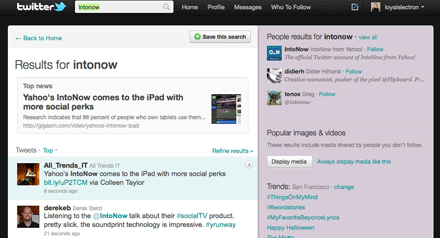
Twitter is taking its first step to curate the news that flows across its network, quietly rolling out a “top news” section in its search results.
When people rush to Twitter to search for news keywords (say, “Osama bin Laden” or “Oscars”), they will see not only tweets containing those terms, but also a headline, teaser, thumbnail image and direct link for a popular news story on the subject.
The feature is being tested with some users. I don’t have access to it yet, but GigaOm writer Colleen Taylor does, and she broke the story and posted screenshots.
http://www.blogger.com/blogger.g?blogID=8672091774752856243#editor/target=post;postID=4313155477248617402
Twitter is taking its first step to curate the news that flows across its network, quietly rolling out a “top news” section in its search results.
When people rush to Twitter to search for news keywords (say, “Osama bin Laden” or “Oscars”), they will see not only tweets containing those terms, but also a headline, teaser, thumbnail image and direct link for a popular news story on the subject.
The feature is being tested with some users. I don’t have access to it yet, but GigaOm writer Colleen Taylor does, and she broke the story and posted screenshots.
-
- GigaOm’s Colleen Taylor captured an early image of how Twitter’s new “top news” feature works. This screenshot shows a Yahoo story featured at the top of the search results, with a headline, image and blurb.

http://www.blogger.com/blogger.g?blogID=8672091774752856243#editor/target=post;postID=4313155477248617402
Friday, September 23, 2011
43% of Twitter Users Access Twitter From a Mobile Phone
HubSpotBlog reporting: The latest data on mobile phone usage
is out, and the numbers show that mobile isn't slowing down. And where
inbound marketing is concerned, some of the key mobile data centers
around how people are using their phones to access content and social
media.
MarketingCharts' mobile research has found that people are increasingly using their mobile phones to access content on browsers, apps, and social networks:

The research also provided some fascinating data on people who are users of LinkedIn, Facebook, and Twitter. Although the vast majority of these people indicated they access these social networks on their desktop, they showed various rates of usage on their mobile phones.
Read more: http://blog.hubspot.com/blog/tabid/6307/bid/25026/43-of-Twitter-Users-Access-Twitter-From-a-Mobile-Phone-Data.aspx#ixzz1YnRR4Y7C
MarketingCharts' mobile research has found that people are increasingly using their mobile phones to access content on browsers, apps, and social networks:
- In March 2011, nearly 39% of US mobile subscribers were browsing the internet using their mobile device. That's up by 2.2 percentage points from just 3 months prior.
- Mobile apps are almost as popular as browsers; 37% of subscribers used downloaded apps.
- Subscribers are also increasingly using social networks on their phones. In March, 27.3% indicated they used a social network on their mobile phone, up from 24.7% just 3 months prior.
The research also provided some fascinating data on people who are users of LinkedIn, Facebook, and Twitter. Although the vast majority of these people indicated they access these social networks on their desktop, they showed various rates of usage on their mobile phones.
Read more: http://blog.hubspot.com/blog/tabid/6307/bid/25026/43-of-Twitter-Users-Access-Twitter-From-a-Mobile-Phone-Data.aspx#ixzz1YnRR4Y7C
Friday, September 2, 2011
Twitter to begin showing in-stream ads to users who didn’t opt-in
Poynter reporting:
Twitter is expanding its advertising program to show ads to users who didn’t take some direct action to trigger them, either by following a specific account or searching for a term on the service, Peter Kafka reports. Until now, advertisers could place in-stream messages before users who already had chosen to follow them. The new program lets brands reach users whom Twitter judges to be similar to others who follow the brand. The ads will appear on Twitter.com starting in September, and Twitter users cannot opt out. The move is part of Twitter’s quest to begin profiting from its large network, but like other recent attempts it may bother some users.
http://www.poynter.org/latest-news/media-lab/social-media/144765/twitter-to-begin-showing-in-stream-ads-to-users-who-didnt-opt-in
Twitter is expanding its advertising program to show ads to users who didn’t take some direct action to trigger them, either by following a specific account or searching for a term on the service, Peter Kafka reports. Until now, advertisers could place in-stream messages before users who already had chosen to follow them. The new program lets brands reach users whom Twitter judges to be similar to others who follow the brand. The ads will appear on Twitter.com starting in September, and Twitter users cannot opt out. The move is part of Twitter’s quest to begin profiting from its large network, but like other recent attempts it may bother some users.
http://www.poynter.org/latest-news/media-lab/social-media/144765/twitter-to-begin-showing-in-stream-ads-to-users-who-didnt-opt-in
Sunday, August 28, 2011
Aug. 26, 6 p.m. The NYT launches a Twitter feed for live coverage of breaking news
NiemanLabs reporting:
As Hurricane Irene storms its way toward the Eastern seaboard — and as news organizations scramble to cover it — The New York Times has launched @NYTLive, a Times-run account featuring “in-depth Twitter curation of major news stories by New York Times editors.”
In the hour since the feed’s been live, it’s served as a hurricane-tweet clearinghouse, sharing tweets from the Times’ Metro desk, @NYTMetro, as well as — quite interesting from the whole individual-vs.-institutional-brand perspective — Times reporters Thomas Kaplan and Brian Stelter. (The latter, who’s currently in North Carolina covering the storm, also had a link to his Twitter feed featured on the Times’ homepage earlier today.)
The paper’s main account, @NYTimes, has over 3.6 million followers; the brand new @NYTLive has only 2,200. Not at all shabby for an hour-old account, but why wouldn’t the Times use its biggest Twitter megaphone? First, it solves a problem faced by many news organizations, the small and especially the big, that use Twitter to share stories across several topics and coverage areas. By breaking out the breaking news from the everyday news — the you-care-about-it-now from the comparatively evergreen — @NYTLive gives the Times the flexibility to live-tweet big stories without flooding its main account and overwhelming the other stories that are sent out on its feed. You may recall that Andy Carvin recently met some criticism for over-tweeting, the main complaint being that his uber-curation drowns out the other Twitter feeds users follow; to the extent that Andy Carvin is a one-man news organization, he’s dealing with the same problem. Stelter himself used a separate account, @brianstelternyt, to livetweet a tech conference earlier this year, but the account seems to have gone dormant.
http://www.niemanlab.org/2011/08/the-nyt-launches-a-twitter-feed-for-live-coverage-of-breaking-news/?utm_source=Daily+Lab+email+list&utm_medium=email&utm_campaign=9c4960855e-DAILY_EMAIL
As Hurricane Irene storms its way toward the Eastern seaboard — and as news organizations scramble to cover it — The New York Times has launched @NYTLive, a Times-run account featuring “in-depth Twitter curation of major news stories by New York Times editors.”
In the hour since the feed’s been live, it’s served as a hurricane-tweet clearinghouse, sharing tweets from the Times’ Metro desk, @NYTMetro, as well as — quite interesting from the whole individual-vs.-institutional-brand perspective — Times reporters Thomas Kaplan and Brian Stelter. (The latter, who’s currently in North Carolina covering the storm, also had a link to his Twitter feed featured on the Times’ homepage earlier today.)
The paper’s main account, @NYTimes, has over 3.6 million followers; the brand new @NYTLive has only 2,200. Not at all shabby for an hour-old account, but why wouldn’t the Times use its biggest Twitter megaphone? First, it solves a problem faced by many news organizations, the small and especially the big, that use Twitter to share stories across several topics and coverage areas. By breaking out the breaking news from the everyday news — the you-care-about-it-now from the comparatively evergreen — @NYTLive gives the Times the flexibility to live-tweet big stories without flooding its main account and overwhelming the other stories that are sent out on its feed. You may recall that Andy Carvin recently met some criticism for over-tweeting, the main complaint being that his uber-curation drowns out the other Twitter feeds users follow; to the extent that Andy Carvin is a one-man news organization, he’s dealing with the same problem. Stelter himself used a separate account, @brianstelternyt, to livetweet a tech conference earlier this year, but the account seems to have gone dormant.
http://www.niemanlab.org/2011/08/the-nyt-launches-a-twitter-feed-for-live-coverage-of-breaking-news/?utm_source=Daily+Lab+email+list&utm_medium=email&utm_campaign=9c4960855e-DAILY_EMAIL
Saturday, June 11, 2011
Curation as authorship in the web
NiemanLab/Maria Popova:
Today, the two biggest question marks about Twitter’s evolution in my subjective experience are correction and attribution. The fact that there’s no present way of correcting an erroneous tweet remains an issue, especially as Twitter becomes more and more a tool of serious journalism, disaster reporting, human rights activism, and other issues of very palpable real-life impact. As journalists and curators, we remain human — which means we remain prone to everything from innocuous (and often humorous) typos to inadvertent yet serious misinformation. By the time we catch these errors, a tweet could have easily reached thousands of people. Erasing the original tweet will only remove those retweets sent through Twitter’s official RT button, and tweeting a correctional follow-up will only reach a fraction of the people who saw the original tweet. We need to invent a way to either correct core text in tweets retroactively, or to append correctional tweets to the original tweet so that everyone who retweeted it or otherwise linked to it gets an instant update of the correction.
The second issue is something I feel particularly strongly about. If information discovery plays such a central role in how we make sense of the world in this new media landscape, then it is a form of creative labor in and of itself. And yet our current normative models for crediting this kind of labor are completely inadequate, if they exist at all. We have clearly defined systems for what’s right or wrong in terms of crediting creative labor in “text” (or image, or video), from image rights to literary citations. But we don’t have the same ethical principles for sources of discovery. In a culture of “information overload,” though, it’s through these very nodes in the information ecosystem, these human sense-makers, that this very text or image or video finds its way into our scope of attention. Via-crediting, when given at all, lacks a codified morphology of credit types. (I’ve devised my own system, where I use “RT” for a verbatim retweet, “via” for reworded, and “HT” — “hat tip” — for indirect discovery, where I tweet a link I’ve discovered through something else that person shared or through their site rather than their Twitter feed. Adding to the taxonomy, some have also started using “MT” for “modified tweet.”)Finding a way to acknowledge content curation and information discovery (or, better, the new term we invent for these fluffy placeholders) as a form of creative labor, and to codify this acknowledgement, is the next frontier in how we think about “intellectual property” in the information age. IP, as a term, is inherently flawed and anachronistic in its focus on ownership (“property”) in an age of sharing and open access, certainly. But it also challenges our most fundamental notions of authorship. As Bob Stein put it in his thoughtful 2006 critique of Jaron Lanier’s Digital Maoism, there’s an “emerging sense of the author as moderator — someone able to marshal ‘the wisdom of the network.’”
Ultimately, I see Twitter neither as a medium of broadcast, the way text is, nor as one of conversation, the way speech is, but rather as a medium of conversational direction and a discovery platform for the text and conversations that matter. Until we find new ways to classify, codify, and talk about this medium — new language, new laws, new normative models — our understanding and use of it will remain a museum of empty frames.
http://www.niemanlab.org/2011/06/maria-popova-in-a-new-world-of-informational-abundance-content-curation-is-a-new-kind-of-authorship/?utm_source=Daily+Lab+email+list&utm_campaign=68eeba47b6-DAILY_EMAIL&utm_medium=email
Monday, June 6, 2011
Is Twitter writing, or is it speech? Why we need a new paradigm for our social media platforms
NiemanJournalismLab reporting:
New tools are at their most powerful, Clay Shirky says, once they’re ubiquitous enough to become invisible. Twitter may be increasingly pervasive — a Pew study released yesterday shows that 13 percent of online adults use the service, which is up from 8 percent six months ago — but it’s pretty much the opposite of invisible. We talk to each other on Twitter, yes, but almost as much, it seems, we talk to each other about it.
Often, we yell. The big debates about Twitter’s overall efficacy as a medium — like the one launched by, say, Bill Keller, whose resignation from The New York Times’ editorship some Twitterers have attributed (jokingly? I think?) to his Twitter-take-on columns — tend to conclude without much consensus. A recent (and comparatively calm) debate between Mathew Ingram and Jeff Jarvis ended like so: “I guess we will have to agree to disagree.”
But why all the third-railiness? Twitter, like many other subjects of political pique, tends to be framed in extremes: On the one hand, there’s Twitter, the cheeky, geeky little platform — the perky Twitter bird! the collective of “tweets”! all the twee new words that have emerged with the advent of the tw-efix! — and on the other, there’s Twitter, the disruptor: the real-time reporting tool. The pseudo-enabler of democratic revolution. The existential threat to the narrative primacy of the news article. Twetcetera.
The dissonance here could be chalked up to the fact that Twitter is simply a medium like any other medium, and, in that, will make of itself (conversation-enabler, LOLCat passer-onner, rebellion-facilitator) whatever we, its users, make of it. But that doesn’t fully account for Twitter’s capacity to inspire so much angst (“Is Twitter making us ____?”), or, for that matter, to inspire so much joy. The McLuhany mindset toward Twitter — the assumption of a medium that is not only the message to, but the molder of, its users — seems to be rooted in a notion of what Twitter should be as much as what it is.
Which begs the question: What is Twitter, actually? (No, seriously!) And what type of communication is it, finally? If we’re wondering why heated debates about Twitter’s effect on information/politics/us tend to be at once so ubiquitous and so generally unsatisfying…the answer may be that, collectively, we have yet to come to consensus on a much more basic question: Is Twitter writing, or is it speech?
http://www.niemanlab.org/2011/06/is-twitter-writing-or-is-it-speech-why-we-need-a-new-paradigm-for-our-social-media-platforms
New tools are at their most powerful, Clay Shirky says, once they’re ubiquitous enough to become invisible. Twitter may be increasingly pervasive — a Pew study released yesterday shows that 13 percent of online adults use the service, which is up from 8 percent six months ago — but it’s pretty much the opposite of invisible. We talk to each other on Twitter, yes, but almost as much, it seems, we talk to each other about it.
Often, we yell. The big debates about Twitter’s overall efficacy as a medium — like the one launched by, say, Bill Keller, whose resignation from The New York Times’ editorship some Twitterers have attributed (jokingly? I think?) to his Twitter-take-on columns — tend to conclude without much consensus. A recent (and comparatively calm) debate between Mathew Ingram and Jeff Jarvis ended like so: “I guess we will have to agree to disagree.”
But why all the third-railiness? Twitter, like many other subjects of political pique, tends to be framed in extremes: On the one hand, there’s Twitter, the cheeky, geeky little platform — the perky Twitter bird! the collective of “tweets”! all the twee new words that have emerged with the advent of the tw-efix! — and on the other, there’s Twitter, the disruptor: the real-time reporting tool. The pseudo-enabler of democratic revolution. The existential threat to the narrative primacy of the news article. Twetcetera.
The dissonance here could be chalked up to the fact that Twitter is simply a medium like any other medium, and, in that, will make of itself (conversation-enabler, LOLCat passer-onner, rebellion-facilitator) whatever we, its users, make of it. But that doesn’t fully account for Twitter’s capacity to inspire so much angst (“Is Twitter making us ____?”), or, for that matter, to inspire so much joy. The McLuhany mindset toward Twitter — the assumption of a medium that is not only the message to, but the molder of, its users — seems to be rooted in a notion of what Twitter should be as much as what it is.
Which begs the question: What is Twitter, actually? (No, seriously!) And what type of communication is it, finally? If we’re wondering why heated debates about Twitter’s effect on information/politics/us tend to be at once so ubiquitous and so generally unsatisfying…the answer may be that, collectively, we have yet to come to consensus on a much more basic question: Is Twitter writing, or is it speech?
http://www.niemanlab.org/2011/06/is-twitter-writing-or-is-it-speech-why-we-need-a-new-paradigm-for-our-social-media-platforms
Saturday, June 4, 2011
How do you build local engagement on Twitter?
A Journal Register Co. editor mentioned a common challenge in a newsroom trying to master social media. How do you build an engaged audience on Twitter? My answer to the editor (expanded some as I’ve thought more about it):
Engaging followers is largely a result of two factors: following people who care about your community and conversing with them.
How many people follow you (and how many you follow) are not as important as identifying the people who share your interests and engaging meaningfully with them. So don’t get hung up on numbers, though you do want your engaged community to grow steadily.
I know of three tools that would be useful for building an engaged Twitter following. Enter your community(ies) in Twellow or Nearby Tweets and they will show you Twitter users in the community. Twellow shows you users (largely businesses) who have registered with Twellow, using that location. NearbyTweets shows people who are tweeting right now near you.
You can also use Advanced Twitter search to look for tweets by location (here’s the tweets within 15 miles of Yardley, Pa., where JRC is headquartered).
I would not make these sites a one-time visit either. Advanced Twitter Search and Nearby Tweets especially are places to visit occasionally, because different people will be tweeting each time. When a breaking news story or community event might be generating Twitter discussion, those are excellent places to connect with that discussion.
...
And you shouldn’t forget simple things: prominent display of social media buttons on your home page and sharing buttons on your story pages and blog posts. Curate social media content in your news coverage, and people will tweet links to your stories and their followers will start following you.
http://stevebuttry.wordpress.com/2011/05/27/how-do-you-build-local-engagement-on-twitter/?blogsub=confirming#subscribe-blog

Engaging followers is largely a result of two factors: following people who care about your community and conversing with them.
How many people follow you (and how many you follow) are not as important as identifying the people who share your interests and engaging meaningfully with them. So don’t get hung up on numbers, though you do want your engaged community to grow steadily.
I know of three tools that would be useful for building an engaged Twitter following. Enter your community(ies) in Twellow or Nearby Tweets and they will show you Twitter users in the community. Twellow shows you users (largely businesses) who have registered with Twellow, using that location. NearbyTweets shows people who are tweeting right now near you.
You can also use Advanced Twitter search to look for tweets by location (here’s the tweets within 15 miles of Yardley, Pa., where JRC is headquartered).
I would not make these sites a one-time visit either. Advanced Twitter Search and Nearby Tweets especially are places to visit occasionally, because different people will be tweeting each time. When a breaking news story or community event might be generating Twitter discussion, those are excellent places to connect with that discussion.
...
And you shouldn’t forget simple things: prominent display of social media buttons on your home page and sharing buttons on your story pages and blog posts. Curate social media content in your news coverage, and people will tweet links to your stories and their followers will start following you.
http://stevebuttry.wordpress.com/2011/05/27/how-do-you-build-local-engagement-on-twitter/?blogsub=confirming#subscribe-blog
Friday, June 3, 2011
13 % of US online adults use twitter
Pew institue reporting:
13% of online adults use the status update service Twitter, which represents a significant increase from the 8% of online adults who identified themselves as Twitter users in November 2010. 95% of Twitter users own a mobile phone, and half of these users access the service on their handheld device.
As in our previous research on Twitter use, African Americans and Latinos continue to have high rates of adoption of the service. Fully 25% of online African Americans use Twitter at least occasionally, with 11% doing so on a typical day.
Additionally, Twitter use by internet users ages 25-34 has doubled since late 2010 (from 9% to 19%) and usage by those ages 35-44 has also grown significantly (from 8% to 14%).
These findings come from national survey findings from a poll conducted on landline and cell phones, in English and Spanish, between April 26 and May 22, 2011 among 2,277 adults (age 18 and older). The margin of error among the internet users is +/- 3.7 percentage points.
http://pewinternet.org/%20Reports/2011/Twitter-Update-2011.aspx
13% of online adults use the status update service Twitter, which represents a significant increase from the 8% of online adults who identified themselves as Twitter users in November 2010. 95% of Twitter users own a mobile phone, and half of these users access the service on their handheld device.
As in our previous research on Twitter use, African Americans and Latinos continue to have high rates of adoption of the service. Fully 25% of online African Americans use Twitter at least occasionally, with 11% doing so on a typical day.
Additionally, Twitter use by internet users ages 25-34 has doubled since late 2010 (from 9% to 19%) and usage by those ages 35-44 has also grown significantly (from 8% to 14%).
These findings come from national survey findings from a poll conducted on landline and cell phones, in English and Spanish, between April 26 and May 22, 2011 among 2,277 adults (age 18 and older). The margin of error among the internet users is +/- 3.7 percentage points.
http://pewinternet.org/%20Reports/2011/Twitter-Update-2011.aspx
Subscribe to:
Posts (Atom)