Showing posts with label web use. Show all posts

Saturday, May 23, 2015

Content overload on the web is a turn-off: here's how to manage it

theguardian reporting:
41% of people (and 33% of millennials, those aged roughly 18- to 34-years-old) claim to feel overwhelmed by the sheer wealth of choice on the internet, preferring friends’ recommendations on social media rather than searching for content and products themselves.
Advertisement
This trend has huge implications for both publishers, especially for those relying solely on advertising revenues and trying to build audiences at scale, and advertisers heavily investing in native advertising, looking for a deeper connection with consumers.
The recent push towards branded content has plainly contributed to this sense of content overload too.
However, better curated content, creative distribution strategies supported by smart data that leverage the opportunities offered by media convergence, can stop content overload from hindering the overall value of native advertising.

1. Listen and learn

Knowing your audience is a must for brands as much as it is for publishers. It is therefore important to audit your audience’s conversations comprehensively – social listening can be a particularly effective tool for this. This provides clear insight into people’s content consumption habits, for example, what they are interested in, what formats of content they like, who their influencers are, when and where they read and how they feel about that content.

2. Capitalise on context...

http://www.theguardian.com/media-network/2015/may/18/content-overload-turn-off-audiences-brands-publishers?CMP=new_1194&CMP=

How Millennials Get News: Inside the habits of America’s first digital generation

API reporting:
Millennials consume news and information in strikingly different ways than previous generations, and their paths to discovery are more nuanced and varied than some may have imagined, according to the new study by the Media Insight Project, a collaboration of the American Press Institute and the Associated Press-NORC Center for Public Affairs Research.

How Millennials get news

Percent of Millennials who…
Say keeping up with the news is at least somewhat important to them85%
Get news daily69%
Regularly follow five or more "hard news" topics45%
Usually see diverse opinions through social media86%
Pay for at least one news-specific service, app, or digital subscription40%
MEDIA INSIGHT PROJECT
The data also suggest that social networks are exposing Millennials to more news than they were initially seeking. Overall, just 47 percent who use Facebook say that getting news is a main motivation for visiting, but it has become one of the significant activities they engage in once they are there. Fully 88 percent of Millennials get news from Facebook regularly, for instance, and more than half of them do so daily...

Saturday, February 22, 2014

Social or search...this obsession with traffic ignores the complexity of turning readers into revenue

theMediaBfiefing reporting:
Amid all the debate about whether or not social is overtaking search as the most important source of traffic for media brands, many have lost sight of a key issue: Search and social are two vital and often complementary methods of getting people to read content - but the way you monetise those people varies massively.
...

What's a reader worth, and why?

There are a number of questions a media brand should be asking about each person who visits its site, including:
-- Direct revenue: Will this person pay for my content?
-- Partner revenue: Will this person buy something else through me or one of my partners via my site?
-- Better targeting: Will this person give me more data to enhance my marketing efforts, or those of my clients?
-- More valuable target: Is this person, because they are more engaged, more valuable to my advertising clients?
There's a compelling argument that in answering many of these questions, media brands will start valuing social more. On Google, a media brand is just one purveyor of information among many. But with social media, be it Twitter, Facebook, Pinterest or LinkedIn, there are more complex relationships between publisher and reader at play. ...
http://www.themediabriefing.com/article/no-social-traffic-hasn-t-overtaken-search-but-that-doesn-t-mean-it-isn-t-becoming-more-important

Tuesday, February 11, 2014

Are Teens Really Unfriending Facebook?

eMarketer reporting:
A brand is in a tricky position when it has no place to go but down. Given its must-have status among US teens in recent years—eMarketer estimates 95.9% of social networkers ages 12 to 17 used Facebook in 2013—that’s the position Facebook finds itself in, according to a new eMarketer report, “US Teens: Sizing Up the Selfie-Expressive Generation.”
And there are indications it’s vulnerable to a downturn—including an acknowledgement in Facebook’s Q3 2013 earnings call that it suffered a quarter-to-quarter dip in daily usage by younger US teens.
A rising number of options may be dispersing teen activity across a broader social landscape. A November 2013 item in The Futures Company’s online Monitor Minute newsletter caught this theme: “We expect this fragmentation to continue as teens test and adopt new social upstarts.” While noting that Facebook “is still huge among teens and 20-somethings,” it added that “the way some are using it has changed from an all-encompassing, one-stop shop to a quick check-in before moving on to explore their other social networks.”
It’s not so much that Facebook is losing teens as that it’s losing the exclusive power to define what social networking means for them. 
See statistics at http://www.emarketer.com/Article/Teens-Really-Unfriending-Facebook/1010598/2

Visual content-based apps on the rise—but Facebook is still No. 1

A brand is in a tricky position when it has no place to go but down. Given its must-have status among US teens in recent years—eMarketer estimates 95.9% of social networkers ages 12 to 17 used Facebook in 2013—that’s the position Facebook finds itself in, according to a new eMarketer report, “US Teens: Sizing Up the Selfie-Expressive Generation.”
And there are indications it’s vulnerable to a downturn—including an acknowledgement in Facebook’s Q3 2013 earnings call that it suffered a quarter-to-quarter dip in daily usage by younger US teens.

A rising number of options may be dispersing teen activity across a broader social landscape. A November 2013 item in The Futures Company’s online Monitor Minute newsletter caught this theme: “We expect this fragmentation to continue as teens test and adopt new social upstarts.” While noting that Facebook “is still huge among teens and 20-somethings,” it added that “the way some are using it has changed from an all-encompassing, one-stop shop to a quick check-in before moving on to explore their other social networks.”
It’s not so much that Facebook is losing teens as that it’s losing the exclusive power to define what social networking means for them.

Read more at http://www.emarketer.com/Article/Teens-Really-Unfriending-Facebook/1010598#gTIjKEft80X2IuyG.99

Visual content-based apps on the rise—but Facebook is still No. 1

A brand is in a tricky position when it has no place to go but down. Given its must-have status among US teens in recent years—eMarketer estimates 95.9% of social networkers ages 12 to 17 used Facebook in 2013—that’s the position Facebook finds itself in, according to a new eMarketer report, “US Teens: Sizing Up the Selfie-Expressive Generation.”
And there are indications it’s vulnerable to a downturn—including an acknowledgement in Facebook’s Q3 2013 earnings call that it suffered a quarter-to-quarter dip in daily usage by younger US teens.

A rising number of options may be dispersing teen activity across a broader social landscape. A November 2013 item in The Futures Company’s online Monitor Minute newsletter caught this theme: “We expect this fragmentation to continue as teens test and adopt new social upstarts.” While noting that Facebook “is still huge among teens and 20-somethings,” it added that “the way some are using it has changed from an all-encompassing, one-stop shop to a quick check-in before moving on to explore their other social networks.”
It’s not so much that Facebook is losing teens as that it’s losing the exclusive power to define what social networking means for them.

Read more at http://www.emarketer.com/Article/Teens-Really-Unfriending-Facebook/1010598#gTIjKEft80X2IuyG.99

Visual content-based apps on the rise—but Facebook is still No. 1

A brand is in a tricky position when it has no place to go but down. Given its must-have status among US teens in recent years—eMarketer estimates 95.9% of social networkers ages 12 to 17 used Facebook in 2013—that’s the position Facebook finds itself in, according to a new eMarketer report, “US Teens: Sizing Up the Selfie-Expressive Generation.”
And there are indications it’s vulnerable to a downturn—including an acknowledgement in Facebook’s Q3 2013 earnings call that it suffered a quarter-to-quarter dip in daily usage by younger US teens.

A rising number of options may be dispersing teen activity across a broader social landscape. A November 2013 item in The Futures Company’s online Monitor Minute newsletter caught this theme: “We expect this fragmentation to continue as teens test and adopt new social upstarts.” While noting that Facebook “is still huge among teens and 20-somethings,” it added that “the way some are using it has changed from an all-encompassing, one-stop shop to a quick check-in before moving on to explore their other social networks.”
It’s not so much that Facebook is losing teens as that it’s losing the exclusive power to define what social networking means for them.

Read more at http://www.emarketer.com/Article/Teens-Really-Unfriending-Facebook/1010598#gTIjKEft80X2IuyG.99

Monday, February 10, 2014

Why It's So Hard to Measure Online Readership

The Atlantic reporting:
Name a metric, any metric, for measuring audience attention, and there is (a) a reason why it's useful; (b) a reason why it's worthless; and (c) a way for digital media companies to corrupt it.
Page views (e.g.: clicks) used to be the most common currency of online attention, only to be replaced by unique visitors (e.g.: readers). But in the viral age, "readers" doesn't mean what it used to mean. If you were a newspaper in the 1980s, readers = subscribers who receive your bundle of paper each morning. In a bookmarked-site world, readers meant Web visitors who drop by a few days a month at most. But in the viral age, readers can mean 1 million Facebook users who see some sensational headline, clicked it, and scurried away, having no recollection of what URL hosted the article, and never visit the site again.
Reader used to be a person. Now it's a spectrum. There are dedicated readers on one end, Tsetse-fly-brained Facebook browsers on the other, and fully engaged one-time readers in the middle. Surely they shouldn't count equally to an advertiser seeking an consistently engaged and knowable audience.
That's why some digital companies are trying to the Internet less like a newspaper and more like TV. YouTube now measures “Time Watched." Medium counts “Total Time Reading." Chartbeat tracks “Average Engaged Time.” And now Upworthy—the viral firehose of the Web—announced that it's developed a new metric. "Attention minutes" seeks to measure time spent watching or reading an Upworthy page, by studying "length of time a browser tab has been open, how long a video player has been running, and the movement of the mouse on screen," according to Nieman Lab.

Monday, December 30, 2013

Social Media Engagement: The Surprising Facts About How Much Time People Spend On The Major Social Networks Read more: http://www.businessinsider.com/social-media-engagement-statistics-2013-12#ixzz2ox9QHQ8z

BusinessInsider reporting:
We tend to talk about social networks in terms of size, because audience reach is one of social media’s biggest advantages. That’s why Facebook gets so much attention. With 1.2 billion monthly active users, it’s a beast.
But as audiences adopt newer social networks, and people’s social activity becomes increasingly fragmented, other measures of social network activity become more important, especially for businesses trying to determine where to best allocate time and resources. How much time users spend on each social network and how engaged and interactive they are with content there are increasingly important ways of evaluating the sites.
Here are our findings:
  • Social is now the top Internet activity: Americans spend an average of 37 minutes daily on social media, a higher time-spend than any other major Internet activity, including email.
  • Social-mobile rules: 60% or so of social media time is spent not on desktop computers but on smartphones and tablets. 
  • Facebook has a monster lead in engagement: Facebook is a terrific absorber of audiences' time and attention, 114 billion minutes a month in the U.S. alone, on desktop PCs and smartphones. By comparison, Instagram commands 8 billion minutes a month, and Twitter just 5.3 billion. 
  • Facebook attracts roughly seven times the engagement that Twitter does, when looking at both smartphone and PC usage, in per-user terms
  • Snapchat is a smaller network than WhatsApp, but outpaces it in terms of time-spend per user
  • Pinterest, Tumblr and LinkedIn have made major successful pushes in 2013 to increase engagement on their mobile sites and apps. The new race in social media is not for audience per se, but for multi-device engagement
  • Multi-device social media: Our analysis is based on BI Intelligence's social media Engagement Index, which compares the effectiveness of social networks in keeping individual users engaged across smartphones and desktop PCs (for an explanation of the Index, sign up for instant access to BI Intelligence). 

Tuesday, November 12, 2013

It’s the engagement, stupid: Jim Chisholm says newspapers need to do more to earn attention

Nieman Journalism Lab reporting:


Newspapers’ declining hold on audience attention began long before the web came along, the Scottish newspaper consultant argues, and tablets are one of the best hopes for reclaiming it.
“There is no statistical evidence anywhere that print circulations are declining because of the Internet. I’ve said this many times, and everybody tells me I’m talking complete rubbish,” says Jim Chisholm. “Circulations in the U.S.A. were declining long before anyone invented the word ‘WWW’…The cause of decline in analog consumption is more to do with changes in society than it is to do with the emergence of the Internet.”
That argument — that the decline of newspapers’ fortunes has roots much deeper than the proliferation of screens in our lives — may go against the flow, but Chisholm, a Scottish newspaper consultant, believes it’s important to acknowledge it if newspapers are going to thrive. He presented his ideas at this year’s WAN-IFRA newspaper congress in Bangkok (which Frédéric Filloux deftly summarized), making a case that online content is, at this point, no replacement for print when it comes to reader engagement — and, therefore, advertising revenue.

Shallow engagement

How newspapers are faring online depends on how you look at the numbers, which Chisholm draws from comScore and Nielsen. On one hand, newspapers are among the most popular destinations for Internet users in the United States — 61.5 percent of Americans with an Internet connection visited a newspaper’s website in May, for instance.
But that same data says that Americans often don’t go much further than a newspaper’s homepage and don’t spend much time actually reading its content. Newspapers represented just 1.5 percent of pageviews, 7.9 percent of total visits, and 1.7 percent of the total time that Americans spent online in May, Chisholm says...http://www.blogger.com/blogger.g?blogID=8672091774752856243#editor/target=post;postID=965910540641669012

Saturday, September 28, 2013

Cell Phone Activities 2013 in USA

Pew reporting:
Fully 91% of American adults own a cell phone and many use the devices for much more than phone calls. In our most recent nationally representative survey, we checked in on some of the most popular activities people perform on their cell phones and found:

Who’s Not Online and Why in USA

PEW reporting:
As of May 2013, 15% of American adults ages 18 and older do not use the internet or email.

Asked why they do not use the internet:

34% of non-internet users think the internet is just not relevant to them, saying they are not interested, do not want to use it, or have no need for it.
32% of non-internet users cite reasons tied to their sense that the internet is not very easy to use. These non-users say it is difficult or frustrating to go online, they are physically unable, or they are worried about other issues such as spam, spyware, and hackers. This figure is considerably higher than in earlier surveys.
19% of non-internet users cite the expense of owning a computer or paying for an internet connection.
7% of non-users cited a physical lack of availability or access to the internet.
http://pewinternet.org/Reports/2013/Non-internet-users.aspx?utm_source=Mailing+List&utm_campaign=d5f32541a0-Newsletter_092713&utm_medium=email&utm_term=0_79a7fe984b-d5f32541a0-387794238

Tech More: Chart Of The Day Twitter CHART OF THE DAY: Twitter Is Still Very Small Read more: http://www.businessinsider.com/chart-of-the-day-twitter-is-still-very-small-2013-9#ixzz2gB9T5rMV

Business Insider reports:
Twitter, despite feeling ubiquitous to people in the media, remains a relatively small platform.
This chart from BI Intelligence shows that just 18% of U.S. Internet users are on Twitter. The people that are on Twitter are using it largely to track news.
There's two ways to look at this. On the one hand, it means Twitter has room to grow. On the other, it suggests Twitter isn't mainstream, and it might not ever go mainstream.

Sunday, September 22, 2013

The mobile war is over and the app has won: 80% of mobile time spent in apps

VentureBeat reporting:
Only 20 percent of American consumers’ time on mobile devices is spent on the web. A massive majority, 80 percent, is spent in apps: games, news, productivity, utility, and social networking apps.
Turns out, it’s an app world, after all.
According to app analytics firm Flurry, which tracks app usage on a staggering 300,000 apps on over a billion active mobile devices, we spend an average of 158 minutes each and every day on our smartphones and tablets. Two hours and seven minutes of that is in an app, and only 31 minutes is in a browser, surfing the old-school web.
A big chunk of that 158 minutes is taken up with games — 32 percent — but it’s almost shocking to see how much time a single app and a single company eats up. Eighteen percent of all the time that Americans spend on their phones is spent in the Facebook app, a figure that by itself dwarfs all other social networking apps.
Combined, the others only take up six percent of our time.
The mobile war is over and the app has won: 80% of mobile time spent in apps

...
In an interesting twist, however, HTML5 is actually being used more as a tool for cross-platform native app development. In fact, it’s now the number one choice for developers building apps for multiple platforms.
Flurry also says that people are now using more apps than ever, launching 7.9 per day in the last part of 2012 versus 7.5 per day in 2011 and 7.2 per day in 2010. Consumers are continuing to try new apps as well, with long-term users adding new apps regularly to their existing stack.
http://venturebeat.com/2013/04/03/the-mobile-war-is-over-and-the-app-has-won-80-of-mobile-time-spent-in-apps/

Saturday, March 30, 2013

The Difference Between What You Share And What People Want To Read

BusinessIntellligence reporting:
The stories people share aren't necessarily the stories their friends want to read, according to data from 33Across, which tracks links for online publications.
It found that people are sharing science related content more often than any other content category. However, science content is clicked on significantly less than the content that is less popular for sharing, like politics, news, or celebrity gossip.
There's some rationale behind the split in what's read and what's shared. People will want to share science content because it makes them seem smart. People will click on celebrity content because no one will know.
The data in this chart shows how many stories are shared in a particular category for every 100 reads. So, for every 100 reads of a science story, 17 are shared. The clicked is how many links are clicked by the person sent the link

Read more: http://www.businessinsider.com/chart-of-the-day-the-difference-between-what-you-share-and-what-people-want-to-read-2013-3#ixzz2P2cQEETu

Tuesday, January 29, 2013

BII REPORT: Here's What Smartphone Users Are Doing With Their Phones

BusinessInsider reporting:
According to eMarketer, mobile now accounts for 12 percent of Americans' media consumption time, triple its share in 2009.
Where is this consumer attention being focused?
The biggest beneficiaries have been mobile apps. Time spent on apps dwarfs time spent on the mobile Web, and smartphone owners now spend 127 minutes per day in mobile apps.

  • Mobile gaming has become a juggernaut: Mobile games are the biggest time bucket of the mobile app era. According to Flurry, games account for 43% of the time spent on mobile apps on iOS and Android. Not surprisingly, games, which are usually monetized through in-app purchases, are also the biggest app money-makers. According to a BII analysis of Apple's App Store, games accounted for 70% of the top-grossing apps in the store.
  • Social and mobile usage and monetization is exploding: Social networking is the second most popular mobile app category, accounting for 26% of time spent in apps. The percentage of all U.S. mobile users that accessed a social network on their phone rose from 14% in September 2009 to 39% in November, according to comScore. The growth of mobile social underscores that companies like Twitter and Facebook are now essentially mobile businesses. Mobile is not a superfluous sideshow, but central to these companies' businesses.
  • Weather, video, email, and search are all increasingly popular mobile activities: As of September, comScore reported 46% of U.S. mobile subscribers have accessed email on their phone, 40% checked the weather, 36% used a search engine, and 31% looked at maps. Mobile video is the third most popular smartphone activity in the U.S., with two-thirds of smartphone owners watching at least an hour of video weekly, according to a study released in December by the IAB
  • Saturday, November 17, 2012

    Copy and Paste Drives Sharing

    emarketing reporting:
    Social sharing buttons may be sexier, but according to research from user engagement platform Tynt, copy and paste is the sharing method of choice 82% of the time.
    The service, which offers a way for content publishers to track sharing behavior through embedded code that indicates referrals and includes site URLs when content is pasted elsewhere, reported that in October 2012, 2% of all page views across its network involved a copy and paste.
    Just over half of the content copied was then shared. This could be in an email, an instant message or another social channel. In addition, about one-quarter of copy-and-pastes resulted in a search—that is, a word or phrase from the content being viewed was copied into a search bar to look for more information on the topic.

    Sunday, October 21, 2012

    New MPA study focuses on magazine reading on smartphones

    MPA reporting:

    MPA–The Association of Magazine Media has released Magazine Media Readers and Their Smart Phones, as part of the association’s ongoing effort to examine the attitudes and behaviors of a select group of consumers: mobile device owners who read digital magazines.

    The research, conducted in the summer of 2012, investigates how millennial (18-34 year-old) smartphone owners access magazine content on their smartphones, in particular Apple iPhones and Android devices. The study was conducted by independent research firm GfK MRI for MPA, and sheds light on younger consumers’ engagement with digital magazine content as well as their attitudes on content sharing, advertising, QR codes and e-commerce.

    “This is the first study to uncover the behaviors and preferences of younger magazine readers exclusively on smart phones, and the findings provide magazine media editors and publishers with constructive insights for designing and evolving their mobile editions to better align with consumer preferences going forward,” said Christopher Kevorkian, chief marketing and digital officer, MPA. “The advertising community would also find this research valuable, in particular the compelling results around the coveted millennials’ engagement with ads on magazine smartphone editions.”

    Key findings
    • Most magazine readers 18-34 who own a smartphone access or download magazine branded apps using digital newsstands and/or newsreaders (Flipboard, Pulse and Zite)
    • 60 per cent said they would like the smartphone version to deliver more current information than the printed copy
    • The smartphone owners surveyed have downloaded an average of 2.6 magazine apps
    • 83 per cent of respondents accessed or downloaded a magazine branded app via a digital newsstand, while more than a third (35 per cent) use a newsreader to view magazine digital content
    • 86 per cent accessed digital magazine content on their smartphone from home. 43 per cent read the content at work, and 31 per cent on their commute...http://www.fipp.com/news/New-MPA-study-focuses-on-magazine-reading-on-smartphones

    Friday, October 5, 2012

    Survey: Americans turn to established media for breaking news, mobile

    Poynter reporting:
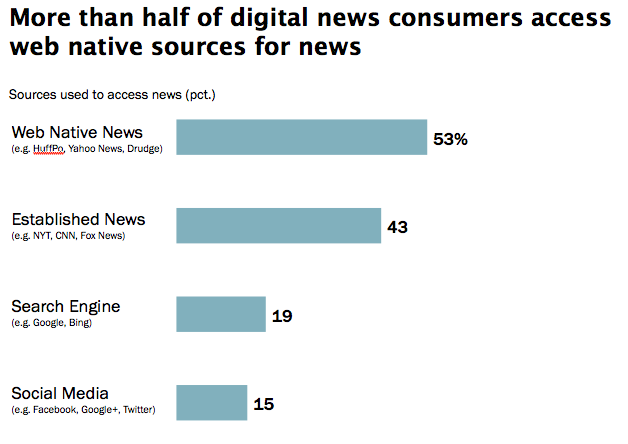
    Most digital news consumers now get information from Web-native sources like The Huffington Post, but they turn to “established” news outlets like the New York Times, CNN or Fox News for big events and mobile news, according to new research.
    That is one finding from a national survey commissioned by The New York Times that examines the cross-platform behaviors of news consumers. Brian Brett, executive director of customer research, will present the findings today at the International Newsmedia Marketing Association’s Audience Summit in Chicago.
    This data came from an online survey this spring by Knowledge Networks of 3,022 U.S. residents 18 to 65, weighted to match the general population. Eighty-five percent of the respondents qualified as “news consumers” who get some kind of news at least a few times a week.
    A majority (53 percent) of digital news consumers said they get information from Web-native sources, citing their convenience and accessibility. Only 43 percent regularly use traditional news sources for digital news, but they prefer it for in-depth reporting and trustworthiness.
    Newer online outlets are more likely to be used as a daily news source.
    http://www.poynter.org/latest-news/top-stories/190586/new-data-show-shifting-patterns-as-people-seek-news-across-platforms/ 

    Thursday, August 30, 2012

    Taking stock of social media (of magazines)

    emedia/vitals reporting: People magazine recently eclipsed 4 million followers on Twitter. Vogue has 3.1 million Facebook fans. The big numbers underscore the progress magazine publishers have made establishing a strong social media presence. But the question remains, what impact do these followers have on the business?
    Measuring social ROI continues to be a challenge for media companies and marketers alike. Some say it’s a fool’s errand to even try to formulate an ROI metric for social media.
    “Keep dreaming,” Unmetric CEO Lakshmanan Narayan wrote in a guest post for Forbes about the folly of brands (not publishers specifically) attempting to pinpoint social media ROI. He adds:
    In terms of social media today, we often hear questions like “what is the monetary value of a fan?” Ironic, considering that we still have not fully defined the value of a TV commercial viewer. In fact, we continue to ‘invest’ in television and other mass media advertising, notwithstanding the fact that we still don’t know which (proverbial) 50% of our budget is working.
    L2 ThinkTank, in its most recent Digital IQ Index for magazines, found that only 38% of the 80 magazine brands it studied are actively monetizing a Facebook tab (for example, by referencing an advertiser), and just 35% are monetizing their tweet stream (eg, through sponsored tweets).
    Although publishers haven’t yet figured out the magic ROI formula for Facebook and Twitter, not to mention emerging platforms such as Pinterest, Tumblr, Instagram and Google+, they are collecting an awful lot of information about how their audience likes to engage on social media. This data can lead to insights that inform content and audience development decisions and, indirectly at least, boost revenues.
    A recent MPA study of 18-to-34-year-olds sheds some light on how magazine brands are attracting Millennials into their social media communities. The study found that 56% of magazine readers who use Twitter follow a magazine brand on Twitter. For respondents who identified themselves as “avid magazine readers,” that figure jumps to 69%. Two-thirds of avid readers said they had re-tweeted articles from a magazine’s feed.
    http://www.emediavitals.com/content/taking-stock-social-media?utm_source=Vital+Guide+to+eMedia&utm_campaign=66491a916e-emV_Vital_Guide_Social_Media_8_29_2012&utm_medium=email

    Thursday, August 16, 2012

    Stop Publishing Web Pages

    Anil Dash reporting:
    Most users on the web spend most of their time in apps. The most popular of those apps, like Facebook, Twitter, Gmail, Tumblr and others, are primarily focused on a single, simple stream that offers a river of news which users can easily scroll through, skim over, and click on to read in more depth.
    Most media companies on the web spend all of their effort putting content into content management systems which publish pages. These pages work essentially the same way that pages have worked since the beginning of the web, with a single article or post living at a particular address, and then tons of navigation and cruft (and, usually, advertisements) surrounding that article.
    Users have decided they want streams, but most media companies are insisting on publishing more and more pages. And the systems which publish the web are designed to keep making pages, not to make customized streams.
    It's time to stop publishing web pages.
    Obviously, I've written this in an old-style content publishing system, and this piece lives on my website as an old-fashioned HTML page. But if I had my preference, I'd write up an article like this, and it'd seamlessly glide into a clean, simple stream of my writing, organized by topic and sorted with the newest stuff on top. Blogs have always worked this way, but they were shoehorning this stream-like behavior into the best representation possible under the old page model.
    The vast majority of advertising online is dependent on a page-view model that users have overwhelmingly decided to abandon. Facebook, Twitter, Tumblr and others will succeed by making in-stream advertisements that fit in with the native content of their networks. Meanwhile, page-based sites are cramming every corner and bit of white space on their sites with ads that only ever decrease in effectiveness until they are made even larger and more intrusive every few years...http://dashes.com/anil/2012/08/stop-publishing-web-pages.html?utm_source=Daily+Buzz+from+eMedia+Vitals&utm_campaign=4138d53523-_nl_DB_08-16-2012&utm_medium=email

    Tuesday, July 31, 2012

    CIMM finds multi-screen consumers engaging with brands

    research. reporting:
    The results are contained in two white papers, produced in association with ComScore and Arbitron. The studies were commissioned last year.
    In ComScore’s white paper, entitled How Multi-Screen Consumers Are Changing Media Dynamics, the agency explores a study of 10 broadcast network and cable brands covering a five-week period. It found that an average of 90% of consumers engaging with a given brand did so on TV, while 25% did so online and 12% via online video.
    The study also found that the segments of multi-screen consumers showing the highest propensity to engage with these brands tended to correlate strongly with their key demographic targets, suggesting that engagement on other platforms represents an important extension of the audiences’ use and enjoyment of the media brands.
    Meanwhile, Arbitron’s white paper, based on its cross-platform media measurement pilot, revealed that a significant share of TV viewers are using PCs and mobile devices as second and third screens to access video content.
    In all, 91.7% of the panelists who viewed the TV/cable outlets of CIMM members used a second or third screen to access video sites and 35.5% used all three screens – TVs, PCs and Android/BlackBerry devices.
    http://www.research-live.com/4007588.article

    Tuesday, May 15, 2012

    Millennials Lead the Quest for Mobile-Enabled, Just-in-Time Information

    emarketer reporting:
    No longer do consumers wait until they are back at a home computer to make plans, buy products and connect with friends—instead, consumers are reaching for their smartphones to take action right in the moment. According to a study conducted between March and April 2012 by The Pew Research Center’s Internet & American Life Project, smartphone and mobile device-connected consumers are falling under a new “culture of real-time information seekers and problem solvers.”
    Half of all US smartphone users, according to Pew’s data, had used their device in the 30 days prior to the survey to coordinate a gathering. And nearly half had used it to decide whether or not to visit a business like a restaurant. Non-smartphone owners are following this trend to a much lesser degree—only 10% had used their mobile phone during the 30-day period to decide whether or not to visit a business. Other popular smartphone information quests included solving an unexpected problem, looking something up to settle an argument and looking up a sports score.

    US Mobile Phone Owners Who Conduct Select Real-Time Mobile Activities, by Device Type, April 2012 (% of respondents)

    Unsurprisingly, millennials are leading this real-time information-seeking trend. ..
    http://www.emarketer.com/Article.aspx?R=1009045&ecid=a6506033675d47f881651943c21c5ed4