Mediashift reprting:
Poorly tracking your metrics is almost worse than not tracking them at all.
http://mediashift.org/2016/07/5-steps-to-execute-metrics-that-matter/?utm_source=API+Need+to+Know+newsletter&utm_campaign=b86e0339ef-Need_to_Know_July_12_20167_12_2016&utm_medium=email&utm_term=0_e3bf78af04-b86e0339ef-31701933
Showing posts with label web audience. Show all posts
Showing posts with label web audience. Show all posts
Tuesday, July 12, 2016


Wednesday, April 20, 2016
'The pageview is antiquated': How Purch is trying to measure true reader impact
digitoday reporting:
Like a lot of publishers, Purch used to measure its success by looking at metrics including pageviews, pageviews per visit and repeat visits over a 30-day period. Now, using a combination of Google Analytics and technology created by its eight-person business intelligence team, Purch devised a score based on three metrics: how far the reader scrolled; if they clicked on the article or page; and most important, did they take an action such as signing up for a newsletter, sharing an article or clicking to buy a product.
http://digiday.com/publishers/pageview-antiquated-purch-trying-measure-true-reader-impact/
Like a lot of publishers, Purch used to measure its success by looking at metrics including pageviews, pageviews per visit and repeat visits over a 30-day period. Now, using a combination of Google Analytics and technology created by its eight-person business intelligence team, Purch devised a score based on three metrics: how far the reader scrolled; if they clicked on the article or page; and most important, did they take an action such as signing up for a newsletter, sharing an article or clicking to buy a product.
http://digiday.com/publishers/pageview-antiquated-purch-trying-measure-true-reader-impact/
Monday, April 18, 2016
Don't miss: Five key insights into online video consumption habits
the mediabriefing reporting:
The Online Video Forecasts claim that just over half (52.7 percent) of all video will be consumed on mobile devices in 2016, while Ooyala's latest Global Video Index demonstrated that 46 percent of all video plays in Q4 2015 were on mobile devices.And Statista predictions demonstrate that the number of people in the US who are consuming video on mobile devices is set to increase still further in the US alone, let alone the emerging markets:
https://www.themediabriefing.com/article/don-t-miss-key-insights-into-newspaper-subscription-models-in-the-us
Sunday, September 28, 2014
One secret to the success of Quartz, BuzzFeed and Gawker: They look at news as a service
Ggigaoma Matthew Ingram reporting:
...Many media companies and publishers do occasional customer surveys or focus groups. But these tend to be primarily marketing exercises, and ultimately just reinforce existing design and content decisions that have already been made by editors. For the most part, such organizations see their job as coming up with great ideas and producing great content — a process that usually takes place with zero input from readers — and then delivering that content on a variety of platforms. In effect, a one-way relationship.
Even the NYT’s innovation report,
as valuable as it is, makes it clear that as far as the newspaper is
concerned, the web and social media tools are useful primarily because
they are new ways of distributing and promoting all that great content
its journalists produce, not because they change anything about the
journalist-reader dynamic or allow journalism to occur in new ways.
...n order to do that properly, you have to experiment, and iterate rapidly, and most of all use data to watch what your users (or readers, or customers, whatever you choose to call them) are doing with your product.
Take Snow Fall as a cautionary example — the wonderfully designed, wildly popular multimedia project the New York Times released in 2012 about the aftermath of an avalanche. It was obvious that dozens of designers and developers and writers and editors had spent thousands of hours on the article, and it showed. It was beautiful. But according to comments made recently by former NYT digital strategist Aron Pilhofer — now director of digital at The Guardian — despite the massive investment of resources, the newspaper had no analytics attached to the project.
...
How do you make that kind of cultural change within a traditional media organization? I don’t really know, but appointing half a dozen longtime newspaper insiders to senior jobs, as the NYT’s new executive editor recently did, doesn’t seem like a great start to me, to be brutally honest.
There are some hints of evolution even at the Times: apps like NYT Now are an attempt to do things somewhat differently, and even incremental efforts like putting links to other websites on the front page — a top-secret project that no doubt took months to plan and approve — are worthwhile steps, tiny as they may be. Cultures don’t change overnight. But the clock is ticking, and more flexible players like Quartz and BuzzFeed have a head start.
https://gigaom.com/2014/09/25/one-secret-to-the-success-of-quartz-buzzfeed-and-gawker-they-look-at-news-as-a-service/
...Many media companies and publishers do occasional customer surveys or focus groups. But these tend to be primarily marketing exercises, and ultimately just reinforce existing design and content decisions that have already been made by editors. For the most part, such organizations see their job as coming up with great ideas and producing great content — a process that usually takes place with zero input from readers — and then delivering that content on a variety of platforms. In effect, a one-way relationship.
...n order to do that properly, you have to experiment, and iterate rapidly, and most of all use data to watch what your users (or readers, or customers, whatever you choose to call them) are doing with your product.
Take Snow Fall as a cautionary example — the wonderfully designed, wildly popular multimedia project the New York Times released in 2012 about the aftermath of an avalanche. It was obvious that dozens of designers and developers and writers and editors had spent thousands of hours on the article, and it showed. It was beautiful. But according to comments made recently by former NYT digital strategist Aron Pilhofer — now director of digital at The Guardian — despite the massive investment of resources, the newspaper had no analytics attached to the project.
...
How do you make that kind of cultural change within a traditional media organization? I don’t really know, but appointing half a dozen longtime newspaper insiders to senior jobs, as the NYT’s new executive editor recently did, doesn’t seem like a great start to me, to be brutally honest.
There are some hints of evolution even at the Times: apps like NYT Now are an attempt to do things somewhat differently, and even incremental efforts like putting links to other websites on the front page — a top-secret project that no doubt took months to plan and approve — are worthwhile steps, tiny as they may be. Cultures don’t change overnight. But the clock is ticking, and more flexible players like Quartz and BuzzFeed have a head start.
https://gigaom.com/2014/09/25/one-secret-to-the-success-of-quartz-buzzfeed-and-gawker-they-look-at-news-as-a-service/
Sunday, August 31, 2014
Research shows that if you remove anonymity, you won’t hear from most of your readers
gigaom reporting:
Many media outlets seem to believe that by forcing readers to use their real identities, they will solve the problem of bad comments — but in reality, all they are doing is making it less likely that most of their readers will ever respond to their content...
..
Many online publishers and journalists believe that there’s a simple solution to the problem of internet comments — the trolls, the flame-wars, and so on — and that is to require that people use “real” identities, usually by forcing them to login with Facebook or some other external service. But as I’ve argued a number of times, doing this only appears to solve the problem, while creating an even larger one: namely, that by removing the option to be anonymous, media companies will never hear from a majority of their readers.
...As Livefyre points out, there are a number of ways that sites can cut down on bad behavior, including pre-moderation. But the best way — as long-time blogger Anil Dash pointed out in a post in 2011 — is to actually engage in the comments with members of your reader community, and even set up ways for them to help you moderate. Some new-media sites such as the crowdfunded De Correspondent in the Netherlands see their commenters as partners rather than antagonists, or use tools like Gawker’s Kinja platform to make it easier for readers to become contributing members of the community....
http://gigaom.com/2014/08/27/research-shows-that-if-you-remove-anonymity-you-wont-hear-from-most-of-your-readers/
Many media outlets seem to believe that by forcing readers to use their real identities, they will solve the problem of bad comments — but in reality, all they are doing is making it less likely that most of their readers will ever respond to their content...
..
Many online publishers and journalists believe that there’s a simple solution to the problem of internet comments — the trolls, the flame-wars, and so on — and that is to require that people use “real” identities, usually by forcing them to login with Facebook or some other external service. But as I’ve argued a number of times, doing this only appears to solve the problem, while creating an even larger one: namely, that by removing the option to be anonymous, media companies will never hear from a majority of their readers.
...As Livefyre points out, there are a number of ways that sites can cut down on bad behavior, including pre-moderation. But the best way — as long-time blogger Anil Dash pointed out in a post in 2011 — is to actually engage in the comments with members of your reader community, and even set up ways for them to help you moderate. Some new-media sites such as the crowdfunded De Correspondent in the Netherlands see their commenters as partners rather than antagonists, or use tools like Gawker’s Kinja platform to make it easier for readers to become contributing members of the community....
http://gigaom.com/2014/08/27/research-shows-that-if-you-remove-anonymity-you-wont-hear-from-most-of-your-readers/
Wednesday, June 11, 2014
The Christian Science Monitor tweaks its engagement algorithm
digiday reporting:
The Christian Science Monitor, a 106-year-old news organization that boasts a serious, civic-minded audience, would seem well poised to crack the engagement code. A digital-focused publication since 2008, the Monitor ought to be ahead of its competitors in keeping readers on its site and engaged. Yet the audience isn’t as committed as one might think; csmonitor.com has a high bounce rate (70 percent leave after viewing one page) and low pages per visit (4 on average).
The Monitor is betting that it can reverse those numbers, though, through a so-simple-it’s-brilliant tactic: simply asking for more engagement. Among a raft of new features coming to the site starting today, the most prominent is a “take action” link in articles that eventually will lead to a page with related stories, conversation starters and links to relevant outside organizations and elected representatives...
Similarly, the Monitor has begun asking readers at the bottom of stories for feedback or suggestions for follow-up stories. The Monitor had tested this approach on its politics channel, DC Decoder, and in addition to getting readers’ feedback, it asked for their email, which also provided a way to contact readers after the polling.
http://digiday.com/publishers/christian-science-monitor-going-maximum-engagement/?utm_source=Sailthru&utm_medium=email&utm_term=Digiday%20Daily%20Newsletter&utm_campaign=temporary%20daily
The Christian Science Monitor, a 106-year-old news organization that boasts a serious, civic-minded audience, would seem well poised to crack the engagement code. A digital-focused publication since 2008, the Monitor ought to be ahead of its competitors in keeping readers on its site and engaged. Yet the audience isn’t as committed as one might think; csmonitor.com has a high bounce rate (70 percent leave after viewing one page) and low pages per visit (4 on average).
The Monitor is betting that it can reverse those numbers, though, through a so-simple-it’s-brilliant tactic: simply asking for more engagement. Among a raft of new features coming to the site starting today, the most prominent is a “take action” link in articles that eventually will lead to a page with related stories, conversation starters and links to relevant outside organizations and elected representatives...
Similarly, the Monitor has begun asking readers at the bottom of stories for feedback or suggestions for follow-up stories. The Monitor had tested this approach on its politics channel, DC Decoder, and in addition to getting readers’ feedback, it asked for their email, which also provided a way to contact readers after the polling.
http://digiday.com/publishers/christian-science-monitor-going-maximum-engagement/?utm_source=Sailthru&utm_medium=email&utm_term=Digiday%20Daily%20Newsletter&utm_campaign=temporary%20daily
Monday, December 30, 2013
Social Media Engagement: The Surprising Facts About How Much Time People Spend On The Major Social Networks Read more: http://www.businessinsider.com/social-media-engagement-statistics-2013-12#ixzz2ox9QHQ8z
BusinessInsider reporting:
We tend to talk about social networks in terms of size, because audience reach is one of social media’s biggest advantages. That’s why Facebook gets so much attention. With 1.2 billion monthly active users, it’s a beast.
But as audiences adopt newer social networks, and people’s social activity becomes increasingly fragmented, other measures of social network activity become more important, especially for businesses trying to determine where to best allocate time and resources. How much time users spend on each social network and how engaged and interactive they are with content there are increasingly important ways of evaluating the sites.
We tend to talk about social networks in terms of size, because audience reach is one of social media’s biggest advantages. That’s why Facebook gets so much attention. With 1.2 billion monthly active users, it’s a beast.
But as audiences adopt newer social networks, and people’s social activity becomes increasingly fragmented, other measures of social network activity become more important, especially for businesses trying to determine where to best allocate time and resources. How much time users spend on each social network and how engaged and interactive they are with content there are increasingly important ways of evaluating the sites.
Friday, November 15, 2013
About a fifth of Facebook and Twitter users often get news from newspapers, too
Poynter reporting:
21 percent of Facebook users and 18 percent of Twitter users tell the Pew Research Journalism Project they get news “often” from print newspapers. The organization continues to look at how social media users get news.

21 percent of Facebook users and 18 percent of Twitter users tell the Pew Research Journalism Project they get news “often” from print newspapers. The organization continues to look at how social media users get news.
YouTube, LinkedIn and Google Plus news consumers are more likely than Facebook and Twitter news consumers to watch cable news. Twitter news consumers are among the least likely to turn to local and cable TV. And nearly four-in-ten LinkedIn news consumers listen to news on the radio, compared to about a quarter of the general population.
Tuesday, November 5, 2013
Few people frequently turn to Twitter for breaking news in the U.S.
Poynter reporting:
Sixteen percent of Twitter users “say they turn to Twitter frequently for breaking news,” a poll by Associated Press and CNBC says. “That said, 44 percent of users do so at least some of the time.” And yet far fewer Americans get news from Twitter (8 percent) than from Facebook (30 percent), separate analysis the Pew Research Center released Monday says.
Forty-five percent of those who use Twitter to get news are 18-29 years old — more than the 30 percent of Twitter users overall who are in that demographic, Pew previously reported. Both organizations found a similar number of Americans use the service — one in five, CNBC-AP finds, 16 percent, Pew says.
http://www.poynter.org/latest-news/mediawire/228401/few-people-frequently-turn-to-twitter-for-breaking-news/

Sixteen percent of Twitter users “say they turn to Twitter frequently for breaking news,” a poll by Associated Press and CNBC says. “That said, 44 percent of users do so at least some of the time.” And yet far fewer Americans get news from Twitter (8 percent) than from Facebook (30 percent), separate analysis the Pew Research Center released Monday says.
Forty-five percent of those who use Twitter to get news are 18-29 years old — more than the 30 percent of Twitter users overall who are in that demographic, Pew previously reported. Both organizations found a similar number of Americans use the service — one in five, CNBC-AP finds, 16 percent, Pew says.
http://www.poynter.org/latest-news/mediawire/228401/few-people-frequently-turn-to-twitter-for-breaking-news/
Thursday, October 24, 2013
IAB Engage: YouTube is as big as ITV among 15-34s
Brand reporting:
YouTube is as big as ITV among people between the ages of 15 and 34, according to Matt Brittin, Google's vice president of business and operations in Europe, speaking at the IAB Engage conference today 17 October.
Brittin boasted that the video platform "is bigger" than ITV among the sought after 15-34 demographic. YouTube claims to have a wider monthly reach in the age group than ITV.
In a bid to show the scale of Google's video platform in the UK, Brittin said 45 million hair and beauty videos are watched on YouTube every week, while on mobile, people spend 25 times more time watch watching YouTube than iPlayer or anything else...
http://www.themediabriefing.com/news/iab-engage-youtube-is-as-big-as-itv-among-15-34s
Saturday, September 28, 2013
Tech More: Chart Of The Day Twitter CHART OF THE DAY: Twitter Is Still Very Small Read more: http://www.businessinsider.com/chart-of-the-day-twitter-is-still-very-small-2013-9#ixzz2gB9T5rMV
Business Insider reports:
Twitter, despite feeling ubiquitous to people in the media, remains a relatively small platform.
This chart from BI Intelligence shows that just 18% of U.S. Internet users are on Twitter. The people that are on Twitter are using it largely to track news.
There's two ways to look at this. On the one hand, it means Twitter has room to grow. On the other, it suggests Twitter isn't mainstream, and it might not ever go mainstream.
Twitter, despite feeling ubiquitous to people in the media, remains a relatively small platform.
This chart from BI Intelligence shows that just 18% of U.S. Internet users are on Twitter. The people that are on Twitter are using it largely to track news.
There's two ways to look at this. On the one hand, it means Twitter has room to grow. On the other, it suggests Twitter isn't mainstream, and it might not ever go mainstream.
Tuesday, January 29, 2013
BII REPORT: Here's What Smartphone Users Are Doing With Their Phones
BusinessInsider reporting:
According to eMarketer, mobile now accounts for 12 percent of Americans' media consumption time, triple its share in 2009.
Where is this consumer attention being focused?
The biggest beneficiaries have been mobile apps. Time spent on apps dwarfs time spent on the mobile Web, and smartphone owners now spend 127 minutes per day in mobile apps.
Mobile gaming has become a juggernaut: Mobile games are the biggest time bucket of the mobile app era. According to Flurry, games account for 43% of the time spent on mobile apps on iOS and Android. Not surprisingly, games, which are usually monetized through in-app purchases, are also the biggest app money-makers. According to a BII analysis of Apple's App Store, games accounted for 70% of the top-grossing apps in the store.
Social and mobile usage and monetization is exploding: Social networking is the second most popular mobile app category, accounting for 26% of time spent in apps. The
percentage of all U.S. mobile users that accessed a social network on
their phone rose from 14% in September 2009 to 39% in November,
according to comScore. The growth of mobile social underscores that companies like Twitter and Facebook are now essentially mobile businesses. Mobile is not a superfluous sideshow, but central to these companies' businesses.
Weather, video, email, and search are all increasingly popular mobile activities: As
of September, comScore reported 46% of U.S. mobile subscribers have
accessed email on their phone, 40% checked the weather, 36% used a
search engine, and 31% looked at maps. Mobile
video is the third most popular smartphone activity in the U.S., with
two-thirds of smartphone owners watching at least an hour of video
weekly, according to a study released in December by the IAB
According to eMarketer, mobile now accounts for 12 percent of Americans' media consumption time, triple its share in 2009.
Where is this consumer attention being focused?
The biggest beneficiaries have been mobile apps. Time spent on apps dwarfs time spent on the mobile Web, and smartphone owners now spend 127 minutes per day in mobile apps.
Saturday, December 8, 2012
Social Media Report 2012: Social Media Comes of Age
nielsenwire reporting:
Social media and social networking are no longer in their infancy. Social media continues to grow rapidly, offering global consumers new and meaningful ways to engage with the people, events and brands that matter to them. According to Nielsen and NM Incite’s latest Social Media Report, consumers continue to spend more time on social networks than on any other category of sites—roughly 20 percent of their total time online via personal computer (PC), and 30 percent of total time online via mobile. Additionally, total time spent on social media in the U.S. across PCs and mobile devices increased 37 percent to 121 billion minutes in July 2012, compared to 88 billion in July 2011.
The recent proliferation of mobile devices and connectivity helped fuel the continued growth of social media. While the computer remains as the predominant device for social media access, consumers’ time spent with social media on mobile apps and the mobile web has increased 63 percent in 2012, compared to the same period last year.
http://blog.nielsen.com/nielsenwire/global/social-media-report-2012-social-media-comes-of-age/
Social media and social networking are no longer in their infancy. Social media continues to grow rapidly, offering global consumers new and meaningful ways to engage with the people, events and brands that matter to them. According to Nielsen and NM Incite’s latest Social Media Report, consumers continue to spend more time on social networks than on any other category of sites—roughly 20 percent of their total time online via personal computer (PC), and 30 percent of total time online via mobile. Additionally, total time spent on social media in the U.S. across PCs and mobile devices increased 37 percent to 121 billion minutes in July 2012, compared to 88 billion in July 2011.
The recent proliferation of mobile devices and connectivity helped fuel the continued growth of social media. While the computer remains as the predominant device for social media access, consumers’ time spent with social media on mobile apps and the mobile web has increased 63 percent in 2012, compared to the same period last year.
http://blog.nielsen.com/nielsenwire/global/social-media-report-2012-social-media-comes-of-age/
Thursday, November 22, 2012
Guardian mobile visits overtake desktop at some times of day
thequardian reporting:
"Mobile is having a huge transformational effect not only on how our audience seek out content, but how they're discovering it," says Anthony Sullivan, group product manager for Guardian Core products at Guardian News & Media.
Sullivan was speaking at the Guardian Mobile Business Summit 2012 conference in London, where he provided some stats on how people are accessing Guardian products – its website, mobile website and native apps – on mobile phones and tablets.
"The way we've organised ourselves reflects that we put mobile really at the centre of our planning," said Sullivan, revealing that at the start of 2011, mobile devices accounted for just over 10% of visits to core Guardian products, but less than two years later, that's closer to 30%.
"That's just mobile handsets," added Sullivan. "Once you add tablets on top, that jumps to closer to 35%, and it's in tablets we're seeing the most rapid growth at the moment."
Sullivan said that 94% of tablet visits to Guardian products are on Apple's iPad, but that he expects this to change "pretty quickly" in the months ahead, thanks to the release of new, high-profile Android and Windows 8 tablets.
http://www.guardian.co.uk/media/appsblog/2012/nov/19/guardian-mobile-tablet-growth?utm_source=Daily+Buzz+from+eMedia+Vitals&utm_campaign=025e615e53-nl_DB_11_20_2012&utm_medium=email
"Mobile is having a huge transformational effect not only on how our audience seek out content, but how they're discovering it," says Anthony Sullivan, group product manager for Guardian Core products at Guardian News & Media.
Sullivan was speaking at the Guardian Mobile Business Summit 2012 conference in London, where he provided some stats on how people are accessing Guardian products – its website, mobile website and native apps – on mobile phones and tablets.
"The way we've organised ourselves reflects that we put mobile really at the centre of our planning," said Sullivan, revealing that at the start of 2011, mobile devices accounted for just over 10% of visits to core Guardian products, but less than two years later, that's closer to 30%.
"That's just mobile handsets," added Sullivan. "Once you add tablets on top, that jumps to closer to 35%, and it's in tablets we're seeing the most rapid growth at the moment."
Sullivan said that 94% of tablet visits to Guardian products are on Apple's iPad, but that he expects this to change "pretty quickly" in the months ahead, thanks to the release of new, high-profile Android and Windows 8 tablets.
http://www.guardian.co.uk/media/appsblog/2012/nov/19/guardian-mobile-tablet-growth?utm_source=Daily+Buzz+from+eMedia+Vitals&utm_campaign=025e615e53-nl_DB_11_20_2012&utm_medium=email
Wednesday, November 21, 2012
Tuesday, October 30, 2012
The Somewhat Surprising State of Online Advertising
HubSpot Blog reporting:
What do you think of it? Annoying? Effective? Come a long way? Waste of money? Don't even notice it?
And when you're answering, are you answering as a marketer, or as a consumer? Or (gasp) both? Some of us do fall into both buckets, after all.
Adobe set out to answer some of these very questions in their recent report, The State of Online Advertising. In their research, Adobe partnered with Edelmen Berland to survey 1,250 adults over age 18 -- 1,000 were part of the general population, and 250 were marketing decision makers. They asked the survey respondents questions about advertising, and sometimes even marketing, trying to get a gauge on things like channel effectiveness, preferences, and just gut feelings. Hey, make fun of those warm and fuzzy feelings all you want, but putting some numbers behind them is a mighty task worth attempting!
Take a look at some of the most fascinating highlights from their study on online advertising; and I encourage you to take notice of how the discrepancies between consumers' and marketers' opinions play out, too. It's always good and sobering to take off your marketer hat and remember how your target audience actually perceives the work you do.
What do you think of it? Annoying? Effective? Come a long way? Waste of money? Don't even notice it?
And when you're answering, are you answering as a marketer, or as a consumer? Or (gasp) both? Some of us do fall into both buckets, after all.
Adobe set out to answer some of these very questions in their recent report, The State of Online Advertising. In their research, Adobe partnered with Edelmen Berland to survey 1,250 adults over age 18 -- 1,000 were part of the general population, and 250 were marketing decision makers. They asked the survey respondents questions about advertising, and sometimes even marketing, trying to get a gauge on things like channel effectiveness, preferences, and just gut feelings. Hey, make fun of those warm and fuzzy feelings all you want, but putting some numbers behind them is a mighty task worth attempting!
Take a look at some of the most fascinating highlights from their study on online advertising; and I encourage you to take notice of how the discrepancies between consumers' and marketers' opinions play out, too. It's always good and sobering to take off your marketer hat and remember how your target audience actually perceives the work you do.
The State of Online Advertising, According to Adobe
1) In general, how do consumers "feel" about online advertising?..
2) So, what's a better alternative to online advertising? You might never guess it, but ...
3) Actually, traditional media is overwhelmingly the preferred place to view advertising
The Year of Mobile…Measurement
ClickZ reporting:
The Interactive Advertising Bureau (IAB) Mobile Marketing Center of Excellence has gotten an early start thinking about plans and priorities for 2013. Our most recent mobile board of directors meeting last week in San Francisco included some brainstorming about big issues in Q4 2012 and into the new year.
There is still a lot to do across the board to help mobile live up to its potential as a medium for advertising and marketing. But one set of topics on the list does seem to increasingly be the priority for our members, and therefore us as well. At the risk of being premature, I will tip the IAB's hand and say that for us, 2013 will be the year of mobile measurement.
In the world of media, when we talk about "measurement" we really mean three different, but often overlapping things:
http://www.clickz.com/clickz/column/2220087/the-year-of-mobile-measurement?utm_source=Daily+Buzz+from+eMedia+Vitals&utm_campaign=a3015189d1-nl_DB_10_30_2012&utm_medium=email
The Interactive Advertising Bureau (IAB) Mobile Marketing Center of Excellence has gotten an early start thinking about plans and priorities for 2013. Our most recent mobile board of directors meeting last week in San Francisco included some brainstorming about big issues in Q4 2012 and into the new year.
There is still a lot to do across the board to help mobile live up to its potential as a medium for advertising and marketing. But one set of topics on the list does seem to increasingly be the priority for our members, and therefore us as well. At the risk of being premature, I will tip the IAB's hand and say that for us, 2013 will be the year of mobile measurement.
In the world of media, when we talk about "measurement" we really mean three different, but often overlapping things:
- Planning. The metrics that help an advertiser decide where to place their ads to best reach an intended audience.
- Currency. The metrics that determine how much the advertiser actually writes the check for.
- Effectiveness. The metrics that prove whether an ad campaign had its intended impact on consumers' psyches or purchasing behaviors.
http://www.clickz.com/clickz/column/2220087/the-year-of-mobile-measurement?utm_source=Daily+Buzz+from+eMedia+Vitals&utm_campaign=a3015189d1-nl_DB_10_30_2012&utm_medium=email
Friday, October 19, 2012
Only 6% of Fans Engage With a Brand’s Facebook Page
Mashable reporting:
Big brands like to tout the number of fans they have on Facebook, but a new study suggests they may want to start focusing more on the core audience who actually engage with their Page.
On average, just 6% of fans engage with a brand’s Facebook Page via likes, comments, polls and other means, according to a study from Napkin Labs, a Facebook app developer that works with brands and agencies. Of those fans that did, the average engagement was the equivalent of less than one like over the course of the eight weeks the study was conducted.
Napkin Labs analyzed fan engagement for more than 50 brand pages, including consumer electronics companies, retailers and more, with between 200,000 to 1 million fans each. The researcher found that having more likes doesn’t necessarily mean having more engagement. In fact, the more Facebook fans a brand has, the lower the percentage of engaged fans tends to be. For example, brands with between 900,000 to 1 million fans had 60% less engagement than brands with 500,000-600,000 fans.
What really drives the engagement on a brand’s page appears to be the core group of devoted fans — or what Napkin Labs refers to as “superfans.” The study found that, on average, the engagement of each one of a brand’s 20 most engaged fans is equal to that of 75 average fans. Each month, the so-called superfan likes 10 posts, shares five pieces of content and comments once. What’s more, these fans tend to get significantly more likes and comments on their posts than average fans, which helps drive up engagement on the brand’s page even more.
http://mashable.com/2012/10/18/facebook-fan-engagement-2/
Big brands like to tout the number of fans they have on Facebook, but a new study suggests they may want to start focusing more on the core audience who actually engage with their Page.
On average, just 6% of fans engage with a brand’s Facebook Page via likes, comments, polls and other means, according to a study from Napkin Labs, a Facebook app developer that works with brands and agencies. Of those fans that did, the average engagement was the equivalent of less than one like over the course of the eight weeks the study was conducted.
Napkin Labs analyzed fan engagement for more than 50 brand pages, including consumer electronics companies, retailers and more, with between 200,000 to 1 million fans each. The researcher found that having more likes doesn’t necessarily mean having more engagement. In fact, the more Facebook fans a brand has, the lower the percentage of engaged fans tends to be. For example, brands with between 900,000 to 1 million fans had 60% less engagement than brands with 500,000-600,000 fans.
What really drives the engagement on a brand’s page appears to be the core group of devoted fans — or what Napkin Labs refers to as “superfans.” The study found that, on average, the engagement of each one of a brand’s 20 most engaged fans is equal to that of 75 average fans. Each month, the so-called superfan likes 10 posts, shares five pieces of content and comments once. What’s more, these fans tend to get significantly more likes and comments on their posts than average fans, which helps drive up engagement on the brand’s page even more.
http://mashable.com/2012/10/18/facebook-fan-engagement-2/
Thursday, October 18, 2012
24/7 Internet: Online Behavior Viewed As Extension Of Daily Life
online mediadaily reporting:
Although U.S. consumers are exposed to more Web-connected devices than ever before, they actually report spending less time online, according to new research from Forrester.
How is that possible? For modern consumers, the lines between everyday life and "going online" are simply blurring, according to Gina Sverdlov, an analyst at Forrester.
"Given the various types of connected devices that U.S. consumers own, many people are connected and logged on (automatically) at all times," according to Sverdlov.
As such, consumers no longer consider some of the online activities they perform -- i.e., going on Facebook -- to be activities related to "using the Internet."
“It’s only when consumers are actively doing a specific task, like search, that they consider this to be time that they’re spending online,” Sverdlov explains.
How do all the devices consumers now own play together? “We found that the user experience defines device preference,” said Sverdlov, citing the research she did with fellow Forrester colleague Samantha Jaddou.
“For example, the majority of U.S online consumers still rely on their main computer (either a laptop or a desktop) to perform serious online tasks, such as shopping, banking, or booking travel -- even when they have access to a smartphone or a tablet.”
Engaging with social media is the only activity where tablet owners are equally likely to use their tablet or their mobile phone. Even then, the laptop remains the No. 1 device of choice, Sverdlov notes. She also found that social activities have become so dominant that they are actually cannibalizing other online activities.
According to Forrester's 2012 Technographics surveys of over 58,000 U.S. online adults, 70% now visit social networking sites regularly, while 59% watch video from other users -- 12 and 11 percentage points more, respectively, than just two years ago.
Online activities that have “dipped” this year include posting to photo-sharing sites or adding labels or tags to online photos, as both activities can now be done on social networking sites.
Although U.S. consumers are exposed to more Web-connected devices than ever before, they actually report spending less time online, according to new research from Forrester.
How is that possible? For modern consumers, the lines between everyday life and "going online" are simply blurring, according to Gina Sverdlov, an analyst at Forrester.
"Given the various types of connected devices that U.S. consumers own, many people are connected and logged on (automatically) at all times," according to Sverdlov.
As such, consumers no longer consider some of the online activities they perform -- i.e., going on Facebook -- to be activities related to "using the Internet."
“It’s only when consumers are actively doing a specific task, like search, that they consider this to be time that they’re spending online,” Sverdlov explains.
How do all the devices consumers now own play together? “We found that the user experience defines device preference,” said Sverdlov, citing the research she did with fellow Forrester colleague Samantha Jaddou.
“For example, the majority of U.S online consumers still rely on their main computer (either a laptop or a desktop) to perform serious online tasks, such as shopping, banking, or booking travel -- even when they have access to a smartphone or a tablet.”
Engaging with social media is the only activity where tablet owners are equally likely to use their tablet or their mobile phone. Even then, the laptop remains the No. 1 device of choice, Sverdlov notes. She also found that social activities have become so dominant that they are actually cannibalizing other online activities.
According to Forrester's 2012 Technographics surveys of over 58,000 U.S. online adults, 70% now visit social networking sites regularly, while 59% watch video from other users -- 12 and 11 percentage points more, respectively, than just two years ago.
Online activities that have “dipped” this year include posting to photo-sharing sites or adding labels or tags to online photos, as both activities can now be done on social networking sites.
Friday, October 5, 2012
Survey: Americans turn to established media for breaking news, mobile
Poynter reporting:
Most digital news consumers now get information from Web-native sources like The Huffington Post, but they turn to “established” news outlets like the New York Times, CNN or Fox News for big events and mobile news, according to new research.
That is one finding from a national survey commissioned by The New York Times that examines the cross-platform behaviors of news consumers. Brian Brett, executive director of customer research, will present the findings today at the International Newsmedia Marketing Association’s Audience Summit in Chicago.
This data came from an online survey this spring by Knowledge Networks of 3,022 U.S. residents 18 to 65, weighted to match the general population. Eighty-five percent of the respondents qualified as “news consumers” who get some kind of news at least a few times a week.
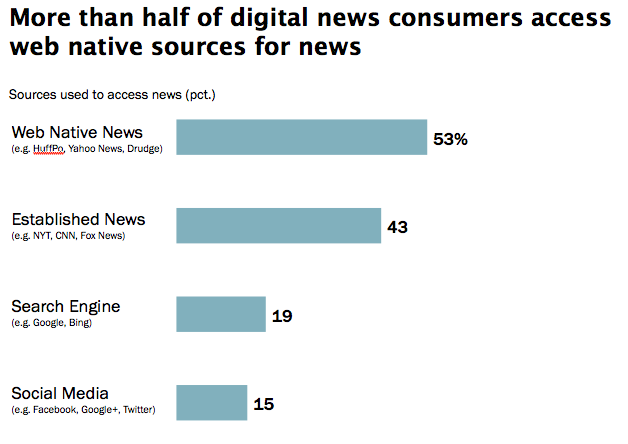
A majority (53 percent) of digital news consumers said they get information from Web-native sources, citing their convenience and accessibility. Only 43 percent regularly use traditional news sources for digital news, but they prefer it for in-depth reporting and trustworthiness.
Most digital news consumers now get information from Web-native sources like The Huffington Post, but they turn to “established” news outlets like the New York Times, CNN or Fox News for big events and mobile news, according to new research.
That is one finding from a national survey commissioned by The New York Times that examines the cross-platform behaviors of news consumers. Brian Brett, executive director of customer research, will present the findings today at the International Newsmedia Marketing Association’s Audience Summit in Chicago.
This data came from an online survey this spring by Knowledge Networks of 3,022 U.S. residents 18 to 65, weighted to match the general population. Eighty-five percent of the respondents qualified as “news consumers” who get some kind of news at least a few times a week.
A majority (53 percent) of digital news consumers said they get information from Web-native sources, citing their convenience and accessibility. Only 43 percent regularly use traditional news sources for digital news, but they prefer it for in-depth reporting and trustworthiness.
-
- Newer online outlets are more likely to be used as a daily news source.
- http://www.poynter.org/latest-news/top-stories/190586/new-data-show-shifting-patterns-as-people-seek-news-across-platforms/

Subscribe to:
Posts (Atom)