Monday Note reporting:
I used to think the breadth and depth of older large newsrooms could
guarantee their survival in a digital world plagued by mediocrity and
loose ethics. But considering great pure players like Quartz — which is
just the latest offspring of a larger league — I now come to think we
are witnessing the emergence of a new breed of smaller, digital-only
outlets that are closing the gap, quality-wise, with legacy media. In
the context of an increasingly segmented and short-on-time readership, I
can only wonder how long the legacy newsroom’s strategic advantage of
size and scope will last.
Quartz editorial staff has nothing to do with the low-paid, poultry farm
newsrooms of many digital outlets. Most of the 25 journalists and
editors (out a staff of 50) were drawn from well established brands such
as Bloomberg, The Economist, Reuters, New York Magazine or The Wall
Street Journal (Kevin Delaney, 41, is himself a former WSJ.com managing
editor). “Our staff is slightly younger than the average newsroom, and
it is steeped in the notion of entrepreneurial journalism”, says the
Quartz editor-in-chief. “With Quartz, we had many opportunity to rethink
the assumptions of traditional media”.
The original idea was to devise how The Economist would look like if it had been born in 2012 rather than in 1843,
explains Delaney. It would be digital native, mostly for mobile
reading, and focus on contemporary economic engines such as digital,
globalization, e-commerce, the future of energy, debt, China, etc.
Instead of abiding by the usual classification of business news that
looks like a nomenclature from the Bureau of Labor Statistics
(Industry, Services, Markets, Trade, etc.), Quartz opted for a sexier
taxonomy; its coverage is based on an evolving list of “Obsessions“, a much more cognitive-friendly way to consider the news cycle than the usual “beat” (read this on the matter). As an avid magazine reader, Delaney said he derived the idea from publications like New York
Magazine...
http://www.mondaynote.com/2013/10/06/the-quartz-way-1/?utm_source=MadMimi&utm_medium=email&utm_content=Monday+Note+%23292+-+The+Quartz+Way+-+Apple+Under+Siege&utm_campaign=20131006_m117465766_Monday+Note+%23292+-+The+Quartz+Way+-+Apple+Under+Siege&utm_term=The+Quartz+Way+_281_29
Showing posts with label enewspapers. Show all posts
Showing posts with label enewspapers. Show all posts
Sunday, October 6, 2013


Tuesday, July 23, 2013
How news organizations are experimenting with ‘digestible digital weeklies’ on mobile devices
Poynter reporting:
...
Hoping to seize on the advantages of both models while ditching the downsides, two venerable monthly magazine brands are experimenting with a third publishing option that’s somewhere in the middle: digestible digital weeklies.
Enter Esquire Weekly for iPad and The Atlantic Weekly for iPad and iPhone, launched in May and June, respectively....
With Esquire Weekly and The Atlantic Weekly, two monthly legacy print publications are trying different formulas for getting compact editions in front of readers with a frequency they can’t achieve in print and a level of curation they can’t achieve online. The two take different approaches to content selection, target audience and distribution, but what’s most important about these new initiatives is what they have in common: ease and frequency of delivery, tender editorial care, digestible length and, surely, low cost of production.
They’re also, crucially, products that could only work on the tablet...
http://www.poynter.org/latest-news/media-lab/mobile-media/218609/how-news-organizations-are-experimenting-with-digestible-digital-weeklies-on-mobile-devices/
...
Hoping to seize on the advantages of both models while ditching the downsides, two venerable monthly magazine brands are experimenting with a third publishing option that’s somewhere in the middle: digestible digital weeklies.
Enter Esquire Weekly for iPad and The Atlantic Weekly for iPad and iPhone, launched in May and June, respectively....
With Esquire Weekly and The Atlantic Weekly, two monthly legacy print publications are trying different formulas for getting compact editions in front of readers with a frequency they can’t achieve in print and a level of curation they can’t achieve online. The two take different approaches to content selection, target audience and distribution, but what’s most important about these new initiatives is what they have in common: ease and frequency of delivery, tender editorial care, digestible length and, surely, low cost of production.
They’re also, crucially, products that could only work on the tablet...
http://www.poynter.org/latest-news/media-lab/mobile-media/218609/how-news-organizations-are-experimenting-with-digestible-digital-weeklies-on-mobile-devices/
Saturday, April 27, 2013
Yes, The Times and Journal Are Sending You More Push Notifications
Ad Age reporting:
The country's two largest digital newspapers have been sending more push notifications to mobile readers lately, and not just because of the recent eruption in urgent national news.
The New York Times and the Wall Street Journal -- No. 1 and No. 2,
respectively, in terms of U.S. digital circulation, according to the
Alliance for Audited Media -- are putting more emphasis on using mobile
alerts to distribute breaking news stories and promote their mobile
apps.
News publishers have long considered push notifications, which pop up on phone and tablet screens, too intrusive to use more than sparingly. In recent months, however, The Journal and Times have reconsidered that stance and started using them more often.
"We felt comfortable that our breaking news alerts have been well-received by readers and that we may have been a little too stringent about what alerts we should have been sending," said Jonathan Ellis, deputy editor of digital platforms at The Times, which has revised its guidelines on the subject. "More frequently, we're asking ourselves the question 'Should this be a mobile push alert?'"
The change corresponds to in an increase in mobile readership at both newspapers. The Times more than doubled its number of unique visitors on iOS and Android devices over the last year, to 14.3 million in March from some 6 million in March 2012, according to comScore figures encompassing both app users and visitors on the mobile web. The Journal's mobile uniques increased to 4.6 million from from 2.1 million over the same time period.
http://adage.com/article/media/times-sending-push-notifications/241082/
The country's two largest digital newspapers have been sending more push notifications to mobile readers lately, and not just because of the recent eruption in urgent national news.
News publishers have long considered push notifications, which pop up on phone and tablet screens, too intrusive to use more than sparingly. In recent months, however, The Journal and Times have reconsidered that stance and started using them more often.
"We felt comfortable that our breaking news alerts have been well-received by readers and that we may have been a little too stringent about what alerts we should have been sending," said Jonathan Ellis, deputy editor of digital platforms at The Times, which has revised its guidelines on the subject. "More frequently, we're asking ourselves the question 'Should this be a mobile push alert?'"
The change corresponds to in an increase in mobile readership at both newspapers. The Times more than doubled its number of unique visitors on iOS and Android devices over the last year, to 14.3 million in March from some 6 million in March 2012, according to comScore figures encompassing both app users and visitors on the mobile web. The Journal's mobile uniques increased to 4.6 million from from 2.1 million over the same time period.
http://adage.com/article/media/times-sending-push-notifications/241082/
Saturday, March 30, 2013
“Post Classic”: The Washington Post integrates its print edition into a new iPad app
Nieman Journalism Lab:
What if you had an old-school newspaper newsroom where the digital producers were at the core of the operation, and the task of putting together the print newspaper was the side job?
The Washington Post’s Cory Haik, executive producer for digital news, says that’s “exactly what we are trying to do,” with the new iPad app the paper launched Monday as a step in that “one web” direction. (Disclosure: I freelance regularly for the Post.)
But the Post is also trying to find ways to bring along less digitally oriented readers. The new app includes a print replica edition — so you can still read the daily paper in its entirety from A1 to the back page — but with the display of each story still optimized for the tablet, rather than frozen in awkwardly static PDFs or in ungainly digital presentations. (The replica includes puzzles, comics, and Sunday magazine, plus a 14-day archive so you can dig back into recently published material.) Plenty of newspapers offer a replica edition for the iPad, but most are separate from their “traditional” iPad apps. (Can we say “traditional iPad app” yet?)
“The app features the new ‘Post Classic,’ which yes, is an entire replica of the broadsheet newspaper,” Haik told me in an email. “This was something users had been asking for since our first version of the iPad. They wanted the complete Washington Post. The mobile teams worked hard to create something that delivered across the board. It’s more than a PDF reader — we thought a lot about the UX and flow from the ‘Post Classic’ version into our iPad reading experience.”
http://www.niemanlab.org/2013/03/post-classic-the-washington-post-integrates-its-print-edition-into-a-new-ipad-app/
What if you had an old-school newspaper newsroom where the digital producers were at the core of the operation, and the task of putting together the print newspaper was the side job?
The Washington Post’s Cory Haik, executive producer for digital news, says that’s “exactly what we are trying to do,” with the new iPad app the paper launched Monday as a step in that “one web” direction. (Disclosure: I freelance regularly for the Post.)
But the Post is also trying to find ways to bring along less digitally oriented readers. The new app includes a print replica edition — so you can still read the daily paper in its entirety from A1 to the back page — but with the display of each story still optimized for the tablet, rather than frozen in awkwardly static PDFs or in ungainly digital presentations. (The replica includes puzzles, comics, and Sunday magazine, plus a 14-day archive so you can dig back into recently published material.) Plenty of newspapers offer a replica edition for the iPad, but most are separate from their “traditional” iPad apps. (Can we say “traditional iPad app” yet?)
“The app features the new ‘Post Classic,’ which yes, is an entire replica of the broadsheet newspaper,” Haik told me in an email. “This was something users had been asking for since our first version of the iPad. They wanted the complete Washington Post. The mobile teams worked hard to create something that delivered across the board. It’s more than a PDF reader — we thought a lot about the UX and flow from the ‘Post Classic’ version into our iPad reading experience.”
http://www.niemanlab.org/2013/03/post-classic-the-washington-post-integrates-its-print-edition-into-a-new-ipad-app/
Thursday, December 13, 2012
Financial Times now giving away free Nexus 7 tablets
TabTimes reporting:
The offer,
first detailed in the print newspaper today, will be offered to readers
signing up for a one-year digital or print subscription and will run
until December 17. The deal only applies to Google's 8GB Nexus 7 tablet,
which usually retails for $199.
A digital-only subscription to the FT starts at $447 per year, while annual access to both the print and digital editions comes in at $597.
Such news marks the second time a prominent newspaper has offered the Nexus 7 at a discounted rate, following a similar offer from The Times of the UK earlier this month.
http://tabtimes.com/news/media/2012/12/12/financial-times-now-giving-away-free-nexus-7-tablets
Just
weeks after British newspaper The Times started offering subsidized
Nexus 7 tablets and The Financial Times has gone one better by offering
Google’s tablet for free to print or digital subscribers in the U.S.
A digital-only subscription to the FT starts at $447 per year, while annual access to both the print and digital editions comes in at $597.
Such news marks the second time a prominent newspaper has offered the Nexus 7 at a discounted rate, following a similar offer from The Times of the UK earlier this month.
http://tabtimes.com/news/media/2012/12/12/financial-times-now-giving-away-free-nexus-7-tablets
Thursday, October 18, 2012
Mobile Rising: Newspapers, Magazine Readership, Ad Engagement Up
MediaDailyNews reporting:
More tablet owners are reading newspapers and magazines on their
devices, according to the latest data from comScore’s TabLens research
service, which is based on a
three-month rolling sample of 6,000 tablet owners; these findings, along
with new data from GfK MRI, hold out the promise of growing advertising
and circulation revenues from this burgeoning new
channel.
Overall, 11.5% of tablet owners -- a definition that includes iPad, Android tablets, Kindle Fire, and Nook -- said they read newspapers on their tablets “almost every day” or “at least once a week.” Some 14.6% said they read newspapers on their tablets one to three times a month, and 37.1% said they read newspapers on their tablets once a month.
Mark Donovan, comScore senior vice president for mobile,
noted that 7% of all newspaper page views now come from tablets. Turning
to magazines, 9.7% of all tablet owners said they read
magazines on their tablets almost every day, 13.3% at least once a week,
16.7% one to three times a month, and 39.6% once a month.Overall, 11.5% of tablet owners -- a definition that includes iPad, Android tablets, Kindle Fire, and Nook -- said they read newspapers on their tablets “almost every day” or “at least once a week.” Some 14.6% said they read newspapers on their tablets one to three times a month, and 37.1% said they read newspapers on their tablets once a month.
Tablet owners who read newspaper and magazine content tend to skew male, with newspaper audiences 17% more likely to be male than the average tablet owner, while magazine audiences were 11% more likely to be male.
More than half of tablet readers had a household income of $75,000 or more. Tablet readers also skewed younger, with adults ages 25-34 accounting for the largest share of newspaper and magazine readers: 27.4% and 28.2%, respectively.
GfK MRI Starch Digital found high engagement rates for digital advertising delivered to tablets or e-readers along with magazine content. The survey of 30,000 digital ads across 1,000 magazine issues from April-July of this year found 55% of digital magazine readers noted or read a digital ad on their tablet or e-reader.
Within this group, 52% (28.6% of the total) interacted with the ad as result, with 38% (20.9% of the total) touching or clicking the ad to expand it...
Tuesday, August 7, 2012
Denver Post’s new iPad app ‘advances how news apps should look’
Poynter reporting: Design expert Mario Garcia has high praise for the new iPad app launched by Digital First Media’s Denver Post.
“It advances how news apps should look like, it does not pretend to
look like a newspaper … Bravo. … a news app appearing today does not
need to remind us of the iconic newspaper look,” Garcia writes.

While that’s true, the app does carry over at least one old tradition from print — the comics.
“Comics have actually been a feature of our iPad platform since August 2011, and it’s consistently one of our top five sections,” Allen Klosowski, Digital First’s senior director of social media and mobile, told me by email. “We did have to clear separate licensing and integration hurdles, but it’s been worth it. We get a tremendous amount of positive feedback.”
http://www.poynter.org/latest-news/mediawire/183930/denver-posts-new-ipad-app-advances-how-news-apps-should-look

While that’s true, the app does carry over at least one old tradition from print — the comics.
“Comics have actually been a feature of our iPad platform since August 2011, and it’s consistently one of our top five sections,” Allen Klosowski, Digital First’s senior director of social media and mobile, told me by email. “We did have to clear separate licensing and integration hurdles, but it’s been worth it. We get a tremendous amount of positive feedback.”
http://www.poynter.org/latest-news/mediawire/183930/denver-posts-new-ipad-app-advances-how-news-apps-should-look
Wednesday, August 1, 2012
Scandinavian media hit by paywall craze
journalism.co.uk reporting:
Would you pay to read your local newspaper online?
An increasing number of Norwegian locals are gambling the answer to that question is yes.
Try reading a small local newspaper such as Hallingdölen , or a regional such Faedrelandsvennen, online and you will hit the paywall for most articles, save those on major news events, the traffic or those originating from newswires. At Norwegian local Möre-Nytt you have to pay if you want to read more than five articles.
Other local newspapers, such as several of those owned by Edda Media, a group in the process of being acquired by A-pressen from Mecom, are introducing so-called "plus models", where readers have to pay to access the "plus" area, which typically offers more features and in-depth articles, of the paper’s digital offering.
This is a model which Schibsted-owned tabloid Aftonbladet has been very successful with in Sweden. Aftonbladet however, is a national which boasts around 2.5 million readers on average each day. How come local newspapers have the audacity to attempt introducing a model pioneered by a market leader?...
In Denmark, it is the nationals who currently are leading the charge to introduce new payment models. Politiken.dk, has announced it will introduce a "soft" paywall, inspired by The New York Times, towards the end of this year.
Another Danish national, Jyllands-Posten (JP.dk) has said it is looking to introduce a payment model inspired by Le Monde’s more "plus-like" model where a lot of content is available for free online, but readers have to pay to access certain unique content.
Mecom-owned Berlingske, who owns national newspaper Berlingske Tidende, has experimented with various forms of user payment, and its national is also expected to launch a new digital payment model online this year.
"Newspapers in general have a weak position in Denmark", said Henrik Schultz, a Danish media analyst at Sparebanken1 Markets.
http://www.journalism.co.uk/news/scandinavian-media-hit-by-pay-wall-craze/s2/a549824/
Would you pay to read your local newspaper online?
An increasing number of Norwegian locals are gambling the answer to that question is yes.
Try reading a small local newspaper such as Hallingdölen , or a regional such Faedrelandsvennen, online and you will hit the paywall for most articles, save those on major news events, the traffic or those originating from newswires. At Norwegian local Möre-Nytt you have to pay if you want to read more than five articles.
Other local newspapers, such as several of those owned by Edda Media, a group in the process of being acquired by A-pressen from Mecom, are introducing so-called "plus models", where readers have to pay to access the "plus" area, which typically offers more features and in-depth articles, of the paper’s digital offering.
This is a model which Schibsted-owned tabloid Aftonbladet has been very successful with in Sweden. Aftonbladet however, is a national which boasts around 2.5 million readers on average each day. How come local newspapers have the audacity to attempt introducing a model pioneered by a market leader?...
In Denmark, it is the nationals who currently are leading the charge to introduce new payment models. Politiken.dk, has announced it will introduce a "soft" paywall, inspired by The New York Times, towards the end of this year.
Another Danish national, Jyllands-Posten (JP.dk) has said it is looking to introduce a payment model inspired by Le Monde’s more "plus-like" model where a lot of content is available for free online, but readers have to pay to access certain unique content.
Mecom-owned Berlingske, who owns national newspaper Berlingske Tidende, has experimented with various forms of user payment, and its national is also expected to launch a new digital payment model online this year.
"Newspapers in general have a weak position in Denmark", said Henrik Schultz, a Danish media analyst at Sparebanken1 Markets.
http://www.journalism.co.uk/news/scandinavian-media-hit-by-pay-wall-craze/s2/a549824/
Monday, May 14, 2012
Philadelphia Inquirer introduces augmented reality
News&Tech reporting:
When Philadelphia Inquirer readers opened their Sunday paper on May 6, they couldn’t readily see what was hiding under a handful of ads and editorial content — that is, unless they were looking with their tablet or smartphone.
That’s because the May 6 Inquirer marked the launch of the publisher’s use of “auras,” or augmented reality features, which allow readers to interact digitally with their paper.
The Inquirer is the first paper in the United States to use the technology, developed by HP unit Aurasma. The Aurasma AR software powers enhanced content, including video, audio and other features, across both iOS and Android devices.
“Augmented reality is not the first idea we had when thinking of ways to engage with our readers, but once we saw the Aurasma technology everything changed,” Philadelphia Media Network Chief Brand Officer Jerry Steinbrink said in a statement. “(It) gives us the capability to deliver interactive content through a customized app without investing heavily in technology, programming or production.”
Equally important, the service bridges the gap between digital and print. The app gives PMN another tool through which it can attract print subscribers while it enhances the value of the ink-on-paper Inquirer.
Finding ways
Publishers like PMN have fervently begun exploiting technologies that bridge the print-to-digital gap — using such enhancements as QR codes and digital watermarks — in a bid to keep their print products relevant within a generation that’s embraced smartphones and tablets.
It’s not the first time PMN dabbled in erasing the chasm. Last fall it began offering Archos Arnova Android tablets to consumers that were loaded with discounted subscriptions to The Inquirer and Philadelphia Daily News (see News & Tech, September/October 2011)...
https://newsandtech-dot-com.bloxcms.com/news/article_8e22d7cc-9adc-11e1-82d4-001a4bcf887a.html
When Philadelphia Inquirer readers opened their Sunday paper on May 6, they couldn’t readily see what was hiding under a handful of ads and editorial content — that is, unless they were looking with their tablet or smartphone.
That’s because the May 6 Inquirer marked the launch of the publisher’s use of “auras,” or augmented reality features, which allow readers to interact digitally with their paper.
The Inquirer is the first paper in the United States to use the technology, developed by HP unit Aurasma. The Aurasma AR software powers enhanced content, including video, audio and other features, across both iOS and Android devices.
“Augmented reality is not the first idea we had when thinking of ways to engage with our readers, but once we saw the Aurasma technology everything changed,” Philadelphia Media Network Chief Brand Officer Jerry Steinbrink said in a statement. “(It) gives us the capability to deliver interactive content through a customized app without investing heavily in technology, programming or production.”
Equally important, the service bridges the gap between digital and print. The app gives PMN another tool through which it can attract print subscribers while it enhances the value of the ink-on-paper Inquirer.
Finding ways
Publishers like PMN have fervently begun exploiting technologies that bridge the print-to-digital gap — using such enhancements as QR codes and digital watermarks — in a bid to keep their print products relevant within a generation that’s embraced smartphones and tablets.
It’s not the first time PMN dabbled in erasing the chasm. Last fall it began offering Archos Arnova Android tablets to consumers that were loaded with discounted subscriptions to The Inquirer and Philadelphia Daily News (see News & Tech, September/October 2011)...
https://newsandtech-dot-com.bloxcms.com/news/article_8e22d7cc-9adc-11e1-82d4-001a4bcf887a.html
Friday, March 30, 2012
ePaper editions: valuable news products, or just unnecessary?
sfnblog reporting:
The Boston Globe announced yesterday that it was following in the footsteps of other newspapers and launching an ePaper edition for online and print subscribers, according to boston.com. The ePaper version, which mirrors the format of the print paper, can be read on a laptop or downloaded as an app for smartphones and tablets, the article said.
The “replica edition” contains additional digital features such as page-turning, navigation scrolling and bookmarking, the article said. The new version also features a “text-to-speech” option, which can read selected articles or the entire newspaper aloud.
According to the description from the iTunes app store, users can choose a setting in which Apple Newsstand automatically downloads the paper daily, just like a print version would be delivered each day. The description also states that users can click on articles to access embedded links or share those articles on social networking sites such as Facebook and Twitter.
Subscribers can obtain the ePaper from bostonglobe.com or download the app from the iTunes store, while non-subscribers can purchase single issues for $0.99 or in-app subscriptions for $14.99 per month, the article said.
Globe publisher Christopher M. Mayer said in the article that the ePaper version is meant to complement the Globe’s other formats and make the paper available in areas where Internet access is not readily available, such as during flights.
“Part of the strategy is to introduce additional digital products that allow our readers to connect with our journalism in a variety of ways,” Mayer said. “We’re constantly looking at ways to increase the value of a Boston Globe subscription.”
NewspaperDirect, which uses its PressReader app to create ePaper versions of newspapers and magazines, produces the Boston Globe ePaper, in addition to versions by The New York Times, The Washington Post and The Chicago Tribune, the article said. PressReader produces more than 2,000 ePapers, according to the website.
http://www.sfnblog.com/2012/03/28/epaper-editions-valuable-news-products-or-just-unnecessary
The Boston Globe announced yesterday that it was following in the footsteps of other newspapers and launching an ePaper edition for online and print subscribers, according to boston.com. The ePaper version, which mirrors the format of the print paper, can be read on a laptop or downloaded as an app for smartphones and tablets, the article said.
The “replica edition” contains additional digital features such as page-turning, navigation scrolling and bookmarking, the article said. The new version also features a “text-to-speech” option, which can read selected articles or the entire newspaper aloud.
According to the description from the iTunes app store, users can choose a setting in which Apple Newsstand automatically downloads the paper daily, just like a print version would be delivered each day. The description also states that users can click on articles to access embedded links or share those articles on social networking sites such as Facebook and Twitter.
Subscribers can obtain the ePaper from bostonglobe.com or download the app from the iTunes store, while non-subscribers can purchase single issues for $0.99 or in-app subscriptions for $14.99 per month, the article said.
Globe publisher Christopher M. Mayer said in the article that the ePaper version is meant to complement the Globe’s other formats and make the paper available in areas where Internet access is not readily available, such as during flights.
“Part of the strategy is to introduce additional digital products that allow our readers to connect with our journalism in a variety of ways,” Mayer said. “We’re constantly looking at ways to increase the value of a Boston Globe subscription.”
NewspaperDirect, which uses its PressReader app to create ePaper versions of newspapers and magazines, produces the Boston Globe ePaper, in addition to versions by The New York Times, The Washington Post and The Chicago Tribune, the article said. PressReader produces more than 2,000 ePapers, according to the website.
http://www.sfnblog.com/2012/03/28/epaper-editions-valuable-news-products-or-just-unnecessary
Wednesday, March 28, 2012
The Guardian hits 4m daily unique user mark
newmediaage reporting:
The website has seen a 64.5% uplift since last year and a 12.7% increase since January, but it still trails behind Mail Online which has 5.7m unique daily users, according to the report.
The Guardian also saw an uplift in traffic to its mobile sites, which now see 640,220 average daily unique visitors, up 28% from last month and 182% year on year.
Mirror Online, which relaunched at the beginning of February (nma.co.uk 8 February 2012), saw average daily visitor numbers slump 25% during the month, which the publisher said was expected during the transition period.
Despite predicting a surge in visitor numbers following the relaunch of The Independent website in November (nma.co.uk 25 November 2011), numbers have remained fairly static, rising just 0.3% year-on-year to 622,910.
The Telegraph, which ranks third behind The Guardian in the audit, saw a 2% increase in daily uniques to 2.5m, while The Sun, which comes in fifth place, saw a 6.3% boost in daily visitors to 1.6m.
http://www.nma.co.uk/4000814.article?cmpid=NMAE12&cmptype=newsletter&email=true
The website has seen a 64.5% uplift since last year and a 12.7% increase since January, but it still trails behind Mail Online which has 5.7m unique daily users, according to the report.
The Guardian also saw an uplift in traffic to its mobile sites, which now see 640,220 average daily unique visitors, up 28% from last month and 182% year on year.
Mirror Online, which relaunched at the beginning of February (nma.co.uk 8 February 2012), saw average daily visitor numbers slump 25% during the month, which the publisher said was expected during the transition period.
Despite predicting a surge in visitor numbers following the relaunch of The Independent website in November (nma.co.uk 25 November 2011), numbers have remained fairly static, rising just 0.3% year-on-year to 622,910.
The Telegraph, which ranks third behind The Guardian in the audit, saw a 2% increase in daily uniques to 2.5m, while The Sun, which comes in fifth place, saw a 6.3% boost in daily visitors to 1.6m.
http://www.nma.co.uk/4000814.article?cmpid=NMAE12&cmptype=newsletter&email=true
Wednesday, March 14, 2012
Newspapers Look to Targeting, Video to Boost Flagging Revenues
emarketer reporting:
It’s not news that newspapers are having a harder time than they once did raking in the ad dollars. After years of more dramatic declines, eMarketer estimates that US spending on print newspaper advertisements will dip another 6% in 2012 to $19.4 billion. Digital ad sales for newspapers are doing better—they are expected to increase 11.4% this year—but will still account for only $3.7 billion, meaning that gains on the online side of the ledger will not yet balance out print’s losses.
March 2012 research from the Pew Project for Excellence in Journalism suggests that newspapers are bullish about online opportunities, however, seeing targeting and newer ad formats as important sources of incremental revenues.
More than nine in 10 US newspapers selling targeted online advertising believed that such ads would take in a greater share of digital revenue over the next year, and nearly as many respondents said the same for video ads. Most respondents, however, also reported that these two tactics represented only a minor portion of their ad sales effort—with more going toward other display and banner advertising or classifieds.
Mobile may also be a new bright spot for the print world. Between Q4
2010 and the same period in 2011, Pew reported, mobile ad revenues
climbed to nine times their earlier level as a percentage of total
digital revenues.
http://www.emarketer.com/Article.aspx?R=1008900&ecid=a6506033675d47f881651943c21c5ed4
It’s not news that newspapers are having a harder time than they once did raking in the ad dollars. After years of more dramatic declines, eMarketer estimates that US spending on print newspaper advertisements will dip another 6% in 2012 to $19.4 billion. Digital ad sales for newspapers are doing better—they are expected to increase 11.4% this year—but will still account for only $3.7 billion, meaning that gains on the online side of the ledger will not yet balance out print’s losses.
March 2012 research from the Pew Project for Excellence in Journalism suggests that newspapers are bullish about online opportunities, however, seeing targeting and newer ad formats as important sources of incremental revenues.
More than nine in 10 US newspapers selling targeted online advertising believed that such ads would take in a greater share of digital revenue over the next year, and nearly as many respondents said the same for video ads. Most respondents, however, also reported that these two tactics represented only a minor portion of their ad sales effort—with more going toward other display and banner advertising or classifieds.

http://www.emarketer.com/Article.aspx?R=1008900&ecid=a6506033675d47f881651943c21c5ed4
Monday, March 12, 2012
Germany Wants To Charge Search Engines To Use News Excerpts
paidcontent reporting:
As in the UK, Germany is proposing “normal” private re-users of web news article summaries be exempt from royalties. But, whilst the UK mechanism avoids charging Google (NSDQ: GOOG) News because it targets only pay-for news aggregators, Germany’s proposal mentions both search engines and news aggregators.
The debate over whether search engines should pay for the privilege of crawling and using excerpts has been a long-running one that Google has sought to contain on multiple fronts…
Belgian newspapers won a European court case forcing Google to stop excerpting stories, demanding a phenomenal €49 million in damages. They even sued the European Commission for the same thing.
Since then, Germany’s publishing industry has been lobbying lawmakers for action, too…
http://paidcontent.org/article/419-germany-wants-to-charge-search-engines-to-use-news-excerpts
Germany’s government wants search engines and news aggregators to pay news publishers for using pieces of their material.
Its coalition committee has resolved that a collecting society should charge royalties to re-publishers of news material.“The term of protection should be one year,” according to the committee.This could bring Germany in to line with the UK, where the Newspaper Licensing Agency (originally formed to charge royalties on photocopies of news clippings that are used commercially) now requires commercial news aggregators and their customers each pay a license to, respectively, process and receive summaries of newspapers’ online articles.
“Commercial traders out there such as search engines and news aggregators should pay a fee to the publishers in the future for the distribution of press products (such as newspaper articles) on the internet.”
As in the UK, Germany is proposing “normal” private re-users of web news article summaries be exempt from royalties. But, whilst the UK mechanism avoids charging Google (NSDQ: GOOG) News because it targets only pay-for news aggregators, Germany’s proposal mentions both search engines and news aggregators.
The debate over whether search engines should pay for the privilege of crawling and using excerpts has been a long-running one that Google has sought to contain on multiple fronts…
Belgian newspapers won a European court case forcing Google to stop excerpting stories, demanding a phenomenal €49 million in damages. They even sued the European Commission for the same thing.
Since then, Germany’s publishing industry has been lobbying lawmakers for action, too…
http://paidcontent.org/article/419-germany-wants-to-charge-search-engines-to-use-news-excerpts
Sunday, March 11, 2012
Financial Times to set up new 'live news' operation
Journalism.co.uk reporting:
The Financial Times is to create a new "live news desk" at the heart of the FT.com operation, tasked with providing a rapid response to breaking news stories including on live blogs and Twitter.
The project, which has been in the pipeline for some time, will be led by Ben Fenton who until now has been the title's media correspondent.
He will lead a team of reporters on the breaking news operation, the size of which has yet to be confirmed.
The initiative aims to provide a "more live response" to developing stories and get a well-written first version online quicker, while freeing up specialised reporters to develop a longer take on the story.
FT.com editor Robert Shrimsley told Journalism.co.uk: "We think it's a natural evolution in the development of our digital offering.
"I was really pleased that Ben could come and do this. It's really important to have experienced and well-regarded journalists doing this."
Fenton wrote on his blog: "I am finally moving on to a new role that the FT has been keeping warm for me for several months.
"I am going to be overseeing the creation of a new live news desk, with live-blogging, Tweeting and rolling news stories about world events and business news from around the world."
Fenton said he was meant to start the job last year, but the "extraordinary events" surrounding the phone-hacking story and the Leveson inquiry caused the launch to be postponed.
He added: "Now, it's been decided that if we wait, it could be years before this story slowed down, so I'm pressing on in this new role.
In other FT news, the publisher has been awarded the best mobile innovation award for for its web app at the Global Mobile Awards in Barcelona.
The HTML5 app, which launched last June, includes automatic content downloads and the ability to read offline and has attracted more than 1.7 million visitors, according to the group.
http://www.journalism.co.uk/news/financial-times-to-set-up-new-live-news-desk-/s2/a548144/
The Financial Times is to create a new "live news desk" at the heart of the FT.com operation, tasked with providing a rapid response to breaking news stories including on live blogs and Twitter.
The project, which has been in the pipeline for some time, will be led by Ben Fenton who until now has been the title's media correspondent.
He will lead a team of reporters on the breaking news operation, the size of which has yet to be confirmed.
The initiative aims to provide a "more live response" to developing stories and get a well-written first version online quicker, while freeing up specialised reporters to develop a longer take on the story.
FT.com editor Robert Shrimsley told Journalism.co.uk: "We think it's a natural evolution in the development of our digital offering.
"I was really pleased that Ben could come and do this. It's really important to have experienced and well-regarded journalists doing this."
Fenton wrote on his blog: "I am finally moving on to a new role that the FT has been keeping warm for me for several months.
"I am going to be overseeing the creation of a new live news desk, with live-blogging, Tweeting and rolling news stories about world events and business news from around the world."
Fenton said he was meant to start the job last year, but the "extraordinary events" surrounding the phone-hacking story and the Leveson inquiry caused the launch to be postponed.
He added: "Now, it's been decided that if we wait, it could be years before this story slowed down, so I'm pressing on in this new role.
In other FT news, the publisher has been awarded the best mobile innovation award for for its web app at the Global Mobile Awards in Barcelona.
The HTML5 app, which launched last June, includes automatic content downloads and the ability to read offline and has attracted more than 1.7 million visitors, according to the group.
http://www.journalism.co.uk/news/financial-times-to-set-up-new-live-news-desk-/s2/a548144/
Washington Post promotes sharing in FB
NetNewsCheck reporting: The Post’s social reader launched last September at Facebook’s F8
conference as a new platform experiment with a simple enough idea: Users
download the app and tap into a deep wellspring of content from The Washington Post
and a broad array of other media properties include Slate, the Daily
Beast and SB Nation. Each time the user reads a story, it’s published to
the user’s timeline and among his or circle of friends.
“You can see what your friends are reading on it and they can see what you’re reading,” said Vijay Ravindran, senior VP and chief digital officer at The Washington Post Co. “By creating that visibility into everyone’s reading, you find lots of interesting stories because they’re themed through the lens of what your friends have read.”
A unique quality of the app is that all of its content lives within its own interface, Ravindran said. The Post has full syndication rights to all of the social reader’s content, so the app isn’t sending readers off to outside links.
Having initially launched the app solely within Facebook, the Post recently opened more pathways to find it through the iTunes store and Android market, and Ravindran said that using the reader on a mobile device also keeps all of its full content through the single Facebook interface.
Straightforward enough, right? The Post takes the current tools for social sharing — all those buttons for Facebook, Twitter or other networks or email that users normally find attached to any news story — and instead embeds a growing virtual newsstand right into Facebook itself. The user reads something, and the message automatically gets sent up to the timeline.
 Friends see headlines they’re more likely to care about, users get convenience and the Post gets…?
Not money. Ravindran said that the Post has no plans to monetize the app for the moment, and nary a display ad pops up nor a revenue stream trickles through its interface.
“Right now we’re running an experiment to see if we can build a new type of engagement, a new audience to read our content, so the entire company is behind seeing this off and seeing how big it can be,” Ravindran said. “We know there will be good businesses behind it if we can build a great enough product with a large enough audience.”
But if the monetization schemes lay beyond the horizon, there is one thing that the social reader is garnering plenty of for the Post: Information. Internal metrics track every nuance of user behavior and access to users’ profiles serves up additional reams of information, kind of like the ultimate reader survey that keeps feeding more information with every click.
http://www.netnewscheck.com/article/2012/03/05/17341/washpo-app-nets-younger-demo-inside-fb
“You can see what your friends are reading on it and they can see what you’re reading,” said Vijay Ravindran, senior VP and chief digital officer at The Washington Post Co. “By creating that visibility into everyone’s reading, you find lots of interesting stories because they’re themed through the lens of what your friends have read.”
A unique quality of the app is that all of its content lives within its own interface, Ravindran said. The Post has full syndication rights to all of the social reader’s content, so the app isn’t sending readers off to outside links.
Having initially launched the app solely within Facebook, the Post recently opened more pathways to find it through the iTunes store and Android market, and Ravindran said that using the reader on a mobile device also keeps all of its full content through the single Facebook interface.
Straightforward enough, right? The Post takes the current tools for social sharing — all those buttons for Facebook, Twitter or other networks or email that users normally find attached to any news story — and instead embeds a growing virtual newsstand right into Facebook itself. The user reads something, and the message automatically gets sent up to the timeline.
Not money. Ravindran said that the Post has no plans to monetize the app for the moment, and nary a display ad pops up nor a revenue stream trickles through its interface.
“Right now we’re running an experiment to see if we can build a new type of engagement, a new audience to read our content, so the entire company is behind seeing this off and seeing how big it can be,” Ravindran said. “We know there will be good businesses behind it if we can build a great enough product with a large enough audience.”
But if the monetization schemes lay beyond the horizon, there is one thing that the social reader is garnering plenty of for the Post: Information. Internal metrics track every nuance of user behavior and access to users’ profiles serves up additional reams of information, kind of like the ultimate reader survey that keeps feeding more information with every click.
http://www.netnewscheck.com/article/2012/03/05/17341/washpo-app-nets-younger-demo-inside-fb
Alt weeklies eye an AP of their own with a content exchange
NiemanJournalismLab reporting: The Association of Alternative Newsmedia
is building out a kind of wire service to allow alternative news sites
to share content with each other — and maybe make some money.
The recently launched AltWeeklies Content Exchange lets papers like the Boston Phoenix, Minneapolis’ City Pages or Oakland’s East Bay Express swap stories, photos, video, or other interactive multimedia to bolster their coverage of national news. While AAN members will be able to use the material for free, outside news organizations — think newspapers, broadcast networks, or news sites — will be able to pay to license it. On a local level, the exchange would also create a platform for citizens and freelancers to offer (or sell) work to their local weekly. (Or another AAN member: The “N” switched from “Newsweeklies” to “Newsmedia” last summer, and the group has started admitting alternative online-only news sites.)
What AAN is trying to do is take advantage of scale — providing extra copy for its members as well as larger, mainstream outlets that don’t have the time or resources to cover the issues the weeklies specialize in. If the program proves successful it would not only increase the amount of journalism readers are exposed to, but it could contribute to papers revenue, said Tiffany Shackelford, executive director of the AAN.
http://www.niemanlab.org/2012/03/alt-weeklies-eye-an-ap-of-their-own-with-a-content-exchange/
The recently launched AltWeeklies Content Exchange lets papers like the Boston Phoenix, Minneapolis’ City Pages or Oakland’s East Bay Express swap stories, photos, video, or other interactive multimedia to bolster their coverage of national news. While AAN members will be able to use the material for free, outside news organizations — think newspapers, broadcast networks, or news sites — will be able to pay to license it. On a local level, the exchange would also create a platform for citizens and freelancers to offer (or sell) work to their local weekly. (Or another AAN member: The “N” switched from “Newsweeklies” to “Newsmedia” last summer, and the group has started admitting alternative online-only news sites.)
What AAN is trying to do is take advantage of scale — providing extra copy for its members as well as larger, mainstream outlets that don’t have the time or resources to cover the issues the weeklies specialize in. If the program proves successful it would not only increase the amount of journalism readers are exposed to, but it could contribute to papers revenue, said Tiffany Shackelford, executive director of the AAN.
http://www.niemanlab.org/2012/03/alt-weeklies-eye-an-ap-of-their-own-with-a-content-exchange/
Saturday, March 10, 2012
Revenge Of The Replicas - 70 UK Papers Hit iOS In One Go
paidcontent reporting:
Researchers Francois Nel and Oscar Westlund criticised publishers for poor mobile strategies which cannibalised their revenue by using mobile only to give away content via free mobile websites.
Archant, Newsquest and Gannett (NYSE: GCI) are going to iOS using PageSuite’s Dynamic App platform, which replicates the printed papers’ old page-turning experience for the touchscreen.
http://www.blogger.com/blogger.g?blogID=8672091774752856243#editor/target=post;postID=9159248859379706691
Historically slow to innovate their products and their
editorial for the digital age, a trio of UK regional news publishers is
this week taking its titles to iOS tablets and mobiles in their original
form.
- Archant of the east of England is debuting over 60 of its titles on iTunes Store’s Newsstand. Its Eastern Daily Press, Ipswich Star, Norwich Evening News and East Anglian Daily Times each launch app editions with a five-day trial, subsequent recurring subscriptions and free access to subscribers who purchased outside the app.
- Gannett’s Newsquest digital MD Roger Green tells paidContent: “There are five trial apps that are going to be used to test various pricing and sampling strategies and to identify whether there is any difference in appeal between the different types of Newsquest product on offer. The five test titles are: The Northern Echo, Brighton Argus, Daily Echo Sports Pink, Oxford Times and Sutton Guardian. All paid for except Sutton Guardian which is on offer for free.”
- Northcliffe’s Swansea-based daily South Wales Evening Post is launching with a 14-day free trial followed by tiered subscriptions of £6.99 for a month, £19.99 for three months, £37.99 for six months and £69.99 per year.
Researchers Francois Nel and Oscar Westlund criticised publishers for poor mobile strategies which cannibalised their revenue by using mobile only to give away content via free mobile websites.
Archant, Newsquest and Gannett (NYSE: GCI) are going to iOS using PageSuite’s Dynamic App platform, which replicates the printed papers’ old page-turning experience for the touchscreen.
http://www.blogger.com/blogger.g?blogID=8672091774752856243#editor/target=post;postID=9159248859379706691
Thursday, March 8, 2012
Papers Put Faith in Paywalls
WSJ reporting:
As more newspapers close the door on free access to their websites, some publishers are still waiting for paying customers to pour in.
The numbers of readers signing up so far suggest that at many papers, "paywalls" aren't about to reverse publishers' deteriorating finances. Yet the results aren't discouraging industry executives, who say their efforts are succeeding in shoring up the core print business after years of declines.
Tribune Co.'s Los Angeles Times as of Monday will begin charging for full online access. Publisher Gannett Co. also said it will join the ranks. Including them, about 10 major U.S. papers and several hundred smaller papers in the past year have said they are now or will soon limit full online access to subscribers who pay either for the print edition or for digital.
So far, the Star Tribune in Minneapolis has attracted 14,000 digital subscribers—equivalent to about 5.7% of its existing weekday print subscribers—since it started charging readers for its website in November. The Boston Globe has sold about 16,000 digital subscriptions, which include those for mobile devices, in the three months after it launched a paid website last fall, compared with its daily print circulation of about 200,000. Meanwhile, Newsday in New York had fewer than 1,000 paying digital subscribers two years after erecting an online paywall.
The industry has little choice but to keep trying. Over the past decade or so, with newspapers' content available free online, their finances have been devastated. Newspapers saw weekday circulation drop by nearly 10 million from 1999 to 2009, about 17% of the total, according to the Editor & Publisher International Yearbook. Print advertising revenue was cut almost in half in that period, according to the Newspaper Association of America.
The rate of decline has slowed recently, but online advertising revenue isn't growing nearly fast enough to make up for the erosion of print.
http://online.wsj.com/article/SB10001424052970203833004577251822631536422.html?mod=dist_smartbrief
As more newspapers close the door on free access to their websites, some publishers are still waiting for paying customers to pour in.
The numbers of readers signing up so far suggest that at many papers, "paywalls" aren't about to reverse publishers' deteriorating finances. Yet the results aren't discouraging industry executives, who say their efforts are succeeding in shoring up the core print business after years of declines.
Tribune Co.'s Los Angeles Times as of Monday will begin charging for full online access. Publisher Gannett Co. also said it will join the ranks. Including them, about 10 major U.S. papers and several hundred smaller papers in the past year have said they are now or will soon limit full online access to subscribers who pay either for the print edition or for digital.
So far, the Star Tribune in Minneapolis has attracted 14,000 digital subscribers—equivalent to about 5.7% of its existing weekday print subscribers—since it started charging readers for its website in November. The Boston Globe has sold about 16,000 digital subscriptions, which include those for mobile devices, in the three months after it launched a paid website last fall, compared with its daily print circulation of about 200,000. Meanwhile, Newsday in New York had fewer than 1,000 paying digital subscribers two years after erecting an online paywall.
The industry has little choice but to keep trying. Over the past decade or so, with newspapers' content available free online, their finances have been devastated. Newspapers saw weekday circulation drop by nearly 10 million from 1999 to 2009, about 17% of the total, according to the Editor & Publisher International Yearbook. Print advertising revenue was cut almost in half in that period, according to the Newspaper Association of America.
The rate of decline has slowed recently, but online advertising revenue isn't growing nearly fast enough to make up for the erosion of print.
http://online.wsj.com/article/SB10001424052970203833004577251822631536422.html?mod=dist_smartbrief
Monday, February 27, 2012
Washington Post steps into paid content with iPad app for politics news
Poynter reporting:
The new WP Politics iPad app, which launches Monday, marks The Washington Post’s most significant attempt yet to charge readers for digital content.
The Post’s website and most everything else it does digitally is free (ad-supported). The company tried charging a nominal $1.99 a year for its main iPhone app when it debuted in 2010, but made it free about a year ago. Its main Android app is free, along with Social Reader, Trove, and niche apps for Redskins news, D.C.-area transit and entertainment. (The only exception is a monthly fee to download Post stories to an e-reader.)
The new politics iPad app is also free to download and mostly free to use, supported by a persistent banner ad across the bottom of the screen. But users (even print subscribers) must pay $2.99 a month to access premium sections.
“We wanted to try a new business model for premium mobile content and kept the monthly fee low, leaving most of the in-depth content on the politics app free,” Beth Jacobs, the Post’s general manager of mobile, told me by email.
Free sections are top news, a candidates and issues guide, interactive maps with polls and voting results, historical election results and TV ads by state.
“The freemium model offers us an opportunity to engage a large audience of habitual users and present them with premium tools and features over time,” Jacobs said. “We believe that those who are passionate about politics will find value in our premium offerings.”
http://www.poynter.org/latest-news/media-lab/mobile-media/164435/washington-post-steps-into-paid-content-with-ipad-app-for-politics-news/
The new WP Politics iPad app, which launches Monday, marks The Washington Post’s most significant attempt yet to charge readers for digital content.
The Post’s website and most everything else it does digitally is free (ad-supported). The company tried charging a nominal $1.99 a year for its main iPhone app when it debuted in 2010, but made it free about a year ago. Its main Android app is free, along with Social Reader, Trove, and niche apps for Redskins news, D.C.-area transit and entertainment. (The only exception is a monthly fee to download Post stories to an e-reader.)
The new politics iPad app is also free to download and mostly free to use, supported by a persistent banner ad across the bottom of the screen. But users (even print subscribers) must pay $2.99 a month to access premium sections.
“We wanted to try a new business model for premium mobile content and kept the monthly fee low, leaving most of the in-depth content on the politics app free,” Beth Jacobs, the Post’s general manager of mobile, told me by email.
-
- The Insider’s Corner, which aggregates all the Post’s political blogs, is one of the sections that requires a $2.99 monthly subscription.
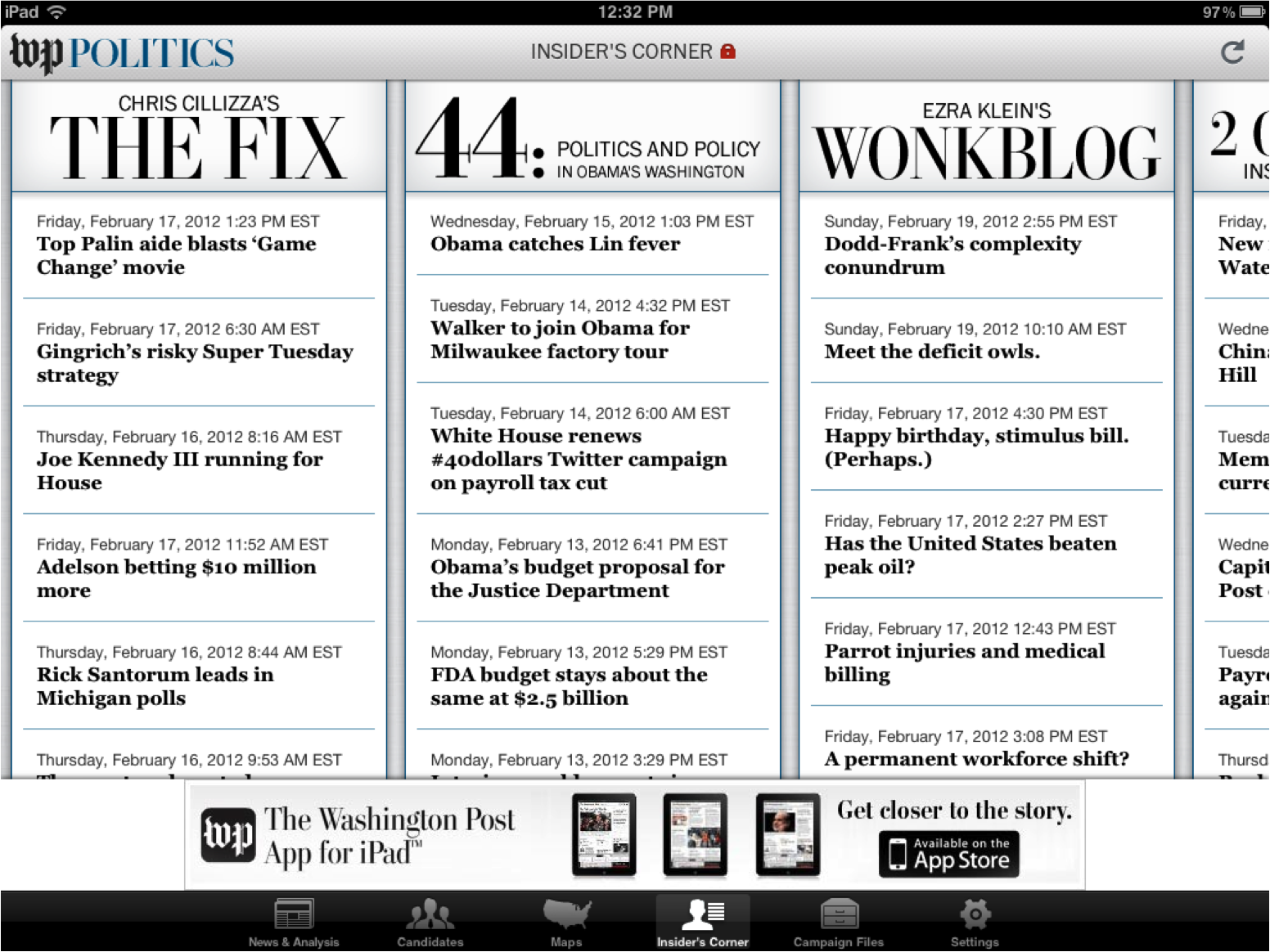
Free sections are top news, a candidates and issues guide, interactive maps with polls and voting results, historical election results and TV ads by state.
“The freemium model offers us an opportunity to engage a large audience of habitual users and present them with premium tools and features over time,” Jacobs said. “We believe that those who are passionate about politics will find value in our premium offerings.”
http://www.poynter.org/latest-news/media-lab/mobile-media/164435/washington-post-steps-into-paid-content-with-ipad-app-for-politics-news/
Los Angeles Times To Add Paywall
paidcontent reporting:
Kathy Thomson, president and COO of the LA Times Media Group, says the company “priced the digital subscription with the Sunday newspaper at a lower rate because they are complementary products.”
Access to the paper’s website through mobile phones and tablets remains free for now, but that will change in the future.
In a cost-cutting move, a new weekly lifestyle section launching March 10, “Saturday,” will combine the health, food and home sections, and “those sections will phase out as stand-alone portions of the paper by March 3 but will remain available online.”
According to the Audit Bureau of Circulations, the LAT has an average daily circulation of 572,998 (down 200,000 from two years ago, says the LAT) and the website has 34.8 million unique monthly visitors.
http://paidcontent.org/article/419-los-angeles-times-to-add-paywall/
It’s been a big week in newspapers starting to charge for content. First it was Gannett; now the Los Angeles Times will launch a metered paywall on Monday, March 5.
The paper announced
the changes today. Website visitors will be able to read 15 stories per
month for free before the paywall kicks in. They will be charged an
introductory rate of 99 cents for the first four weeks; thereafter, the
paper will charge $1.99 per week for a website-plus-Sunday-print-edition
package and $3.99 per month for website access only. The LA Times says
the digital subscription also includes “retail discounts, deals and
giveaways.”Kathy Thomson, president and COO of the LA Times Media Group, says the company “priced the digital subscription with the Sunday newspaper at a lower rate because they are complementary products.”
Access to the paper’s website through mobile phones and tablets remains free for now, but that will change in the future.
In a cost-cutting move, a new weekly lifestyle section launching March 10, “Saturday,” will combine the health, food and home sections, and “those sections will phase out as stand-alone portions of the paper by March 3 but will remain available online.”
According to the Audit Bureau of Circulations, the LAT has an average daily circulation of 572,998 (down 200,000 from two years ago, says the LAT) and the website has 34.8 million unique monthly visitors.
http://paidcontent.org/article/419-los-angeles-times-to-add-paywall/
Subscribe to:
Posts (Atom)