Showing posts with label ereading audience. Show all posts

Saturday, September 27, 2014

Look Away From This Graph, Book Lovers

Few people hold any illusions about the long-term — or even not-so-long-term — prognosis for paper books as a commercially viable product (hint: not good). But a new graph just released by the Bureau of Labor Statistics (hat tip to Catherine Rampell) shows just how dire the situation looks when you take into account age-related differences in reading, and therefore purchasing, habits. Kids these days are not into traditional books.
Take a look:

Monday, April 22, 2013

Why digital book publishers are starting to embrace data

paidContent reporting:
With more than 20 percent of Americans over the age of 16 having read an ebook in the past year, and publishers seeing more than 20 percent of revenues come from ebook sales, there’s no question the future of ebooks is bright, and the industry has a lot of potential customers.
But how exactly ebook publishers reach that audience and how the industry tracks who’s interested in reading what is less clear. A series of ebook publishers who spoke at our PaidContent Live conference in New York on Wednesday talked about the critical importance of gathering data on readership and consumption, and using it to transform the industry:
“The old eveolution of the book publishers used to be very allergic to data. And what you just heard is a very different approach from that. For us it’s about metadata and surfacing. And then rinse and repeat,” said Dominique Raccah, the publisher and CEO of Sourcebooks. “Metadata is a new term in our industry, but it really is the key.”
Raccah pointed out that unless publishers know who is reading the content, it’s hard to craft specific marketing messages or know what people respond to:
“It’s really important to know that book publishers know a lot about what touches readers,” she said. “So it’s important to help craft those messages in interesting ways.”
http://paidcontent.org/2013/04/17/why-digital-book-publishers-are-starting-to-embrace-data/?utm_source=General+Users&utm_campaign=7721b6a87b-c%3Amed+d%3A04-19&utm_medium=email

Saturday, January 26, 2013

5 interesting findings from Scholastic's report on digital reading among children


The New York Times reported yesterday that "Digital reading is rising fast among children ages 6 to 17, but this is not necessarily translating into a greater desire to read, according to a report released on Monday by Scholastic Inc.". Here are the most 10 interesting things you can learn from the report:

1. "The percentage of children who have read an e-book has almost doubled since 2010, to 46 percent." This is a pretty impressive figure comparing to the general share of ebooks in the book market, giving you a pretty good indication how common the use of ebooks will be in 10-15 years (like you didn't know..).

2. "During the same period, the number of girls who reported being frequent readers declined to 36 percent from 42 percent." - does it mean that the growing use of ebooks doesn't necessarily translate into reading more books in general? The answer might be found in the next finding.

3. Children "are increasingly using tablets, like iPads, which allow for more activities than just reading. In fact, slightly more children reported having read a book on a tablet than on a plain e-reader device." 
http://ecolibris.blogspot.fi/2013/01/5-interesting-findings-from-scholastics.html 

Tuesday, November 6, 2012

comScore: Kindle Fire has highest readership rates for digital magazines, newspapers

ZDNet reporting:
Tablets are "reinventing" Americans' relationship with print publications, according to a new report from digital business analytics firm comScore.
Based on new figures, more and more tablet owners in the United States are using their tablets to read digital periodicals on a daily basis. For example, comScore cited that approximately one in 10 tablet owners read digital magazines and/or newspapers on their devices everyday as of August 2012.
Mark Donovan, senior vice president of mobile at comScore, explained in the report that tablets are "redefining" how people consume news because the format is much more suited for long-form content than PCs or smartphones:
In the case of online newspapers, tablets are now driving 7 percent of total page views, an impressive figure considering the relative infancy of the tablet space. Publishers that understand how these devices are shifting consumption dynamics will be best positioned to leverage this platform to not only drive incremental engagement among current subscribers but also attract new readers.
But which devices they are using tends to factor in to which kinds of periodicals they are reading, how often they are reading and for the length of each reading session.
Here's a snapshot of which tablets seemed to be the most popular for a given purpose:

Thursday, October 18, 2012

Mobile Rising: Newspapers, Magazine Readership, Ad Engagement Up

MediaDailyNews reporting:
More tablet owners are reading newspapers and magazines on their devices, according to the latest data from comScore’s TabLens research service, which is based on a three-month rolling sample of 6,000 tablet owners; these findings, along with new data from GfK MRI, hold out the promise of growing advertising and circulation revenues from this burgeoning new channel.

Overall, 11.5% of tablet owners -- a definition that includes iPad, Android tablets, Kindle Fire, and Nook -- said they read newspapers on their tablets “almost every day” or “at least once a week.” Some 14.6% said they read newspapers on their tablets one to three times a month, and 37.1% said they read newspapers on their tablets once a month.
Mark Donovan, comScore senior vice president for mobile, noted that 7% of all newspaper page views now come from tablets. Turning to magazines, 9.7% of all tablet owners said they read magazines on their tablets almost every day, 13.3% at least once a week, 16.7% one to three times a month, and 39.6% once a month.

Tablet owners who read newspaper and magazine content tend to skew male, with newspaper audiences 17% more likely to be male than the average tablet owner, while magazine audiences were 11% more likely to be male.
More than half of tablet readers had a household income of $75,000 or more. Tablet readers also skewed younger, with adults ages 25-34 accounting for the largest share of newspaper and magazine readers: 27.4% and 28.2%, respectively.

GfK MRI Starch Digital found high engagement rates for digital advertising delivered to tablets or e-readers along with magazine content. The survey of 30,000 digital ads across 1,000 magazine issues from April-July of this year found 55% of digital magazine readers noted or read a digital ad on their tablet or e-reader.
Within this group, 52% (28.6% of the total) interacted with the ad as result, with 38% (20.9% of the total) touching or clicking the ad to expand it...

Thursday, October 11, 2012

Around the world, no set rules for ebook pricing or digital reading

paidContent reporting:
Which ebook trends are global and which are country-specific? Execs from Barnes & Noble, Kobo, Google, French retail chain FNAC and India’s Indiaplaza discussed similarities and differences at the CEO panel Wednesday afternoon at the Frankfurt Book Fair…
“Customers are going to pay for value. In the long term, we’re going to see ebooks worth something,” Michael Serbinis, CEO of Kobo, said. “We see a very healthy business.” As for changes in pricing models, “we just see them as fluctuations in this long-term evolution.”
Jamie Iannone, president of digital products at Barnes & Noble, agreed that “for quality works, customers are really willing to pay for ebooks”. “We [and publishers] have been sensitive to the value of the book,” he said, adding: “Even people that buy ebooks still read a lot of physical books – (which is) very different from other industries.”
Santiago de la Mora, director of print content partnerships for Google in Europe, the Middle East and Africa, said ebooks are just at the beginning of adding “tremendous additional value relative to the print book.” He mentioned functions like translations, locations, definitions and highlights (all of which are available in Google’s recently updated Play app for Android). “The ebook is a boon to the industry because, in some cases, it’s an enhanced product [over] print.”
Venkat Valliappan, head of books at Indian e-commerce site Indiaplaza.com, said ebook prices must remain low in India. “[International] publishers sell print books in India at [lower] prices and the same should be true for ebooks,” he said. The volume of Indian customers that international publishers will gain by keeping their ebook prices low “has to be given the utmost importance. That’s why the major publishers have accepted [lowered prices] in the past couple of years,” he said, claiming: “India has bailed out their business at an international level.”
Similarly, booksellers noted differences in the types of devices that consumers are looking for. “Our customers, when they’re frequent readers, just want e-readers. That’s very clear,” said Elodie Perthuisot, director of books at French bookstore chain FNAC. And she said they “don’t hesitate to spend thirty more euros to get the very new device. It’s not a matter of price, it’s a matter of content.
Valliappan, meanwhile, said “the majority of the Indian public are looking for multiple functions, not just an e-reader. E-reader companies should look at multiple functions.”
http://paidcontent.org/2012/10/11/around-the-world-no-set-rules-for-ebook-pricing-or-digital-reading/?utm_source=General+Users&utm_campaign=90a09f1667-c%3Amed+d%3A10-11&utm_medium=email

Wednesday, October 10, 2012

Rich Media The affluent still love print, but they spend more time online, with apps, games and social networks

The rich are just like the rest of us—they're spending more and more time glued to their screens, according to Ipsos Media CT's 2012 Mendelsohn Affluent Survey. Affluents' time online rose 14 percent in 2012 from 2011, as people spent more time doing things like social networking, shopping, using apps and playing games. The rich still do most of their communicating in person—averaging 13.6 hours per week—but that's declining as their use of electronic platforms becomes more widespread and time-consuming. Sixty-three percent of affluents connect on Facebook in a typical week, averaging 4.7 hours for the period. Twelve percent are on Twitter, averaging 6.8 hours, and 18 percent use LinkedIn, averaging 1.4 hours.
http://www.adweek.com/news/technology/data-points-rich-media-144083

Saturday, September 8, 2012

Forbes reporting:

Whether you like it or not, it’s now a tablet world — we just live in it.
According to a recent survey, one out of every five e-book readers use a Kindle Fire to read and almost as many use an iPad. Some 35% use a Kindle e-ink reader but the two leading tablets combined have now surpassed the older technology and will soon leave it in the dust. With the new Google Nexus 7 tablet rising and Barnes & Noble lowering prices on the Nook tablet, reader momentum toward the newer technology will only accelerate.
So, what does this mean for the book publishing world? At least two things:
1. The rise of e-books and e-reading might slow.
2. Publishers have to start thinking about content in new ways...
http://www.forbes.com/sites/jeremygreenfield/2012/08/14/the-new-tablet-reality-for-e-books-will-readers-read-less/ 

Friday, August 10, 2012

Holidaymakers prefer e-books: poll


People are putting paperbacks aside on holiday and reaching for e-books instead, according to a survey.
E-reading devices such as the Kindle are now the preferred way to get stuck into a good novel while on a break, the poll by travel agency www.sunshine.co.uk found.
A total of 1,928 UK adults who had been abroad on holiday in the last 12 months were surveyed.
Of those who had read while away, 51% had used an e-reader while 49% had opted for a traditional book.
E-readers were most popular among those aged 40 or more, with only 11% of 18-25-year-olds using them.
Of those who used an e-reader, 44% said it was easier to hold while 29% said it was easier to see in the sun.
Of those sticking with traditional books, 24% felt e-readers were too expensive while 46% said they "simply preferred books".
http://www.google.com/hostednews/ukpress/article/ALeqM5iW4cNTXiwYizumHhV_xpBX8DnaqA?docId=N0091351343557262687A

Tuesday, August 7, 2012

Uncovering Demographic Differences in Tablet Activities

eMarketer reporting:
eMarketer estimates there will be nearly 70 million tablet users in the US by the end of this year, an increase of more than 100% over 2011, and that robust penetration gains will continue annually through 2015. Currently, around one in five consumers in the country uses such a device at least once per month, but research indicates not all those users are created equal.
A March survey conducted for Adobe by Keynote Systems found the tablet activity mix varied significantly by age. For all tablet owners under age 50, playing games was the most common activity. For the youngest tablet owners, ages 18 to 29, this was followed by shopping, reading books and email.
Email had a much greater importance among 30- to 49-year-olds, who were about twice as likely to use their tablets for email purposes than were their younger counterparts. For 50- to 64-year-olds, email was the most common tablet activity overall, with this group nearly three times as likely than the youngest users to say it was their most common tablet activity.

Most Common Tablet Activity According to US Tablet Owners, by Age, March 2012 (% of respondents in each group)

Users in the 30-to-49 age group were more likely to favor reading books and less likely to shop via their tablets than either the younger or older groups. Viewing videos was most popular among the 50-to-64-year-old group.

Tuesday, July 10, 2012

The iPad becomes the evening newspaper

Romanesko reporting: he iPad and other tablets may prompt newspapers to start changing when they update content, reports Roger Fidler, program director of digital publishing at Reynolds Journalism Institute. Here’s why: His study found that tablet owners tend to use their devices more frequently at home after 5:00 p.m.
Fidler — the man who predicted an iPad-like device in 1994 — also found:
* Compared to a printed newspaper, 60% of large media tablet users and 50% of smartphone owners consider their experience consuming news on their mobile device to be better.
* Compared to watching news on TV, 63% of large media tablet owners and 46% of smartphone users favored watching on their mobile devices.
* Compared to listening to news on the radio, 73% of large media tablets said their experience was better, 59% of smartphone users favored their phone.
http://jimromenesko.com/2012/07/09/the-ipad-becomes-the-evening-newspaper/?utm_source=Daily+Buzz+from+eMedia+Vitals&utm_campaign=dcdfe6399e-_nb_DB_07-10-2012&utm_medium=email

Saturday, July 7, 2012

What Your E-Books Are Telling Companies About You

WSJ reporting:
Kobo, which makes digital reading devices and operates an e-reading service that stocks 2.5 million books and has more than 8 million users, has recently started looking at how readers as a whole engage with particular books and genres. The company tracks how many hours readers spend on particular titles and how far they get.
Kobo recently found, for example, that most readers who started George R.R. Martin’s fantasy novel “A Dance With Dragons” finished the book, and spent an average of 20 hours reading it, a relatively fast read for a 1,040-page novel. Readers tore through “Mockingjay,” the 400-page final book of Suzanne Collins’s dystopian trilogy, finishing in just over seven hours. Kobo also found, comparing fiction and nonfiction titles, that readers tend to spend longer chunks of time reading novels than humor or diet books.
Take a look at this chart on average reading prices and reading times (in hours).
http://blogs.wsj.com/speakeasy/2012/06/29/what-your-e-books-are-telling-companies-about-you/

Saturday, April 7, 2012

New Reports Chart the Rise of E-books

Publishers weekly reporting:
Two new reports released in the past 10 days document the e-book market’s rapid growth in the U.S. and the U.K., and suggest that a significant global spike is close at hand. Among the major takeaways from the “Bowker Market Research Global eBook Monitor” or GeM, study, e-books are beginning to show strong signs of life internationally, while in the U.S., the latest survey from the Pew Internet & American Life Project shows that one in five Americans now say they have read an e-book, and that e-book consumers read more books.
According to Bowker’s v-p of market research, Kelly Gallagher, the GeM data show that the two most developed e-book markets—the U.S. and the U.K.—are following a similar script. “It’s important to note the way in which the U.S. and U.K. markets have copied each other,” Gallagher said during a Webinar last week. “What we see in U.K. market is that they are where the U.S. was about two and a half to three years ago.”
That means the U.K. market is likely to see dramatic growth in the coming months. In the U.S., Gallagher pointed out, the e-book market took off in just a few short months—from October 2010 to January 2011—when e-books shot from 5% of the market to 13%, as the market in the U.K. was just getting started. “In the U.K. market, in December and January, we now see that same kind of hockey stick effect. So in the U.K. market, we see they are about a year behind the U.S. in terms of overall penetration into e-books.” The U.S. market, he added, has retreated from “exponential growth,” settling into more incremental growth, with e-books going from about 13% of the U.S. market to 19% in the past year.
The real action, meanwhile, looks to be in emerging new markets—especially India and Brazil. In all, the GeM study covered 10 countries, with Australia leading the way, with nearly 90% of the population using the Internet and 19% of the total population saying they have purchased an e-book. India, at the bottom, reported just 10% of the population online with 2% of the total Indian population having purchased an e-book. Still, India looks to be a major force, says Bowker’s Jo Henry, noting that India has a population of 1.2 billion, compared to 22 million in Australia, and that India has the greatest percentage of online users buying e-books in the survey. “Of the 10% of Indians online, 24% have purchased an e-book in the last six months,” Henry pointed out.
... Looking ahead, it gets even more interesting. When respondents were asked if they thought they would buy an e-book in the next six months, the data showed the more “mature” markets in Australia, the U.S., and U.K. could see growth as high as 50% over the remainder of 2012. “But we could see massive spikes in Brazil and India,” Henry observed.
http://www.publishersweekly.com/pw/by-topic/digital/retailing/article/51417-new-reports-chart-the-rise-of-e-books.html

Magazine readers resist e-reading inroads in Canada

CNW reporting:
TORONTO, April 4, 2012 /CNW/ - Canadian magazine readers remain loyal to the print versions of their favorite titles, with fewer than one in ten newsstand customers - and one in twenty women readers - having purchased an e-edition in the past year, according to a national survey.
"A strong majority of Canadian magazine readers still prefer a physical copy of their magazines over a digital format," concludes the survey, conducted by Leger Marketing for Periodical Marketers of Canada.
Nationwide, nine per cent of magazine readers reported having bought an electronic edition of a magazine, with 14 per cent planning to do so in the next year.  Seventy-one per cent of respondents said they prefer to read print magazines rather than electronic editions, citing the portability of magazines, the tactile experience of reading print, and ease of browsing.
In comparison, books have gained a larger electronic following, with the survey showing that 24 per cent of Canadians have bought an e-edition of a book in the past year.
The online survey of 1,583 Canadian magazine readers carried out in January 2012 identified women readers and residents of Quebec as having the strongest preference for print format magazines.
Those who have purchased e-editions of magazines also tend to be heavier print consumers. While 45 per cent of all respondents said they have bought a magazine at a newsstand in the past month, 56 per cent of those who have bought e-editions have also bought print copies.
John Harrington, editor of the industry newsletter New Single Copy, said "This is a landmark study which conclusively demonstrates the ongoing viability of print magazines, particularly the role they play in the retail marketplace."
While two of five Canadians have reduced their magazine purchases at newsstands in the past three years, most say this is for economic reasons stemming from the recession, not from a loss of interest in magazines. However, 14 per cent of women and 16 per cent of readers between 18 and 34 say they have actually increased their magazine purchases.
"The so-called doomsday scenario that has print magazines doomed to obscurity is just a myth," says Ray Argyle, executive director of PMC.
"The trend seems to point toward the purchase of single copies and away from mail subscriptions," he added. "Seventy per cent of over-65s have mail subscriptions compared to 45 per cent of those under that age, while many in the under-35 group are buying more, not fewer, magazines at the newsstand."
http://www.newswire.ca/en/story/950159/magazine-readers-resist-e-reading-inroads

Four key takeaways from Pew’s new e-reading study

paidcontent reporting:
E-reader and tablet owners read more books — print and digital — than people who don’t own those devices. In its new report, “The Rise of E-reading,” the Pew Internet & American Life Project finds that the average e-book reader read 24 books in the past 12 months, while the average non-e-book reader read 15 books. Overall, 41 percent of tablet owners and 35 percent of e-reader owners said they read more now that digital content is available.
Of those who own a dedicated e-reader (like Amazon Kindle or Barnes & Noble Nook), 49% are reading an e-book “on any given day” and 59% are reading a printed book. 39 percent of tablet owners are reading an e-book on any given day and 64 percent are reading a print book.
The longer people own an e-reader or tablet, the more likely they are to say that they are reading more: “45% of those who had owned an e-reader for more than a year said they were reading more, vs. 30% of those who had owned an e-reader for less than six months.”
Kindle is still the preferred e-reader, by far.
And iPad is still the preferred tablet, though Kindle Fire’s market share grew hugely after the holidays: from 5% in mid-December to 14% in mid-January...
http://paidcontent.org/2012/04/05/pew-e-reading-study-takeaway/

The Rise of eReading

ePubDirect reporting: Recent research by the Pew Research Center’s Internet and American Life Project that looked a the public’s general reading habits has shown up some stats in favour of eBooks.
2,986 Americans aged 16 and older were surveyed between November and December 2011 and further surveyed in January 2012 to demonstrate the shift in eBook adoption during the Christmas Holiday period.
Key Findings 
  • One fifth of American adults reported that they had read an eBook in the past yeaer- this percentage jumped 4% over the Christmas period.
  • 88% of those who read an eBook in the past 12 months also read printed books.
  • eBook readers read more books than printed book readers.
  • Ownership of original eBook reader, such as Kindle, jumped from 10% in December 2011 to 19% in January 2012.
  • 28% of Americans age 18 or older own at least one specialised device for eReading.
  • Those who read eBooks are more likely to be under age 50, have some college education and live in households earning more than $50,000.
When questioned about the types of eReading devices.  eBook reading happens across an array of devices, including smartphones. 42% read on a computer, 41% read on original ereading devices such as Nook or Kindle, 29% consume books on a mobile phone and 23% consume on a tablet device.
When it comes to format preferences:
“As a rule, dual-platform readers preferred eBooks when they wanted to get a book quickly, when they were traveling or commuting, and when they were looking for a wide selection. However, print was strongly preferred over e-books when it came to reading to children and sharing books with others. When asked about reading books in bed, the verdict was split: 45% prefer reading e-books in bed, while 43% prefer print.”

Some interesting trends and good insights into how reading is evolving. Read the full report from Pew Research here.
http://www.epubdirect.com/index.php/the-rise-of-ereading/

Monday, March 26, 2012

Uusi iPad on lukijan, ei kustantajan kaveri

Pekka Pekkala kolumni:
...Mutta vitsailu sikseen, koska nyt ollaan vakavan asian äärellä. Uusi, kolmas versio iPadista on täällä. Sen pitäisi pelastaa sanomalehdet ja journalismi taas kerran. Kustannusalan ulkopuolella iPad tunnetaan pääosin laitteena, joka pitää lapset hiljaisina lentokoneessa ja muissa tylsissä paikoissa. Mutta kustantajien mielestä iPad on jotain ihan muuta. Sen myötä lukijat ottavat itseään niskasta kiinni ja alkavat jälleen maksaa journalismista.
Tästä syystä myös jokaisen itseään kunnioittavan mediapomon laukusta löytyy iPad. Se on vähän kuin keski-ikäisenä ostettu ensimmäinen Harley-Davidson tai joogamatto (minulla on jälkimmäinen). Molemmat kantavat lupausta ikuisesta nuoruudesta. Valitettavasti kumpikaan ei tee sinusta välittömästi nuorta kapinallista tai notkeaa kettutyttöä. Pahimmassa tapauksessa niiden käyttö johtaa fysioterapiaan ja kuntoutukseen.
Sama pätee myös uuteen iPadiin. Toki se on lukulaitteena täysin käsittämättömän upea. Näyttö on niin tarkka, että siltä voi lukea täyttä Hesarin sivua zoomaamatta ja jopa kokonaisen broadsheet-aukeaman tekstistä saa selvää. Käyttöliittymä toimii kuin unelma, akku kestää pitkään ja mediatuotteiden ostaminen iTunesin kautta on vähän liiankin helppoa.
Vaikka teräväpiirtotelevisiota tarkemmalta näytöltä on kiva selailla lehtiä, perinteisten sanomalehtien pahin ongelma ei katoa mihinkään: suurin osa jutuista on joko vanhoja tai turhia. Kun kaikki oikeat uutiset on kerrottu jo edellispäivänä verkossa, kerran päivässä julkaistavan lehden teko muuttuu todella vaikeaksi. Jostain pitäisi keksiä kasapäin aiheita, jotka tuntuvat uutisilta, mutta eivät oikeasti ole sellaisia.
Erityisen surullinen esimerkki tästä on maailman toiseksi suurimman mediayhtiön News Corporationin luoma The Daily. Suurella kohulla julkaistu maksullinen digitaalinen lehti, jota voi lukea vain iPadilla. The Dailyä selatessa mieleen tulee vain yksi kysymys: miksi tämä on tehty? Minkä ihmeen tarpeen täyttää lehti, joka näyttää ja tuntuu lähinnä opiskelijoiden harjoitustyöltä? Se on täynnä satunnaisia juttuja sekalaisista aiheista, kivaa luettavaa ei-kenenkään tarpeisiin.
...Instapaper, Flipboard, Zite, Longform.org, Editions ja kotimainen Scoopinion ovat Facebookin ja Twitterin lisäksi palveluita, jotka kannattaa ladata uuden iPadin näytölle. Ne kertovat, mihin suuntaan iPadin kaltaiset laitteet ovat viemässä journalismin tulevaisuutta.
http://www.hs.fi/kotimaa/Uusi+iPad+on+lukijan+ei+kustantajan+kaveri/a1305558582753

Sunday, March 25, 2012

Mobile devices bolster 'lure of traditional news brands'

journalism.co.uk reporting: More than a quarter of Americans receive news via mobile devices, with digital news consumers "more likely" to access articles directly from a news website or app on a regular basis than from social media links, according to a US report.
The annual State of the Media report from the Pew Research Center's Project for Excellence in Journalism, now in its ninth year, found that 27 per cent of Americans surveyed receive news via a mobile device, which has been credited with "strengthening the bond with traditional news brands".
According to the report, which asked more than 3,000 adults in the US how news is accessed on digital devices, the highest amount of respondents (36 per cent) said they go direct to a news outlet's website or app "very often", which rises to 38 per cent when looking at tablet users alone.
This is compared to 9 per cent who said the same for accessing news via social media links.
A total of 32 per cent said they use search to access news "very often" while 29 per cent "use news organising sites like Topix or Flipboard".
When looking at the results for users on desktop/laptop computers, both access to news direct from a news site and via search achieved the same results with 30 per cent each.
The report also highlighted "the extent to which technology intermediaries now control the future of news"  and the "closer financial ties between technology giants and news".
http://www.journalism.co.uk/news/report-news-websites-and-apps-bigger-entry-point-than-social-media/s2/a548420/

Condé Nast Will Give Advertisers More Metrics On Tablet Editions

paidcontent reporting:
Months after it began testing a program that provided select advertisers with information about the readers of tablet editions, Condé Nast is rolling out the offering to all advertisers.
Data will be available for iPad, Kindle Fire and Nook editions of magazines. Advertisers will get the info about ten weeks after each issue comes out, AdAge reports, and here’s the data they’ll get:
“—The magazine’s paid tablet subscriptions and single-copy sales during the reporting period
—The number of readers that actually opened the issue’s tablet edition, including print subscribers using their complimentary digital access
—the total number of times that readers opened it
—and the time that readers spent with it”
Premium advertisers get extra info about engagement with their individual ads.
Advertisers may learn that readers of digital editions are not very different from their print-loving counterparts:
http://paidcontent.org/article/419-conde-nast-will-give-advertisers-more-metrics-on-tablet-editions/

Friday, March 23, 2012

Facebook users get news from family & friends, Twitter users get news from journalists

poynter reporting 19.3.2012:
Today’s annual report on the State of the News Media shows that new technologies really are pressing journalists to do much more with much less.
Last week, we learned that newspaper industry ad revenue was down 7.3 percent this year to its lowest level since 1984 (or 1954, adjusted for inflation). As a result, newsrooms continue to shrink.
But The Project For Excellence in Journalism’s report shows us that the needs and demands of the audience are growing and fragmenting.
Social media is an important source of news, the report says, but remains smaller and only “supplemental” to other discovery methods like directly visiting a news website, searching the Web or browsing an aggregator.
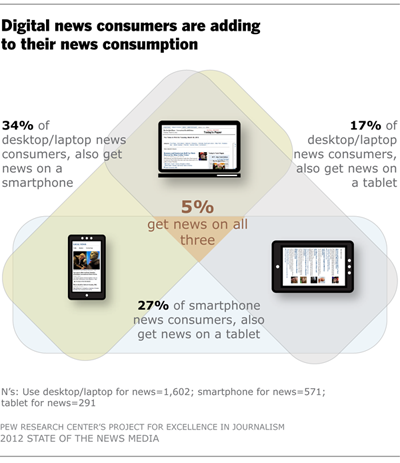
People who own smartphones or tablets are using them heavily to consume news, but they also continue to frequently use a laptop or desktop computer to get news.
People are adding devices while still consuming news on the older ones, which means journalists cannot ignore any platform, though they have fewer resources to serve any of them.
“Consumers are drawn to newer forms [of news consumption] and may even make them their primary mode,” the report says, “but they are not abandoning older forms altogether. Instead their news experience widens and deepens.”
http://www.poynter.org/latest-news/top-stories/166909/growing-social-mobile-audiences-force-journalists-to-publish-on-more-platforms-with-less/