NYT reporting: SAN FRANCISCO — Facebook, the largest social media network, published internal editorial guidelines on Thursday, the company’s latest attempt to rebut accusations that it is politically biased in the news content it shows on the pages of its 1.6 billion users. The 28-page document details how both editors and computer algorithms play roles in the process of picking what should appear in the “Trending Topics” section of users’ Facebook pages.Facebook describes a list of processes it uses to display some of the most popular content across the network, including relying on algorithms to detect up-and-coming news trends as well as a team of editors who, much like a newsroom, direct how those topics are presented and decide what should be displayed to people who regularly use the service.As the guidelines make clear, at practically every point in the process, a human editor is given the leeway to exercise his or her editorial influence.
http://www.nytimes.com/2016/05/13/technology/facebook-guidelines-trending-topics.html?_r=0
Showing posts with label aggregators. Show all posts
Showing posts with label aggregators. Show all posts
Sunday, May 15, 2016


Sunday, May 31, 2015
BuzzFeed's news is growing, but still a small part of its traffic
digiday reporting:
... In short, don’t tell Smith BuzzFeed is fluff: “Our mission’s to do great journalism and tell people about the world,” Smith proclaimed in an interview last year. Out of some 300 editorial staffers, 140 are devoted to news.
...But if the viral perception still sticks, it’s not without reason. BuzzFeed drew 76.7 million multiplatform unique visitors in April, according to comScore. The publisher historically hasn’t broken out its content by vertical to comScore, like other top news sites including CNN, Yahoo and The Huffington Post do. But it started to on a limited basis as of last month, when it began breaking out its Entertainment and Life coverage, which stand at 43.7 million and 20.1 million uniques, respectively. BuzzFeed doesn’t break out its news traffic, suggesting it’s still relatively low.
http://digiday.com/publishers/17-percent-buzzfeeds-traffic-goes-news/
... In short, don’t tell Smith BuzzFeed is fluff: “Our mission’s to do great journalism and tell people about the world,” Smith proclaimed in an interview last year. Out of some 300 editorial staffers, 140 are devoted to news.
...But if the viral perception still sticks, it’s not without reason. BuzzFeed drew 76.7 million multiplatform unique visitors in April, according to comScore. The publisher historically hasn’t broken out its content by vertical to comScore, like other top news sites including CNN, Yahoo and The Huffington Post do. But it started to on a limited basis as of last month, when it began breaking out its Entertainment and Life coverage, which stand at 43.7 million and 20.1 million uniques, respectively. BuzzFeed doesn’t break out its news traffic, suggesting it’s still relatively low.
http://digiday.com/publishers/17-percent-buzzfeeds-traffic-goes-news/
Wednesday, December 3, 2014
The fight to get Google to pay for news continues in Europe
NiemanLab reporting:
BERLIN — The European Union’s new commissioner for digital affairs didn’t waste any time. Days before starting the job at the end of October, Günther Oettinger (his official title is commissioner for digital economy and society) announced plans to reform European copyright law in 2015. That could mean introducing a levy on search engines when they show results for European companies, he said — a contested issue that’s been pushed by large news media companies from across Europe in recent months.
Oettinger has announced few details of his plans for copyright reform. But in an interview with the German daily newspaper Handelsblatt, he made it clear that he wants to tackle Google’s profits from listing European companies in search results. “If Google takes intellectual property from the EU and works with that, then the EU can protect that property and demand Google pay for that,” he said.
Copyright laws nicknamed “Google taxes” have been passed in a few European countries over the past few years. That name is deceptive — the laws don’t call for an actual tax since any fee Google is made to pay will go to publishers, not governments — but they have left Google at the center of legal battles driven by major publishers. Spain passed a law at the end of October that charges search engines to pay a copyright collection agency for including snippets from and links to news websites. In 2013, France’s government settled news publishers’ demands for copyright reform by striking a deal with Google: For a flat rate of €60 million (invested into a fund for digital publishing), the company was allowed to continue listing news articles in search results.
http://www.niemanlab.org/2014/12/the-fight-to-get-google-to-pay-for-news-continues-in-europe/
BERLIN — The European Union’s new commissioner for digital affairs didn’t waste any time. Days before starting the job at the end of October, Günther Oettinger (his official title is commissioner for digital economy and society) announced plans to reform European copyright law in 2015. That could mean introducing a levy on search engines when they show results for European companies, he said — a contested issue that’s been pushed by large news media companies from across Europe in recent months.
Oettinger has announced few details of his plans for copyright reform. But in an interview with the German daily newspaper Handelsblatt, he made it clear that he wants to tackle Google’s profits from listing European companies in search results. “If Google takes intellectual property from the EU and works with that, then the EU can protect that property and demand Google pay for that,” he said.
Copyright laws nicknamed “Google taxes” have been passed in a few European countries over the past few years. That name is deceptive — the laws don’t call for an actual tax since any fee Google is made to pay will go to publishers, not governments — but they have left Google at the center of legal battles driven by major publishers. Spain passed a law at the end of October that charges search engines to pay a copyright collection agency for including snippets from and links to news websites. In 2013, France’s government settled news publishers’ demands for copyright reform by striking a deal with Google: For a flat rate of €60 million (invested into a fund for digital publishing), the company was allowed to continue listing news articles in search results.
http://www.niemanlab.org/2014/12/the-fight-to-get-google-to-pay-for-news-continues-in-europe/
Sunday, November 2, 2014
Spain passes ‘Google tax’ allowing publishers to charge aggregators fee for displaying their content in search results
Talking NewMedia reporting:
The Spanish parliament is the latest to empower publishers to charge search engines a fee whenever they aggregate their online news content in search results. The law goes into effect on January 1.
The new law, Canon AEDE, is similar to efforts in other countries, namely Germany, where news organizations have lobbied to have laws passed that would require Google to pay publishers for displaying content. The problem, of course, is that Google simply says it will not pay, and will, if forced, eliminate the news content of publishers from their search result. The effect is the decrease the web traffic going to publishers, and therefore decreasing the money publishers make online.
http://www.talkingnewmedia.com/2014/10/30/spain-passes-google-tax-allowing-publishers-to-charge-aggregators-fee-for-displaying-their-content-in-search-results/?utm_source=API%27s+Need+to+Know+newsletter&utm_campaign=4c1de47613-Need_to_Know_October_31_201410_31_2014&utm_medium=email&utm_term=0_e3bf78af04-4c1de47613-31701933
The Spanish parliament is the latest to empower publishers to charge search engines a fee whenever they aggregate their online news content in search results. The law goes into effect on January 1.
The new law, Canon AEDE, is similar to efforts in other countries, namely Germany, where news organizations have lobbied to have laws passed that would require Google to pay publishers for displaying content. The problem, of course, is that Google simply says it will not pay, and will, if forced, eliminate the news content of publishers from their search result. The effect is the decrease the web traffic going to publishers, and therefore decreasing the money publishers make online.
http://www.talkingnewmedia.com/2014/10/30/spain-passes-google-tax-allowing-publishers-to-charge-aggregators-fee-for-displaying-their-content-in-search-results/?utm_source=API%27s+Need+to+Know+newsletter&utm_campaign=4c1de47613-Need_to_Know_October_31_201410_31_2014&utm_medium=email&utm_term=0_e3bf78af04-4c1de47613-31701933
Thursday, October 16, 2014
The new Vox daily email, explained
NiemanLab reprting:
Vox is focusing on delivering only a handful of top stories with a collection of the best links from around the web. So on any given day, Vox Sentences will serve up several main topics — say, Ebola, ISIS, and California’s “Yes Means Yes” law — with context provided by some of the day’s best writing. And, as the name implies, it’ll be direct — just a bunch of sentences. One thing that separates Vox’s newsletter from competitors is that it arrives at the end of the day, not the beginning. Instead of an 8 a.m. briefing, Vox is offering an 8 p.m. roundup.
...Vox Sentences would seem to share some DNA with BuzzFeed’s upcoming news app, both want to reach an audience of general news consumers who are looking for a smarter daily bundle of stories. Yes, a package — not unlike, say, the evening newspaper, timed for when people are at home and fiddling around on their phones or tablets. Klein says many of the stories you’ll find in the newsletter won’t be from Vox: “I don’t care if it drives traffic back to the site. I care if the people who read it feel well served by it,” Klein said.
http://www.niemanlab.org/2014/10/the-new-vox-daily-email-explained/
The old email newsletter continues its remarkable return to prominence. The latest move: Vox
wants to make explaining the news a little more manageable by telling
you everything you need to know in the comfort of your inbox.
Tomorrow, the site will launch Vox Sentences, its first daily email newsletter, with an aim at delivering both information and utility to readers. As email has become increasingly popular with publishers — not to mention built individual franchises for writers — the race is on to find ways to differentiate what you deliver.Vox is focusing on delivering only a handful of top stories with a collection of the best links from around the web. So on any given day, Vox Sentences will serve up several main topics — say, Ebola, ISIS, and California’s “Yes Means Yes” law — with context provided by some of the day’s best writing. And, as the name implies, it’ll be direct — just a bunch of sentences. One thing that separates Vox’s newsletter from competitors is that it arrives at the end of the day, not the beginning. Instead of an 8 a.m. briefing, Vox is offering an 8 p.m. roundup.
...Vox Sentences would seem to share some DNA with BuzzFeed’s upcoming news app, both want to reach an audience of general news consumers who are looking for a smarter daily bundle of stories. Yes, a package — not unlike, say, the evening newspaper, timed for when people are at home and fiddling around on their phones or tablets. Klein says many of the stories you’ll find in the newsletter won’t be from Vox: “I don’t care if it drives traffic back to the site. I care if the people who read it feel well served by it,” Klein said.
http://www.niemanlab.org/2014/10/the-new-vox-daily-email-explained/
Wednesday, September 3, 2014
Introducing The Most: trending stories from around the web, all in one place
WashPost reporting:
The Washington Post today introduces The Most, a new feature that lists the most popular stories from The Post and partner publications around the web. Readers can expect to find a mix of content on The Most, surfaced by a diverse group of readers from a variety of sites.
Katie Parker, The Post’s deputy director of digital products and design, put it this way: “Some stories in The Most will be breaking news, some will be blog posts, some will be long reads. All of them will be thought-provoking, sometimes surprising, must-reads.”
On The Most, you’ll find the stories other readers are clicking on. Popular reads from The Washington Post will be there, as will trending articles from partners like Time and The Atlantic, regional newspapers like The Denver Post and The Houston Chronicle, broadcasters like New York Public Radio and digital publications like Slate and The Dodo...
http://www.washingtonpost.com/pr/wp/2014/09/02/introducing-the-most-trending-stories-from-around-the-web-all-in-one-place/
The Washington Post today introduces The Most, a new feature that lists the most popular stories from The Post and partner publications around the web. Readers can expect to find a mix of content on The Most, surfaced by a diverse group of readers from a variety of sites.
Katie Parker, The Post’s deputy director of digital products and design, put it this way: “Some stories in The Most will be breaking news, some will be blog posts, some will be long reads. All of them will be thought-provoking, sometimes surprising, must-reads.”
On The Most, you’ll find the stories other readers are clicking on. Popular reads from The Washington Post will be there, as will trending articles from partners like Time and The Atlantic, regional newspapers like The Denver Post and The Houston Chronicle, broadcasters like New York Public Radio and digital publications like Slate and The Dodo...
http://www.washingtonpost.com/pr/wp/2014/09/02/introducing-the-most-trending-stories-from-around-the-web-all-in-one-place/
Monday, October 21, 2013
Flipboard says that it really wants to help publishers, not take advantage of them
gigaoma reporting:
he problem is that there are several different Flipboards: there’s the one that users (including me) love because it allows them to essentially create their own magazine out of RSS feeds, Twitter lists, Facebook and Flickr pages, and pretty much anything else that comes along. Then there’s the Flipboard some publishers see: the one that takes their content and reproduces it, and in some cases sells ads around it — all things that publishers believe only they should be doing. And finally, there’s Flipboard’s own vision of itself, which is as a partner for media companies, not a competitor.
One of the biggest issues for Flipboard when it comes to making peace with publishers is that its reach currently exceed its grasp. It wants to help more media companies monetize their content — the way it is already doing for a number of magazines, including some Conde Nast titles (although Wired and the New Yorker stepped back from the service last year) — but it is still a relatively small company, and doesn’t have the kind of infrastructure it needs to run an ad network.
Presumably, that’s one of the things that it will be doing with the $50 million in funding it just raised. And Marshall said his latest update that he is willing to reconsider his withdrawal from the service if Flipboard figures out a way to offer him the same kind of advertising-related income it says larger partners are getting:
...
The biggest selling point for Flipboard is that content that appears inside the app looks great — in many cases, better than it does on the publisher’s own website — and that includes advertising. It looks very much like a printed magazine, which is kind of the whole point. McCue’s pitch is that this allows for a form of large-scale display ad that very few online publications are doing, and that this will help take advertising back to what it was in the good old days of magazine publishing, which will ultimately result (and allegedly is resulting for some) in sharply higher revenue...
...The biggest selling point for Flipboard is that content that appears inside the app looks great — in many cases, better than it does on the publisher’s own website — and that includes advertising. It looks very much like a printed magazine, which is kind of the whole point. McCue’s pitch is that this allows for a form of large-scale display ad that very few online publications are doing, and that this will help take advertising back to what it was in the good old days of magazine publishing, which will ultimately result (and allegedly is resulting for some) in sharply higher revenue...http://gigaom.com/2013/10/19/flipboard-says-that-it-really-wants-to-help-publishers-not-take-advantage-of-them/?utm_source=General+Users&utm_campaign=7a601bfdc8-c%3Amed+d%3A10-21&utm_medium=email&utm_term=0_1dd83065c6-7a601bfdc8-99152541
he problem is that there are several different Flipboards: there’s the one that users (including me) love because it allows them to essentially create their own magazine out of RSS feeds, Twitter lists, Facebook and Flickr pages, and pretty much anything else that comes along. Then there’s the Flipboard some publishers see: the one that takes their content and reproduces it, and in some cases sells ads around it — all things that publishers believe only they should be doing. And finally, there’s Flipboard’s own vision of itself, which is as a partner for media companies, not a competitor.
One of the biggest issues for Flipboard when it comes to making peace with publishers is that its reach currently exceed its grasp. It wants to help more media companies monetize their content — the way it is already doing for a number of magazines, including some Conde Nast titles (although Wired and the New Yorker stepped back from the service last year) — but it is still a relatively small company, and doesn’t have the kind of infrastructure it needs to run an ad network.
Presumably, that’s one of the things that it will be doing with the $50 million in funding it just raised. And Marshall said his latest update that he is willing to reconsider his withdrawal from the service if Flipboard figures out a way to offer him the same kind of advertising-related income it says larger partners are getting:
...
The biggest selling point for Flipboard is that content that appears inside the app looks great — in many cases, better than it does on the publisher’s own website — and that includes advertising. It looks very much like a printed magazine, which is kind of the whole point. McCue’s pitch is that this allows for a form of large-scale display ad that very few online publications are doing, and that this will help take advertising back to what it was in the good old days of magazine publishing, which will ultimately result (and allegedly is resulting for some) in sharply higher revenue...
...The biggest selling point for Flipboard is that content that appears inside the app looks great — in many cases, better than it does on the publisher’s own website — and that includes advertising. It looks very much like a printed magazine, which is kind of the whole point. McCue’s pitch is that this allows for a form of large-scale display ad that very few online publications are doing, and that this will help take advertising back to what it was in the good old days of magazine publishing, which will ultimately result (and allegedly is resulting for some) in sharply higher revenue...http://gigaom.com/2013/10/19/flipboard-says-that-it-really-wants-to-help-publishers-not-take-advantage-of-them/?utm_source=General+Users&utm_campaign=7a601bfdc8-c%3Amed+d%3A10-21&utm_medium=email&utm_term=0_1dd83065c6-7a601bfdc8-99152541
Saturday, March 30, 2013
New Flipboard: News and Posts Handpicked and Shared
All Things D reporting:
One of the best ways of following topics that are interesting to you is Flipboard, a popular app for Apple and Android mobile devices that automatically turns social-network posts and news from online publications into beautiful, magazine-like pages you “flip” through by swiping.
Now, a new second generation of Flipboard, out Tuesday, is extending the app so it allows users to create and share their own handsome digital magazines with a few clicks and without any design talent required. If you make your magazine public, anyone with Flipboard, which is a free app, can read it and comment on it.
I’ve been testing this new version of Flipboard, which has some other improved features, over the past week or so, on several iPads and an iPhone. My verdict is the new features make a great mobile app even better. There are some limitations to the new capabilities, but they make your mobile device more personal and more of a creative tool, rather than just a means of consumption. For now, the new version is only available for Apple’s devices, but an Android edition is in the works.
http://allthingsd.com/20130326/new-flipboard-news-and-posts-handpicked-and-shared/
One of the best ways of following topics that are interesting to you is Flipboard, a popular app for Apple and Android mobile devices that automatically turns social-network posts and news from online publications into beautiful, magazine-like pages you “flip” through by swiping.
Now, a new second generation of Flipboard, out Tuesday, is extending the app so it allows users to create and share their own handsome digital magazines with a few clicks and without any design talent required. If you make your magazine public, anyone with Flipboard, which is a free app, can read it and comment on it.
I’ve been testing this new version of Flipboard, which has some other improved features, over the past week or so, on several iPads and an iPhone. My verdict is the new features make a great mobile app even better. There are some limitations to the new capabilities, but they make your mobile device more personal and more of a creative tool, rather than just a means of consumption. For now, the new version is only available for Apple’s devices, but an Android edition is in the works.
http://allthingsd.com/20130326/new-flipboard-news-and-posts-handpicked-and-shared/
Thursday, August 30, 2012
Three billion flips later, Flipboard turns to video
paidcontent reporting:
Tablet content aggregators like Flipboard and Zite have found favor by re-imagining modern web text as linear pages of ye olde magazines. But can the same paradigm work for other online content?
Flipboard on Wednesday launched what it is calling “TV” channels – curated sections of its Content Guide sidebar that include only videos, no text, culled from popular YouTube channels.
In one way, this is nothing new – articles read through Flipboard can already contain videos. What is notable is that Flipboard is making a specific play for audiovisual content inside its magazine-like applications.
How well this will work remains to be seen. On my iPad 2, Flipboard presents videos fractionally more sluggishly than outside; orientation rotation is noticeably slower.
Most of all, will people associate video with the page-turning paradigm of Flipboard’s retro-magazine aesthetic? Perhaps so – the swipe and flip interaction is characteristic of tablets in their entirety, not just magazine-like apps that run on them.
With its “TV” channels, Flipboard may get to do for video publishers like Chow.com, TED Talks and Pitchfork TV what it is doing for web text publishers. More importantly, it shows Flipboard beginning to mature and diversify.
http://paidcontent.org/2012/08/29/three-billion-flips-later-flipboard-turns-to-video/
Tablet content aggregators like Flipboard and Zite have found favor by re-imagining modern web text as linear pages of ye olde magazines. But can the same paradigm work for other online content?
Flipboard on Wednesday launched what it is calling “TV” channels – curated sections of its Content Guide sidebar that include only videos, no text, culled from popular YouTube channels.
In one way, this is nothing new – articles read through Flipboard can already contain videos. What is notable is that Flipboard is making a specific play for audiovisual content inside its magazine-like applications.
How well this will work remains to be seen. On my iPad 2, Flipboard presents videos fractionally more sluggishly than outside; orientation rotation is noticeably slower.
Most of all, will people associate video with the page-turning paradigm of Flipboard’s retro-magazine aesthetic? Perhaps so – the swipe and flip interaction is characteristic of tablets in their entirety, not just magazine-like apps that run on them.
With its “TV” channels, Flipboard may get to do for video publishers like Chow.com, TED Talks and Pitchfork TV what it is doing for web text publishers. More importantly, it shows Flipboard beginning to mature and diversify.
http://paidcontent.org/2012/08/29/three-billion-flips-later-flipboard-turns-to-video/
Sunday, July 8, 2012
A Flipboard first: News app to carry full content of New York Times
Digital Trends reporting:
In a joint statement, the NYTimes said the move signalled the launch of its NYTimes Everywhere strategy, which aims to bring the newspaper’s content to users through third-party apps. NYTimes subscribers, who can currently view all of the publication’s content via its website and app, will now have the additional option of using Flipboard.
In an interview posted on the NYTimes’ Bits blog, Denise F. Warren, general manager of the newspaper’s website, said the deal with Flipboard was the right thing to do as the paper heads in the direction of digital subscriptions.
“We realized that we have an opportunity to enable this kind of access for paying subscribers, and we thought it was something we ought to try, and see how users react to it,” she said.
For Flipboard it could be the start of something big, as the collaboration marks the first time the company has been able to bring premium content to its users.
Flipboard has struck a deal with its first
major publisher to bring premium content to its popular news reading
app. The partnership gives subscribers to the New York Times another
option for viewing content alongside the publication's app and website.
The
New York Times and Flipboard announced late Sunday that from Thursday
all content from the prominent newspaper will be available to NYTimes
subscribers through Flipboard, the news reading app that allows users to
read content in an attractive magazine-style format.In a joint statement, the NYTimes said the move signalled the launch of its NYTimes Everywhere strategy, which aims to bring the newspaper’s content to users through third-party apps. NYTimes subscribers, who can currently view all of the publication’s content via its website and app, will now have the additional option of using Flipboard.
In an interview posted on the NYTimes’ Bits blog, Denise F. Warren, general manager of the newspaper’s website, said the deal with Flipboard was the right thing to do as the paper heads in the direction of digital subscriptions.
“We realized that we have an opportunity to enable this kind of access for paying subscribers, and we thought it was something we ought to try, and see how users react to it,” she said.
For Flipboard it could be the start of something big, as the collaboration marks the first time the company has been able to bring premium content to its users.
Monday, April 30, 2012
AOL Launches Big Video News Video Portal with AP, BBC, Reuters, Wall Street Journal, others
AOL Video/HuffPost Media, has become a major player in video news,
passing both CBS News and Fox News in video views, according to February comScore numbers.
The company has achieved this heft by syndicating videos from outside news sources through its platform. Demand for the videos have come largely from the Huffington Post and hundreds of other publishing partners who seek news videos on their pages.
Last week, as part of the introduction of a new video portal strategy, AOL Video, now known as AOL On, introduced 14 public-facing channels including one for news. The content partners include the the AP, BBC, Reuters, the Wall Street Journal and several smaller video news producers (including Beet.TV).
While the these big news sources sufface videos on their own sites, on YouTube and other places on the Web, AOl On has positioned itself as sort of next generation news syndicator, a new kind "AP or Reuters" for Web news, says Ran Harnevo, SVP, Video for AOL On, in this interview with Beet.TV.
http://www.beet.tv/2012/04/aolnewsvideo-harnevo.html?utm_source=feedburner&utm_medium=email&utm_campaign=Feed%3A+BeetTV+%28Beet.TV%29
The company has achieved this heft by syndicating videos from outside news sources through its platform. Demand for the videos have come largely from the Huffington Post and hundreds of other publishing partners who seek news videos on their pages.
Last week, as part of the introduction of a new video portal strategy, AOL Video, now known as AOL On, introduced 14 public-facing channels including one for news. The content partners include the the AP, BBC, Reuters, the Wall Street Journal and several smaller video news producers (including Beet.TV).
While the these big news sources sufface videos on their own sites, on YouTube and other places on the Web, AOl On has positioned itself as sort of next generation news syndicator, a new kind "AP or Reuters" for Web news, says Ran Harnevo, SVP, Video for AOL On, in this interview with Beet.TV.
http://www.beet.tv/2012/04/aolnewsvideo-harnevo.html?utm_source=feedburner&utm_medium=email&utm_campaign=Feed%3A+BeetTV+%28Beet.TV%29
Wednesday, April 25, 2012
Read Offline: News.me Automatically Downloads Your News Whenever You Leave Home
TechCrunch reporting:
News.me, the newsreader app hatched in The New York Times’ R&D lab and incubated at betaworks, today added a nifty feature to its new iPhone app,
which gives readers instant access to their news offline — whenever
they leave the house. The new feature, called Paper Boy, allows users to
set their home location using their iPhone’s GPS, and thereafter, every
time they leave their digs with phone in tow, News.me automatically
downloads their social news in the background so that it’s ready to read
offline as they go about their day. For anyone who uses public transit to get to work and is as as a result without WiFi, PaperBoy’s value proposition should be immediately apparent. While there are hundreds of ways to check news sources, many of them only offer their content when connected to the Web. News.me General Manager Jake Levine tells us that, since News.me is located in New York City, the team often uses the city’s subway system to get around, but found themselves without anything to read while in transit.
Paper Boy was designed to eliminate this pain point, and provide subway, bus, and train commuters instant access to their news while on-the-go. Outside of Newsstand apps, Levine says that News.me is the first app to offer this functionality — to support background downloading of news content whenever readers leave their home addresses.
In the beginning, News.me’s social newsreading experience was iPad-only, offering readers an aggregated list of news stories drawn from Facebook and Twitter, curated based on signals from Twitter and bit.ly, viewable in the context of the original tweet or Facebook comment. The startup also offers a Summify-like email digest of news culled from users’ Twitter streams, which picked up quite a few users in the wake of Summify’s acquisition.
http://techcrunch.com/2012/04/22/read-offline-news-me-automatically-downloads-your-news-whenever-you-leave-home/?utm_source=Daily+Buzz&utm_campaign=4271441433-_nb_DB_04-25-2012&utm_medium=email
Monday, March 19, 2012
A push for aggregation standards
Nieman Journalism Lab reporting:
Looking for aggregation standards: In response to the dozens of dust-ups over the proper way to aggregate others’ work online over the past few years, a new group has formed to establish some standards guiding the practice of pulling and drawing on others’ writing. The group, called the Council on Ethical Blogging and Aggregation, was announced by Advertising Age’s Simon Dumenco at the South by Southwest Interactive festival and given a shot of publicity in a column by the New York Times’ David Carr.
The group is still in its early stages, but according to Carr, it may end up with some of seal of approval for sites that abide by the standards it comes up with. Its members insisted they weren’t anti-aggregation, but simply want to bring some order to a practice that’s been chaotic and contentious. Dumenco explained his aims in a bit more depth in a Poynter chat as well.
Carr’s column also highlighted a similar effort by Maria Popova, who runs the creatively aggregated site Brain Pickings, to introduce what she calls The Curator’s Code, two new symbols to indicate whether you discovered a piece of content directly or indirectly. As The Atlantic’s Megan Garber explained, behind the code lies the idea that curation — the ability to combine pieces of content together in a creative and compelling way — is a form of intellectual labor and even art, something that should be honored through honest attribution.
The backlash against both ideas didn’t take long to start. Chris Crum of WebProNews said he appreciates the cause, but doesn’t see any real usefulness for Popova’s new symbols. Concern about Dumenco’s council was more significant: FishbowlNY’s Chris O’Shea said the council is made up only of content and blogging bigwigs and that it’ll only be preaching to the choir anyway. Gawker’s Hamilton Nolan made the same points a bit more forcefully, arguing that the group will be unnecessary to those who already care about aggregating properly and ignored anyway by those who don’t. Plus, he said, “This sort of top-down, expert-heavy, credential-credulous media structure is exactly what blogging has so brilliantly been destroying for more than a decade.”
http://www.niemanlab.org/2012/03/this-week-in-review-a-push-for-aggregation-standards-and-the-end-of-an-era-for-print/?utm_source=Daily+Lab+email+list&utm_medium=email&utm_campaign=c1a41e80c0-DAILY_EMAIL
Looking for aggregation standards: In response to the dozens of dust-ups over the proper way to aggregate others’ work online over the past few years, a new group has formed to establish some standards guiding the practice of pulling and drawing on others’ writing. The group, called the Council on Ethical Blogging and Aggregation, was announced by Advertising Age’s Simon Dumenco at the South by Southwest Interactive festival and given a shot of publicity in a column by the New York Times’ David Carr.
The group is still in its early stages, but according to Carr, it may end up with some of seal of approval for sites that abide by the standards it comes up with. Its members insisted they weren’t anti-aggregation, but simply want to bring some order to a practice that’s been chaotic and contentious. Dumenco explained his aims in a bit more depth in a Poynter chat as well.
Carr’s column also highlighted a similar effort by Maria Popova, who runs the creatively aggregated site Brain Pickings, to introduce what she calls The Curator’s Code, two new symbols to indicate whether you discovered a piece of content directly or indirectly. As The Atlantic’s Megan Garber explained, behind the code lies the idea that curation — the ability to combine pieces of content together in a creative and compelling way — is a form of intellectual labor and even art, something that should be honored through honest attribution.
The backlash against both ideas didn’t take long to start. Chris Crum of WebProNews said he appreciates the cause, but doesn’t see any real usefulness for Popova’s new symbols. Concern about Dumenco’s council was more significant: FishbowlNY’s Chris O’Shea said the council is made up only of content and blogging bigwigs and that it’ll only be preaching to the choir anyway. Gawker’s Hamilton Nolan made the same points a bit more forcefully, arguing that the group will be unnecessary to those who already care about aggregating properly and ignored anyway by those who don’t. Plus, he said, “This sort of top-down, expert-heavy, credential-credulous media structure is exactly what blogging has so brilliantly been destroying for more than a decade.”
http://www.niemanlab.org/2012/03/this-week-in-review-a-push-for-aggregation-standards-and-the-end-of-an-era-for-print/?utm_source=Daily+Lab+email+list&utm_medium=email&utm_campaign=c1a41e80c0-DAILY_EMAIL
Monday, March 12, 2012
Germany Wants To Charge Search Engines To Use News Excerpts
paidcontent reporting:
As in the UK, Germany is proposing “normal” private re-users of web news article summaries be exempt from royalties. But, whilst the UK mechanism avoids charging Google (NSDQ: GOOG) News because it targets only pay-for news aggregators, Germany’s proposal mentions both search engines and news aggregators.
The debate over whether search engines should pay for the privilege of crawling and using excerpts has been a long-running one that Google has sought to contain on multiple fronts…
Belgian newspapers won a European court case forcing Google to stop excerpting stories, demanding a phenomenal €49 million in damages. They even sued the European Commission for the same thing.
Since then, Germany’s publishing industry has been lobbying lawmakers for action, too…
http://paidcontent.org/article/419-germany-wants-to-charge-search-engines-to-use-news-excerpts
Germany’s government wants search engines and news aggregators to pay news publishers for using pieces of their material.
Its coalition committee has resolved that a collecting society should charge royalties to re-publishers of news material.“The term of protection should be one year,” according to the committee.This could bring Germany in to line with the UK, where the Newspaper Licensing Agency (originally formed to charge royalties on photocopies of news clippings that are used commercially) now requires commercial news aggregators and their customers each pay a license to, respectively, process and receive summaries of newspapers’ online articles.
“Commercial traders out there such as search engines and news aggregators should pay a fee to the publishers in the future for the distribution of press products (such as newspaper articles) on the internet.”
As in the UK, Germany is proposing “normal” private re-users of web news article summaries be exempt from royalties. But, whilst the UK mechanism avoids charging Google (NSDQ: GOOG) News because it targets only pay-for news aggregators, Germany’s proposal mentions both search engines and news aggregators.
The debate over whether search engines should pay for the privilege of crawling and using excerpts has been a long-running one that Google has sought to contain on multiple fronts…
Belgian newspapers won a European court case forcing Google to stop excerpting stories, demanding a phenomenal €49 million in damages. They even sued the European Commission for the same thing.
Since then, Germany’s publishing industry has been lobbying lawmakers for action, too…
http://paidcontent.org/article/419-germany-wants-to-charge-search-engines-to-use-news-excerpts
Saturday, March 10, 2012
Facebook Interest Lists Turn Your Feed Into a Personalized Newspaper
Mashable reporting: Facebook introduced a new tool Thursday that allows you to organize your newsfeed into a personalized newspaper.
The feature, which will be rolled out to users in the coming weeks, lets you create and subscribe to topical feeds such as “Recipes” or “Fashion.” Under a list for “Sports,” for instance, you could add the public Facebook pages of all of your favorite teams, athletes, publications and pundits.
It functions much like Twitter lists, which allows you to create and follow lists of users who tweet about the same topics, and Google Reader, which lets you subscribe to folders containing different sources about a single subject.

Interest lists made a brief apperance when Facebook introduced Timeline for brand pages last week. Facebook declined to furnish any details about the feature before Thursday.
http://mashable.com/2012/03/08/facebook-interest-lists-2/
The feature, which will be rolled out to users in the coming weeks, lets you create and subscribe to topical feeds such as “Recipes” or “Fashion.” Under a list for “Sports,” for instance, you could add the public Facebook pages of all of your favorite teams, athletes, publications and pundits.
It functions much like Twitter lists, which allows you to create and follow lists of users who tweet about the same topics, and Google Reader, which lets you subscribe to folders containing different sources about a single subject.
Interest lists made a brief apperance when Facebook introduced Timeline for brand pages last week. Facebook declined to furnish any details about the feature before Thursday.
http://mashable.com/2012/03/08/facebook-interest-lists-2/
Friday, February 24, 2012
Are aggregation and curation journalism? Wrong question
gigaom reporting:
The battle between traditional media and the blogosphere over aggregation (or “curation,” if you prefer) continues to rage. In the latest skirmish, Forbes blogger Kashmir Hill got thrown under the bus by many for a recent blog post in which she summarized a New York Times piece about data-mining practices and privacy. According to her critics, Hill “stole” the story from the NYT, along with a lot of web traffic that rightfully belonged to the newspaper. Some argue that this doesn’t deserve to be called “journalism” — but in many ways the eternal debate over what qualifies as journalism is a red herring. The reality is that aggregation and curation are part of the new media ecosystem, and they can add a lot of value whether we like them or not.
As more and more competitors for traditional media outlets emerge — whether they are corporations like The Huffington Post or teenagers in war-torn countries trying to do journalism on the fly, like the 14-year-old profiled in a recent New York Times story — there seems to be a growing obsession with defining what journalism is, and who deserves (or doesn’t deserve) to be called a journalist. Is the man who live-blogged the Osama bin Laden assassination a journalist? Is National Public Radio’s Andy Carvin, who has been using Twitter as a one-man newswire during the Arab Spring, a journalist?
Some mainstream journalists would answer no to both of those questions, but by doing so they miss the larger point, which is that in both cases, information is provided that increases our knowledge about an important topic. Isn’t that a pretty good definition of journalism, not whether someone made a phone call or has a specific degree, or whether they travelled to a war zone or not? In some cases, as journalist Rob Pegoraro noted, smart curation may actually serve that goal better than so-called “original reporting.”
The battle between traditional media and the blogosphere over aggregation (or “curation,” if you prefer) continues to rage. In the latest skirmish, Forbes blogger Kashmir Hill got thrown under the bus by many for a recent blog post in which she summarized a New York Times piece about data-mining practices and privacy. According to her critics, Hill “stole” the story from the NYT, along with a lot of web traffic that rightfully belonged to the newspaper. Some argue that this doesn’t deserve to be called “journalism” — but in many ways the eternal debate over what qualifies as journalism is a red herring. The reality is that aggregation and curation are part of the new media ecosystem, and they can add a lot of value whether we like them or not.
As more and more competitors for traditional media outlets emerge — whether they are corporations like The Huffington Post or teenagers in war-torn countries trying to do journalism on the fly, like the 14-year-old profiled in a recent New York Times story — there seems to be a growing obsession with defining what journalism is, and who deserves (or doesn’t deserve) to be called a journalist. Is the man who live-blogged the Osama bin Laden assassination a journalist? Is National Public Radio’s Andy Carvin, who has been using Twitter as a one-man newswire during the Arab Spring, a journalist?
Some mainstream journalists would answer no to both of those questions, but by doing so they miss the larger point, which is that in both cases, information is provided that increases our knowledge about an important topic. Isn’t that a pretty good definition of journalism, not whether someone made a phone call or has a specific degree, or whether they travelled to a war zone or not? In some cases, as journalist Rob Pegoraro noted, smart curation may actually serve that goal better than so-called “original reporting.”
The question that matters is whether it serves the reader
http://gigaom.com/2012/02/22/are-aggregation-and-curation-journalism-wrong-question/
Friday, November 4, 2011
How Twitter’s new ‘top news’ search results will help (and hurt) publishers
Poynter reporting:
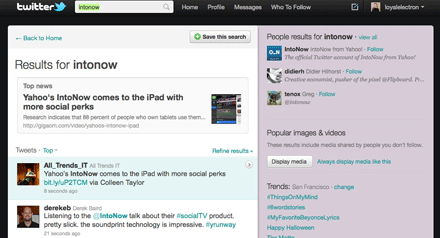
Twitter is taking its first step to curate the news that flows across its network, quietly rolling out a “top news” section in its search results.
When people rush to Twitter to search for news keywords (say, “Osama bin Laden” or “Oscars”), they will see not only tweets containing those terms, but also a headline, teaser, thumbnail image and direct link for a popular news story on the subject.
The feature is being tested with some users. I don’t have access to it yet, but GigaOm writer Colleen Taylor does, and she broke the story and posted screenshots.
http://www.blogger.com/blogger.g?blogID=8672091774752856243#editor/target=post;postID=4313155477248617402
Twitter is taking its first step to curate the news that flows across its network, quietly rolling out a “top news” section in its search results.
When people rush to Twitter to search for news keywords (say, “Osama bin Laden” or “Oscars”), they will see not only tweets containing those terms, but also a headline, teaser, thumbnail image and direct link for a popular news story on the subject.
The feature is being tested with some users. I don’t have access to it yet, but GigaOm writer Colleen Taylor does, and she broke the story and posted screenshots.
-
- GigaOm’s Colleen Taylor captured an early image of how Twitter’s new “top news” feature works. This screenshot shows a Yahoo story featured at the top of the search results, with a headline, image and blurb.

http://www.blogger.com/blogger.g?blogID=8672091774752856243#editor/target=post;postID=4313155477248617402
Friday, October 28, 2011
The Guardian introduces @GuardianTagBot, a “Twitter-based search assistant
Niemanlab reporting:
So robots are one step closer to world domination. Or at least to info domination. This morning, the Guardian announced the birth of @GuardianTagBot, the living, tweeting, occasionally sleeping Twitter account that serves as the public face of the Guardian’s content API explorer. Tweet @GuardianTagBot with a search term — or a whole group of search terms — and it’ll @-reply you with a link to Guardian content that matches your query. Whether you’re looking for Nieman Lab mentions in the Guardian (who isn’t?), or wondering what Nick Clegg is up today (ditto), or concerned that David Cameron may be a lizard (um)…the bot probably has your answer.
“It’s rather like playing fetch with our articles, videos, galleries and audio,” Nina Lovelace, the Guardian’s content development manager, explained in a post announcing the tool. While returns are ad hoc — you have to re-ask @GuardianTagBot each time you want updated search results — if you save a search for GuardianTagBot, Meg Pickard, the Guardian’s head of digital engagement, points out, you can see results in real time, as well.
Again: world domination. Siri-ously.
The TagBot was developed in collaboration with the social media agency Smesh. When I asked Lovelace for more detail about TagBot’s interface, she replied in an email that the tool:
http://www.niemanlab.org/2011/10/the-guardian-introduces-guardiantagbot-a-twitter-based-search-assistant/?utm_source=Daily+Lab+email+list&utm_medium=email&utm_campaign=f2cf5777e7-DAILY_EMAIL
So robots are one step closer to world domination. Or at least to info domination. This morning, the Guardian announced the birth of @GuardianTagBot, the living, tweeting, occasionally sleeping Twitter account that serves as the public face of the Guardian’s content API explorer. Tweet @GuardianTagBot with a search term — or a whole group of search terms — and it’ll @-reply you with a link to Guardian content that matches your query. Whether you’re looking for Nieman Lab mentions in the Guardian (who isn’t?), or wondering what Nick Clegg is up today (ditto), or concerned that David Cameron may be a lizard (um)…the bot probably has your answer.
“It’s rather like playing fetch with our articles, videos, galleries and audio,” Nina Lovelace, the Guardian’s content development manager, explained in a post announcing the tool. While returns are ad hoc — you have to re-ask @GuardianTagBot each time you want updated search results — if you save a search for GuardianTagBot, Meg Pickard, the Guardian’s head of digital engagement, points out, you can see results in real time, as well.
Again: world domination. Siri-ously.
The TagBot was developed in collaboration with the social media agency Smesh. When I asked Lovelace for more detail about TagBot’s interface, she replied in an email that the tool:
http://www.niemanlab.org/2011/10/the-guardian-introduces-guardiantagbot-a-twitter-based-search-assistant/?utm_source=Daily+Lab+email+list&utm_medium=email&utm_campaign=f2cf5777e7-DAILY_EMAIL
Sunday, October 16, 2011
Flipboard editorial chief on how magazines are flipping out (Q&A)
Cnet reporting:
Just a year old, Flipboard's arrival instantly made it clear that the future of media is here. It's social, it streams, and it scales. And this social-reading experience has a sweet look and feel. You can literally "flip" through media content page by page as if you were thumbing through a print magazine or a personal journal--except Flipboard is like a living, breathing publication that changes over time. Content is instantly refreshed and curated by you or your friends via social feeds. No wonder it's become the touch-tablet app to beat. Competitors include Zite, recently scooped up by CNN for an estimated $20 million, and AOL's Editions, which launched in early August.
Social magazines can be personalized according to a reader's interests by pulling in real-time content feeds from sources like Facebook, Twitter, and Instagram, as well as RSS feeds from a variety of Web sites and publications.
Apple named Flipboard "App of the Year," in late 2010. Time wrangled it into its annual list of Top 50 innovations. To date, the tablet app has seen 550 million monthly "flips" through its content and 3.5 million downloads. Top-tier investors have pumped $60 million into Flipboard. Funders include Kleiner Perkins Caufield & Byers, Index Ventures, Insight Venture Partners, and Facebook co-founder Dustin Moskovitz. To date, some 50 publishing partners have agreed to share content on the snazzy app. And on Friday, USA Today became the first national newspaper to stake a claim there. Recently, the social-media platform began testing out branded advertising with Conde Nast titles like Wired and The New Yorker.
CNET recently sat down with Quittner to talk about how Flipboard is upending the media landscape, what his job as editorial director for is all about, when the iPhone app is coming out, and where Flipboard is headed.
http://news.cnet.com/8301-1023_3-20120104-93/flipboard-editorial-chief-on-how-magazines-are-flipping-out-q-a/
Just a year old, Flipboard's arrival instantly made it clear that the future of media is here. It's social, it streams, and it scales. And this social-reading experience has a sweet look and feel. You can literally "flip" through media content page by page as if you were thumbing through a print magazine or a personal journal--except Flipboard is like a living, breathing publication that changes over time. Content is instantly refreshed and curated by you or your friends via social feeds. No wonder it's become the touch-tablet app to beat. Competitors include Zite, recently scooped up by CNN for an estimated $20 million, and AOL's Editions, which launched in early August.
Social magazines can be personalized according to a reader's interests by pulling in real-time content feeds from sources like Facebook, Twitter, and Instagram, as well as RSS feeds from a variety of Web sites and publications.
Apple named Flipboard "App of the Year," in late 2010. Time wrangled it into its annual list of Top 50 innovations. To date, the tablet app has seen 550 million monthly "flips" through its content and 3.5 million downloads. Top-tier investors have pumped $60 million into Flipboard. Funders include Kleiner Perkins Caufield & Byers, Index Ventures, Insight Venture Partners, and Facebook co-founder Dustin Moskovitz. To date, some 50 publishing partners have agreed to share content on the snazzy app. And on Friday, USA Today became the first national newspaper to stake a claim there. Recently, the social-media platform began testing out branded advertising with Conde Nast titles like Wired and The New Yorker.
CNET recently sat down with Quittner to talk about how Flipboard is upending the media landscape, what his job as editorial director for is all about, when the iPhone app is coming out, and where Flipboard is headed.
http://news.cnet.com/8301-1023_3-20120104-93/flipboard-editorial-chief-on-how-magazines-are-flipping-out-q-a/
Sunday, September 4, 2011
Why did CNN buy the news aggregator Zite?
Cnet reporting:
The Zite buy is clearly seen as a strategic move at this point. It's the first acquisition of its kind CNN has ever made and the company has no intention of squeezing revenue from it any time soon. There are no ads on the service, no plans to add them, no "overt monetization" at all. The eight-person Zite will remain a separate business, based in California, with its own leadership and team. Estenson plans to give Zite air cover so it can develop its technology "without venture capital pressure." The business model, he says, will come later.
It's also clear that CNN could learn from Zite's tech team. CTO Mike Klaas gave me a primer in how Zite picks stories for its users. It uses not just the "velocity" of a story (that'd be "trending" to people in the Twitter ecosystem), but social proximity for recommendations. It picks stories for users based on retweets and reposts from people not just closely connected on social networks, but also who have similar interests, determined by their public social network behaviors. While CNN plans to keep Zite independent, I expect the company will attempt to bring some of its technology to the main CNN site.
The Zite buy is clearly seen as a strategic move at this point. It's the first acquisition of its kind CNN has ever made and the company has no intention of squeezing revenue from it any time soon. There are no ads on the service, no plans to add them, no "overt monetization" at all. The eight-person Zite will remain a separate business, based in California, with its own leadership and team. Estenson plans to give Zite air cover so it can develop its technology "without venture capital pressure." The business model, he says, will come later.
It's also clear that CNN could learn from Zite's tech team. CTO Mike Klaas gave me a primer in how Zite picks stories for its users. It uses not just the "velocity" of a story (that'd be "trending" to people in the Twitter ecosystem), but social proximity for recommendations. It picks stories for users based on retweets and reposts from people not just closely connected on social networks, but also who have similar interests, determined by their public social network behaviors. While CNN plans to keep Zite independent, I expect the company will attempt to bring some of its technology to the main CNN site.
Subscribe to:
Posts (Atom)