Showing posts with label emedia publishing. Show all posts

Wednesday, November 7, 2012

E-books Market Share at 22%, Amazon Has 27%

PW reporting:
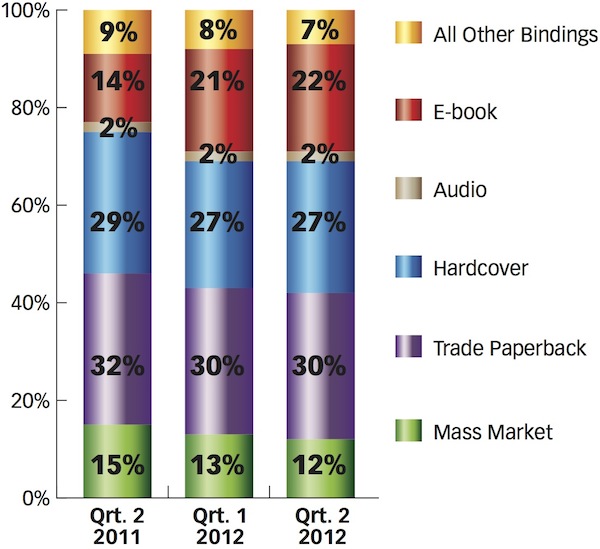
E-books accounted for 22% of all book spending in the second quarter of 2012, only a one percentage point gain from the first quarter of the year, but up from 14% in the comparable period in 2011, according to new figures from Bowker Market Research. In the year-to-year comparison, the hardcover and trade paperback segments both lost two percentage points each to e-books, while mass market paperbacks’ share fell from 15% in the second quarter of 2011 to 12% in this year’s second period. (See our chart.)
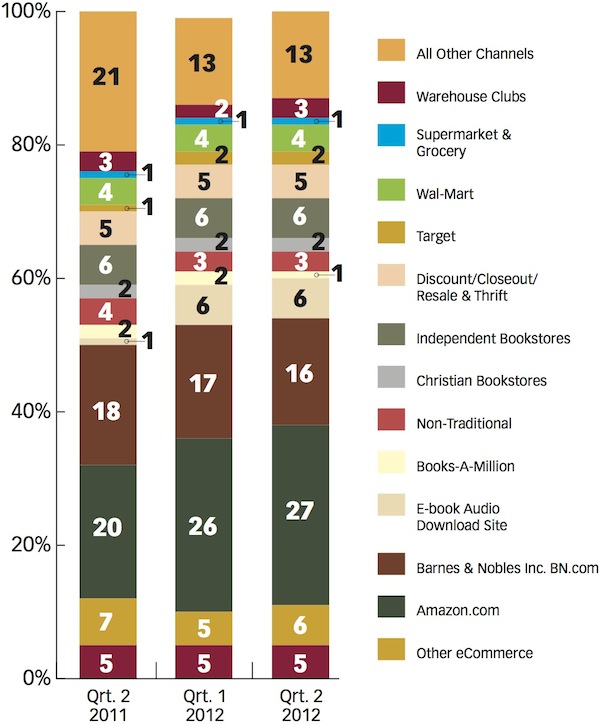
With the fall of Borders and the growth of e-books, Amazon increased its market share of consumer book spending between the second quarter of 2011 and 2012, although its growth slowed between the first quarter of 2012 and the second period. Still, the e-tailer was easily the largest single channel for book purchases in the second quarter, with an 11 percentage-point lead over Barnes & Noble. B&N’s share of unit purchases fell by two percentage points between June 2011 and June 2012, most likely due to sluggish sales of print content through BN.com. Independent booksellers managed to hold their own in the period, maintaining a 6% share of units.
Aside from Amazon’s increase in market share in the June 2011–June 2012 period, the biggest channel shifts came in the “all other” and dedicated e-book and downloadable audio sites. (See our chart.) The 21% share of other units in June 2011 reflects sales of Borders, which had about an 8% share of the market in its last year of existence. One of the many reasons for the failure of Borders was the growth of e-books (and its lack of participation in that segment), and dedicated digital sites’ share of units rose from 1% in June 2011 to 6% in June 2012.
http://publishersweekly.com/pw/by-topic/digital/retailing/article/54609-e-books-market-share-at-22-amazon-has-27.html?et_mid=588493&rid=233619411

Tuesday, October 16, 2012

What Publishing in the Social Age Looks Like

digiday reporting:
Paul Berry knows a thing or two about content on the Web. As the CTO at The Huffington Post, Berry was credited with developing the company’s SEO and social network tools. Now he’s trying to replicate his success at RebelMouse, a content-management system built for the social world.
RebelMouse connects your social networks to create a dynamic homepage that changes as you add tweets, status updates, Instagram pictures, Tumblr reblogs. It takes the content from your feeds but also lets you publish straight from the platform. In a way, it’s like a social aggregator, but you can add content, edit headlines and position stories where you want them to reside.
What’s the biggest challenge publishers face in today’s landscape?
Tech is a difficult one to get right. Publishers are struggling more than they need to or should be. The future is that, and this is where RebelMouse falls into place; you should be able to work on your voice, work on your writing and community and engagement. I don’t think you should work so hard on failing on your tech. There are more solutions to make level ground. People are dying to read and engage on the voice. Publishers that are doing well are the ones finding and expressing their voice. The ones that struggle struggle with tech and being objective built in their DNA. The world isn’t more interested in being objective and more interested in being clear about their voice.
Why is being objective bad for a social era?
The way we consume news is changing drastically and we are accustomed to getting to the source of any story almost if not literally at the same time as we get to the story itself (photos from the Hudson crash, etc). So the reporting of the factual events has been commoditized and crowd sourced. What people want now is to follow voices that resonate with their world view to enjoy and engage with the events that are happening in a way they like. This is part of why blogging was and is so vital to The Huffington Post, because it was someone’s voice that they could attach a name to. Very small groups of reporters in big news organizations are gaining more followers on social networks than the organizations themselves. I believe a larger “objective” is possible and perfect for a social world where strong views and voices from opposing sides are curated together to show as many views of the object through as many quality lenses possible.
How does a publisher find the balance between creating its own technology and using a third party?
http://www.digiday.com/publishers/what-publishing-in-the-social-age-looks-like/?utm_source=Daily+Buzz+from+eMedia+Vitals&utm_campaign=05d3259d0d-nl_DB_10_16_2012&utm_medium=email 

Sunday, August 5, 2012

Why Murdoch’s The Daily Doesn’t Fly

Mondaynote reporting:
Fact is, The Daily never took-off. Six months after its high-wattage launch, it only claimed 80,000 paid-for subscribers. Today, Jesse Angelo mentions a mere 100,000 subs. It is both far from the 500,000 necessary to break-even and totally out of step with the growth of the iPad (and the iPhone, and the Android) installed base.
...
For The Daily, this might be its first problem: It is everything and nothing special at the same time. It’s not a tabloid, but it doesn’t carry in-depth, enterprise journalism either. It’s a sophisticated container for commodity news — i.e. the news that you can get everywhere, in real-time and for free. If I crave celebrity fodder, I go to TMZ or to the Huffington Post. If I want business news, I’ll find everything on CNN Money or Business Insider, all very efficiently and appealingly edited. No need to go through the tedious download of a 100 pages-plus issue.
The Daily’s inherent competition with the web (and mobile) was completely underestimated. Real time is now mandatory, so is the ability to generate conversations. For The Daily, a comparison of last weekend’s newscycle is cruel. Its coverage of the Mitt Romney tax return controversy triggered 179 comments on The Daily vs. 28,464 comments on the Huffington Post. (Note the HuffPo built it on a 150 words Associated Press story and a one minute video segment from CNN — that’s the digital version of the multiplication of the loaves…)
The Daily is like an old concept in a high-tech package. Some draw a parallel with USA Today, the first truly national newspapers launched in 1982.
Another key question for The Daily’s future pertains to its business model. On average, according to the Newspaper Association of America, 70% of the revenue of US dailies comes form advertising, and 14% of the ad revenue comes from digital. By any means, The Daily should have been loaded with ads. There is almost none.
http://www.mondaynote.com/2012/07/16/why-murdochs-the-daily-doesnt-fly/