Monday, October 8, 2012

M Turning social media into cash: 6 insights from the new tech titans

paid content reporting:
Executives from a new generation of tech media companies, from Twitter to Tumblr, gathered in New York on Tuesday to discuss how to make money in an age of social, mobile media.
The Advertising Week event, titled Masters of Monetization 2.0, featured the usual puffery and posturing but also some useful insights into the business of ads and engagement. Here are 6 takeaways:

1. In-stream, native advertising works best

What do LinkedIn, Twitter, Buzzfeed and Tumblr all have in common?  These companies all embed sponsors in their content stream rather than laying ads on top it. This provides a less disruptive user experience and better engagement for advertisers. In-stream ads also scale well to smaller screens which, for many publishers, can be a marketing black hole.
“If you can get into the feed where people are looking and not piss them off, that works,” said BuzzFeed’s CRO, Andy Wiedlin.

2. Mobile natives are best positioned to offer mobile ads

This may seem intuitive but consider a company like Foursquare, which uses location tools to help people find friends and places. As CRO Steven Rosenblatt pointed out, a lack of “desktop baggage” means Foursquare is not tempted to try and shoehorn older ad models into the mobile environment.
A company doesn’t have to be born mobile, however, to succeed on smaller screens. Jonathan Lister, VP of Sales at LinkedIn, explained how the company had designed its mobile site for the “coffee and the couch” habits of its tablet readers. But the most striking example of a company adapting to mobile is Twitter: VP Joel Lunenfield disclosed that the company, whose embedded ads work well on a small screen, now makes more money from mobile than from the desktop.

3. Social communities aren’t created equal...

E-mail sharing is vanishing from the online news world

paid content reporting:
Have you noticed your inbox contains fewer messages from friends who “thought you would be interested” in a random news article? A new survey shows that this type of news sharing has fallen off a cliff in recent months.
According to BuzzFeed, people e-mailing stories on its network of sites has dropped a whopping 61 percent — 13 million in January to 5 million in August. The survey counted the number of referrals sites like TMZ and the Daily Mail received from Gmail, Hotmail and other email services.
The likely explanation here, as you may have guessed, is not that people are reading or sharing less. Instead, it appears the email button is fading compared to other ways of sharing stories like Facebook or Pinterest. (And, of course, more people may be cutting and pasting the article URL instead of clicking the email button).
One result of the decreased use is that some publishers are tucking the familiar email icon into smaller corners. Another implication is that the “most e-mailed stories” box, long a fixture of the New York Times and other major news sites, may soon go the way of MySpace.
http://paidcontent.org/2012/10/04/e-mail-sharing-is-vanishing-from-the-online-news-world/?utm_source=General+Users&utm_campaign=3e9fca218b-c%3Amed+d%3A10-08&utm_medium=email

Research Shows Link Between Online Brand Metrics and Offline Sales

nielsen reporting: Research Shows Link Between Online Brand Metrics and Offline Sales
Advertisers looking to build their brands online will need to look beyond traditional web metrics to determine if their investments are paying off, according to a recent study by Nielsen. In a new report, Beyond Clicks and Impressions: Examining the Relationship Between Online Advertising and Brand Building, there is emerging evidence that brand metrics – which show attitudinal response to online campaigns – can predict offline sales. The research further shows that there’s virtually no relationship between click-through rates and brand opinion or offline sales.

brand-effect-1http://blog.nielsen.com/nielsenwire/consumer/research-shows-link-between-online-brand-metrics-and-offline-sales/

Measure reach and frequency, not clicks’ – Facebook

 research reporting:
US— Facebook’s head of measurement and insights Brad Smallwood has urged marketers to stop looking at click-through rates (CTR) to measure advertising success and look instead at reach and frequency.
Speaking at the IAB MIXX conference in New York, Smallwood said that advertisers understand that reach, frequency and audience insights can lead to sales, but are too reliant on clicks to evaluate the success of online activity.
“Marketers have demanded metrics and we turned to clicks for a long time to offer this. The click model works well for monitoring direct response, but this is inefficient for categories that are not consumable. The onus is on us to find the right metric for you in this case, so we have been looking at what we can do better and how we can help.”
Smallwood told the audience that its recent partnership with Datalogix has been key to the company identifying new needs for brands who want to understand the return they get for their Facebook investment. The two companies undertook a study of 50 digital campaigns using a new tool that compares ad exposure on Facebook with in-store purchases.
“For us, this is a turning point. We’ve been flying blind and metrics haven’t moved from being focused on CTR as a result. Our study with Datalogix has shown us that this isn’t what we should be focusing on. Clicks are great, but it’s impressions that create value. In 99% of the campaigns we evaluated, sales generated from online branding ad campaigns were from people that saw, but did not interact with, ads. Just like TV advertising, it is reach that drives revenue for online brand marketers.”
To support his argument, Smallwood cited research from Nielsen that showed a 0.07% correlation between high click-through rates and actual sales compared to the Datalogix figures on impressions. He said that the Datalogix study found that campaigns that maximised reach had a 70% higher return on investment and by reallocating high-frequency impressions to people seeing too few impressions, you could see a 40% increase in ROI with the same budget. (Facebook has posted a blog with more on this study here).
http://www.research-live.com/4008364.article

Longform journalism is thriving

Poynter reproting:
... Online readers don’t shy away from long stories, says Mark Armstrong, founder of Longreads and editorial director of save-for-later service Pocket. In fact, data, page views and experience have shown they crave the deep read. And while the source of a story clearly plays a role, a reader is going to be more concerned with whether their friend gave it a nod on Facebook than if they saw it on a prominent publication’s homepage.
“I think people are increasingly agnostic about where exactly they’re reading something or what print edition it came out in,” says Longform co-founder Aaron Lammer.
That’s not to say that name recognition and the track record of the publisher and writer aren’t still important, Armstrong says. They’re just now part of a greater equation that includes who else is recommending it and whether the reader trusts that recommender’s taste. After clicking through a “READ THIS NOW” link on a friend’s Twitter or Facebook feed, the reader is then more open to what comes next from that site.
While much has been made about BuzzFeed posting cat photos and investigative profiles on the same site, Shafrir doesn’t think readers will be too concerned with the eclectic mix.
“I think people adapt much faster than we give them credit for,” Shafrir says. “There’s no handwringing of, ‘Should I read this serious, political story on BuzzFeed? They also have cat videos.’ I don’t think that’s a consideration point on the part of most readers.”
http://www.poynter.org/latest-news/top-stories/190421/as-longform-finds-a-new-home-at-buzzfeed-perhaps-its-a-good-gateway-drug/

Friday, October 5, 2012

Survey: Americans turn to established media for breaking news, mobile

Poynter reporting:
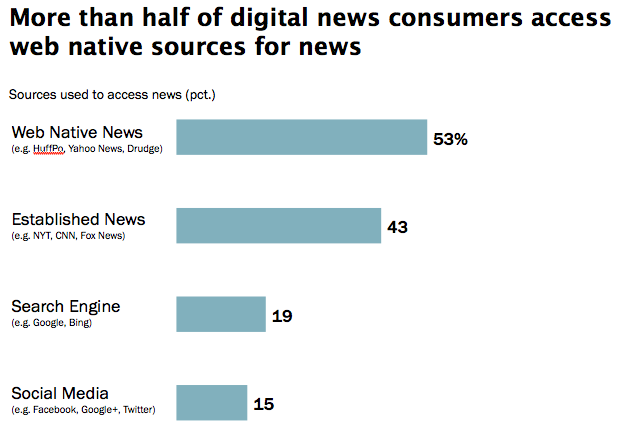
Most digital news consumers now get information from Web-native sources like The Huffington Post, but they turn to “established” news outlets like the New York Times, CNN or Fox News for big events and mobile news, according to new research.
That is one finding from a national survey commissioned by The New York Times that examines the cross-platform behaviors of news consumers. Brian Brett, executive director of customer research, will present the findings today at the International Newsmedia Marketing Association’s Audience Summit in Chicago.
This data came from an online survey this spring by Knowledge Networks of 3,022 U.S. residents 18 to 65, weighted to match the general population. Eighty-five percent of the respondents qualified as “news consumers” who get some kind of news at least a few times a week.
A majority (53 percent) of digital news consumers said they get information from Web-native sources, citing their convenience and accessibility. Only 43 percent regularly use traditional news sources for digital news, but they prefer it for in-depth reporting and trustworthiness.
Newer online outlets are more likely to be used as a daily news source.
http://www.poynter.org/latest-news/top-stories/190586/new-data-show-shifting-patterns-as-people-seek-news-across-platforms/ 

Facebook now has 1 billion active users, more than one-third in US get news there

Poynter reporting: In an appearance on the “Today” show Thursday, Facebook founder Mark Zuckerberg said that the social network now has 1 billion friends. “Just so we’re clear: As of Sept. 14, one in seven people on this planet has been classified as an active Facebook user,” writes Helen A.S. Popkin. “If Facebook was a country, it would have the third largest population, right behind China (1,347,350,000) and India (1,210,200,000), and ahead of the United States (314,500,000).” A recent Pew study showed that the percentage of all Americans getting news from Facebook and other social networks has “roughly tripled – from 7% to 20% – since 2010. And the proportion of social networkers who regularly get news there has more than doubled, from 16% to 36%.” The percentage of young adults getting news socially has increased from about 20 percent in 2010 to about 33 percent in 2012. A fact sheet released today shows the median age of Facebook users is now 22. That’s down from August 2008 when the median age peaked at 26. In January of 2006, the median user age was 19.
....http://www.poynter.org/latest-news/mediawire/190542/facebook-now-has-1-billion-active-users-more-than-one-third-get-news-there/The bad news for media is that 70 percent of people get news links on Facebook through family and friends, with only 13 percent getting those links through journalists or news organizations.